
James Leleghale Bekewei knows the Okomu forest well: he used to make a living illegally logging trees in the Nigerian national park.
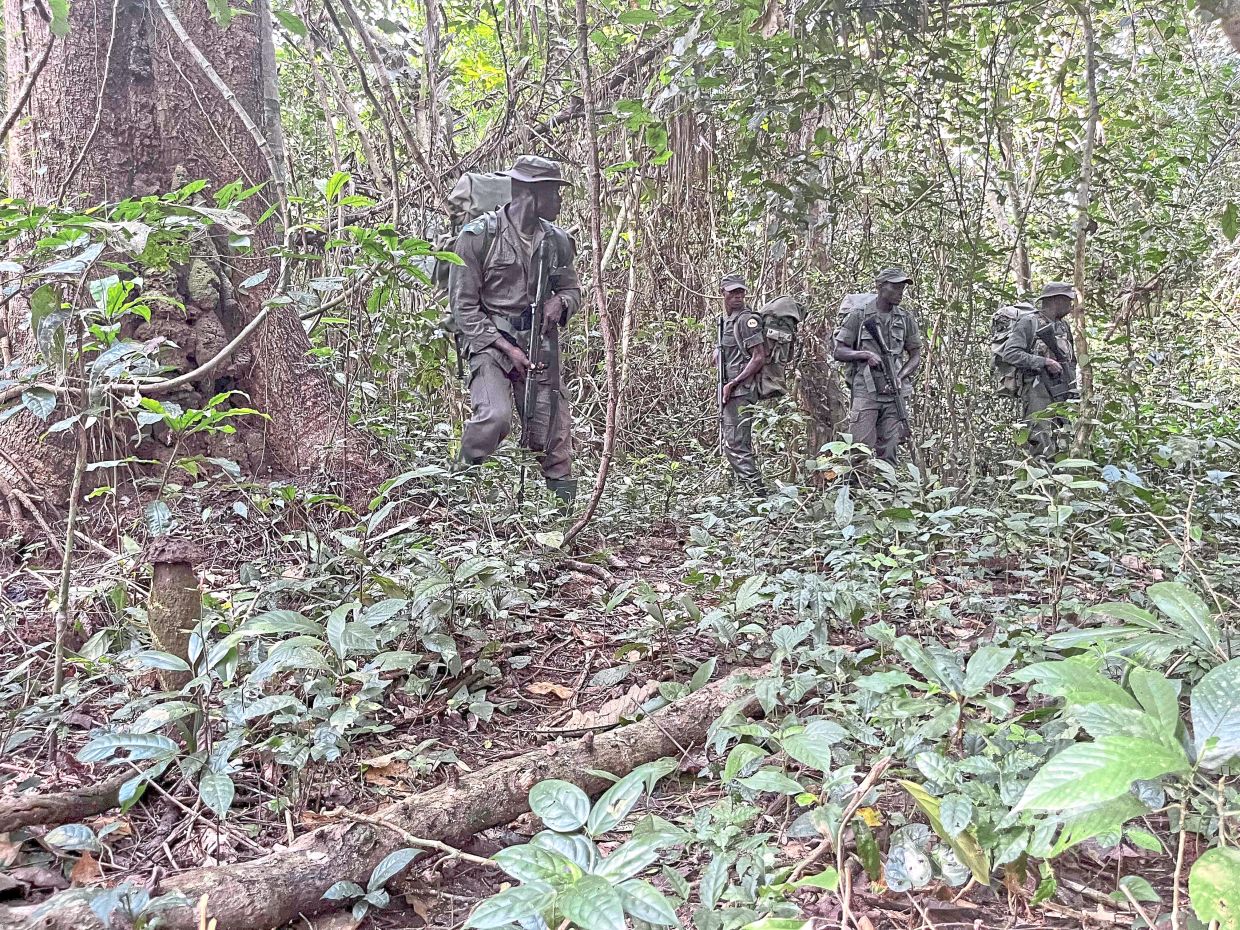
Now, Bekewei is on the other side of the law, working as a ranger tracking down hunters and loggers in the sprawling reserve.
"We made a lot of arrests," he said. "You can ask my team members, I run very fast."
In some ways, a repentant logger like 26-year-old Bekewei is the ideal type of ranger: national parks in Africa's most populous country face a slew of difficulties, many of them stemming from people having few job opportunities.
Poverty – and a weak state unable or unwilling to enforce regulations – has made illegal hunting and logging in protected areas an attractive way to make money.
That puts places like Okomu, a tropical forest in the country's southwest – and the endangered buffalo, forest elephants and white-bellied pangolins that live in it – increasingly at risk.
By recruiting former poachers and loggers, Africa Nature Investors (ANI), an NGO charged by Nigeria's national parks service with managing Okomu, hopes to ease the economic pressures that eat away at Nigeria's nature reserves.
Crime ticking down
It's a difficult task: Nigeria has lost 96% of its original forest cover, according to the Nigerian Conservation Foundation.
Outside of protected areas, palm oil plantations are a major source of deforestation. Edo state, home to Okomu forest, is the country's top palm oil producer.
Before ANI's takeover in 2022, dozens of trucks filled with illegal timber were sneaking out of the 24,000ha Okomu reserve every day.
"The first thing we did was to recruit rangers from the local communities," said Tunde Morakinyo, founder of ANI, noting the "serious unemployment" in the area.
Tests were designed to assess candidates' physical strength and moral integrity, and recruits were trained on human and environmental rights.
Unlike previous generations of park rangers in Nigeria, the ANI rangers carry guns.
But "you're not a soldier or a policeman", Morakinyo said. "You are a steward of the park.
"People are driven into logging and poaching through poverty. If you take away these livelihoods, you must replace them with alternative livelihoods."
In Nigeria, the issue has been compounded by skyrocketing inflation and the worst cost-of-living crisis in a generation over the last two years.
But for James, becoming a ranger has been a good switch.
Living in a forest camp, he earns NGN90,000 (RM252) per month and has his lodging and food covered.
"I make more money (as a ranger)," he said, adding that he was also happy to leave behind the boom-and-bust lifestyle of logging.
A fellow ranger, former poacher Festus Benjamin, 31, said that he now educates his peers on the value of preserving the park's wildlife.
In two years, ANI's rangers have made some 200 arrests, a number that's trending downward, said ANI's park director, Peter Abanyam.
Surrounding poverty
But if the buzz of chainsaws has, at least partially, given way to birdsong and chatter from monkeys, challenges remain.
Some 300 young people showed up when ANI came to recruit rangers. They employ only about 30.
ANI has set up microfinance programmes, in partnership with the microcredit company Roshan Renewables, in several villages on the edge of the park to combat unemployment and poverty.
Savings groups help pool money, which can then be used in addition to zero-interest loans for community projects.
In Iguowan, a village of about 300 people, members are saving up for a new cassava grinding machine so they can more easily make – and sell – flour.
"We could produce 10 bags, 20 bags, 30 bags," said farmer Titus Okepuk, 53.
An ideal future for Morakinyo would be to develop ecotourism – sorely lacking in Nigeria, despite its rich wildlife – and possibly generate funds from carbon credits.
"Our ambition is to have a park which is really well protected, surrounded by a ring of economically prosperous communities, who actively work with us to protect the park," he said. – Reuters