Morning settles over the world’s largest sand desert, painting the landscape in golden light.
Around the tent, dunes glow warmly, their peaks and ridges rising sharply into the clear blue sky. Overnight, the wind has reshaped the sands, leaving subtle waves and patterns.
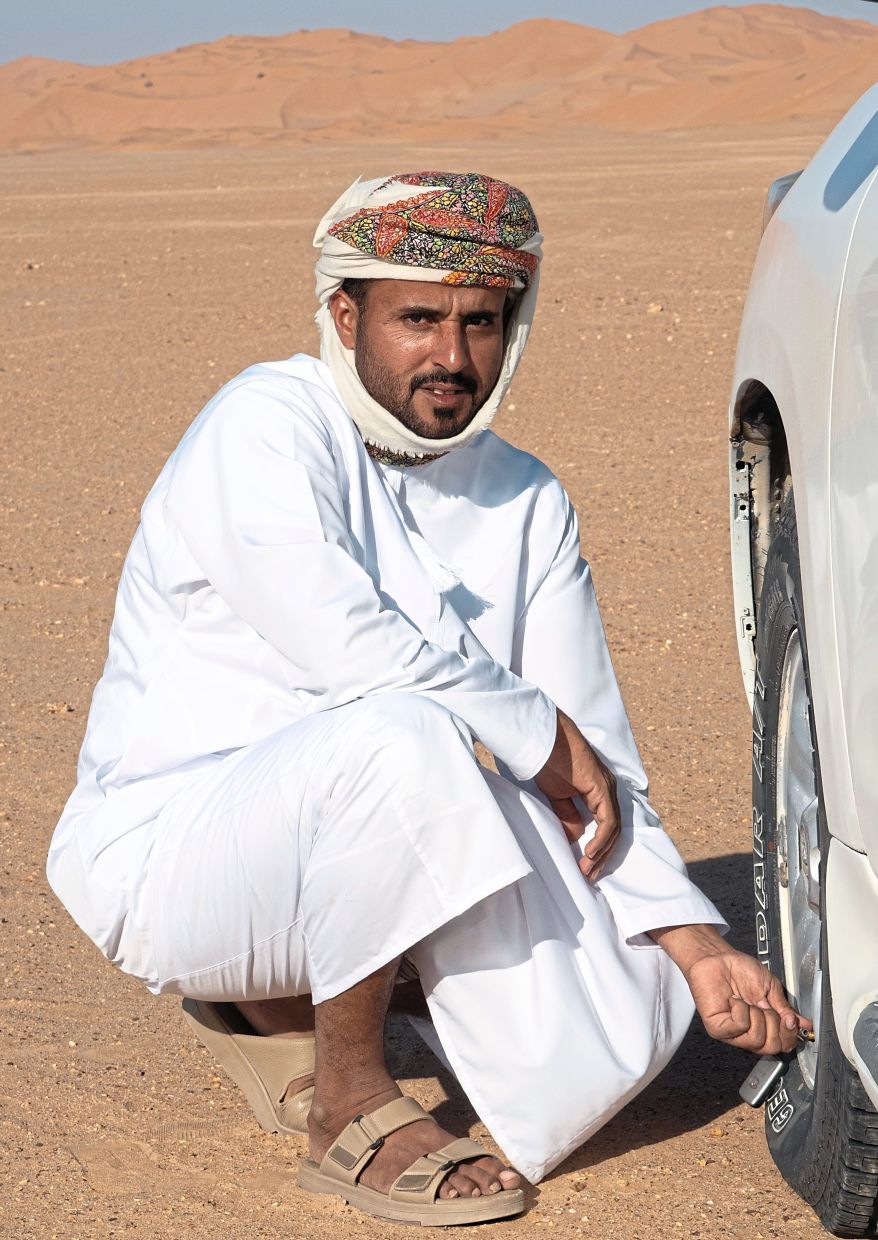
A short distance away, guide Mohammed Mussallem al-Mahri sits beside the off-road vehicle, preparing breakfast. Tracks in the sand reveal that a desert fox has been prowling near the camp.
“Rub’ al Khali translates as ‘empty quarter’, but it’s not empty, it’s full of life,” says the 38-year-old.
Yet life here comes with challenges: The Rub’ al Khali is unforgiving terrain. Stretching across the southern Arabian Peninsula, it spans several countries and covers an area roughly the size of France or the US state of Texas.
Part of it lies in Oman. Here, with the guidance of an experienced leader like al-Mahri, travellers can experience a desert dream: For a few days, become a temporary nomad while still enjoying the comforts of modern life.
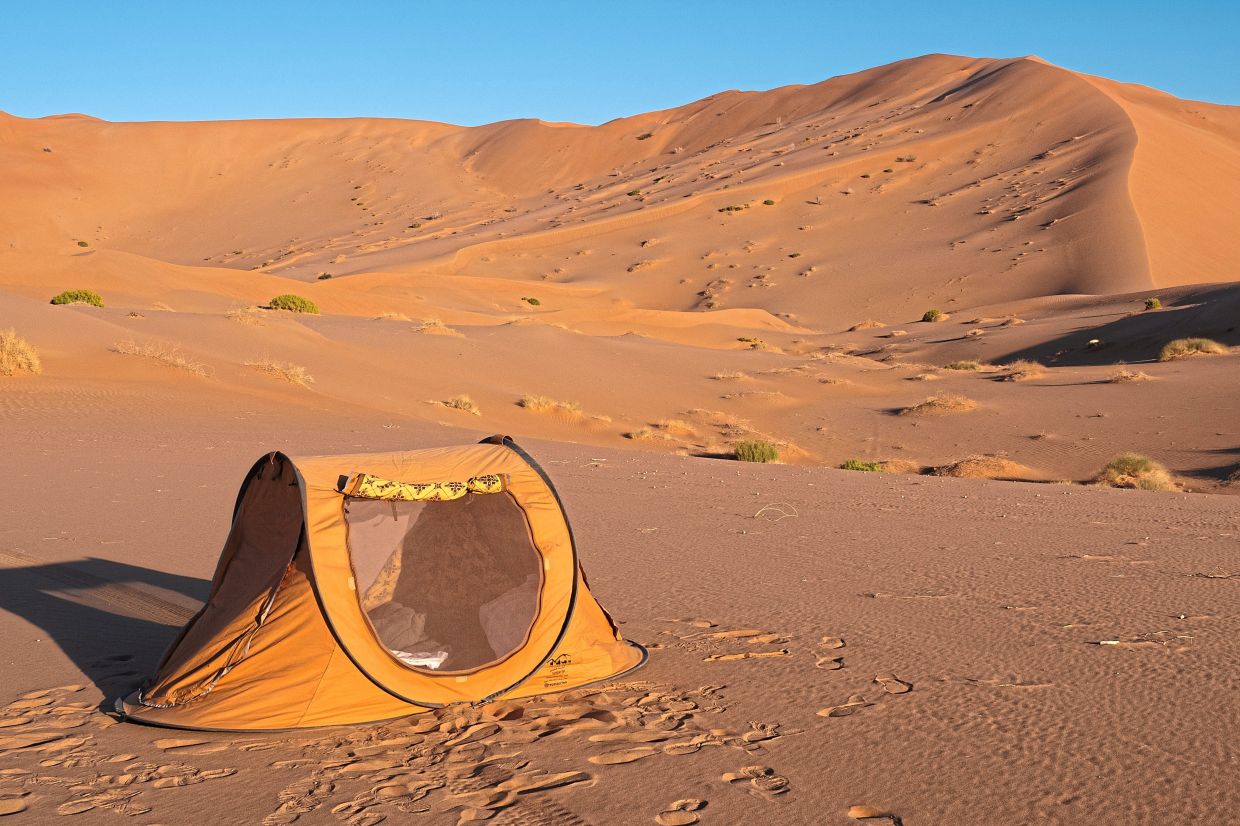
Adventures are motorised, with vehicles equipped with spare fuel cans and GPS, and overnight stays take place in tents or small desert camps.
Yet this contemporary form of desert travel is only one of several ways to experience the region.
Al-Mahri knows them all – and takes us to the people who shape the true face of Rub’ al Khali.
Settled desert dwellers
Anyone picturing real Bedouins as hooded figures wandering the desert with camel herds, braving the harsh climate, might be surprised.
Traditional nomadic life has largely faded; most people have settled down. Yet Salime Hussin al-Rashdi insists: “I am still a Bedouin.”
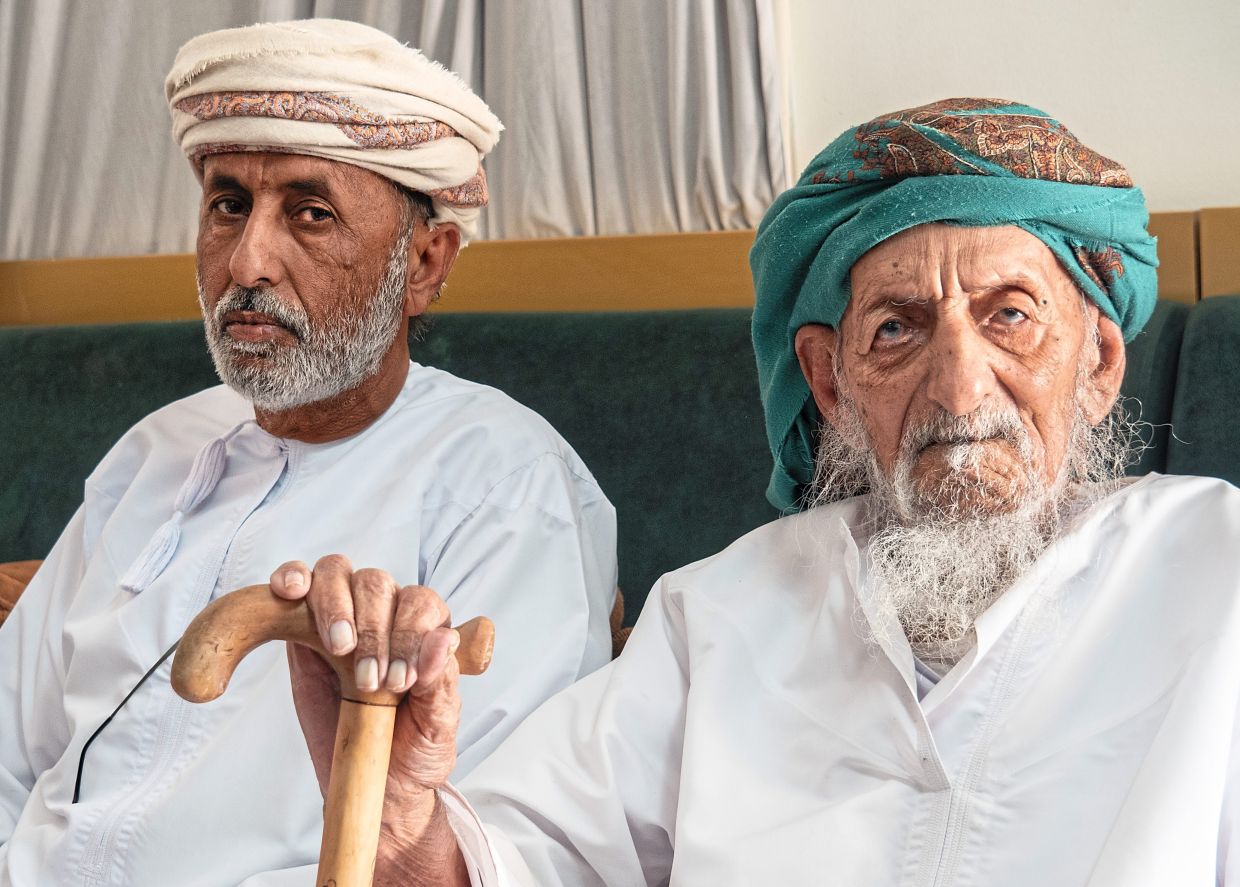
Al-Rashdi, 60, lives on the edge of the desert in al-Hashman. He has witnessed rapid modernisation firsthand, sharing his stories while welcoming guests with coffee and dates – an Omani tradition of hospitality that has endured unchanged.
He recalls sleeping with his family in a Bedouin tent, before the state provided modern houses with air conditioning.
“Life used to be really difficult; now it’s luxurious,” he says, glancing occasionally at his mobile phone.
Al-Rashdi is a respected figure in his village of just a hundred inhabitants.
As the government representative, he oversees everything from the school and mosque to the infirmary and children’s playground, bridging the old traditions with the modern world.
The roots of the ancient nomadic era still live on in al-Rashdi’s household, in his father, Hussain Ali Ramidh al-Rashdi, whose exact age is unknown.
“No less than 115 years,” his son assures us credibly, pulling out historical photos. That would make al-Rashdi senior the oldest man in the world.
A desert expert, he once accompanied the legendary British explorer Wilfred Thesiger (1910–2003) on his historic 1946 crossing of the entire Rub’ al Khali.
Even the modern al-Rashdi junior remains deeply connected to the desert. After finishing his office work and lunch, he drives out to tend his camel herd every day.
The black camels are a special point of pride.
“When I’m with my animals, I forget everything else,” he says, his face lighting up with happiness.
And yet, he admits what he misses most: “The big gatherings, when we all sat together.”
Today, every house has its own private space, and those communal moments are rare.
A treasure trove
Guide al-Mahri is infectious with his enthusiasm for the desert – and his knowledge of its hidden treasures. As soon as he has let air out of the tyres to glide better over the slopes, it becomes clear that this seemingly hostile environment is full of surprises.
Al-Mahri knows how to read the sand and its secrets. He knows where dunes rise up to 300m high and where tennis ball-sized rocks called geodes – plain on the outside but hiding sparkling crystals inside – can be found.
He stops at the skeleton of a dead camel and points out traces of skinks and desert jerboas – life that has adapted to the extremes.
This adaptation is also evident in man-made oases: Al-Mahri knows of a field of sand roses and a warm spring that only came to light because an oil company tapped into the water at a depth of 200m during test drilling.
The inflow is open to everyone, can be opened via a valve and even used as a shower in the desert via a hose.
Here we meet Leyqed Ali, 40. His destination – a herd of camels that is not his. It belongs to a wealthy Omani – as a status symbol.
WhatsApp and air conditioning
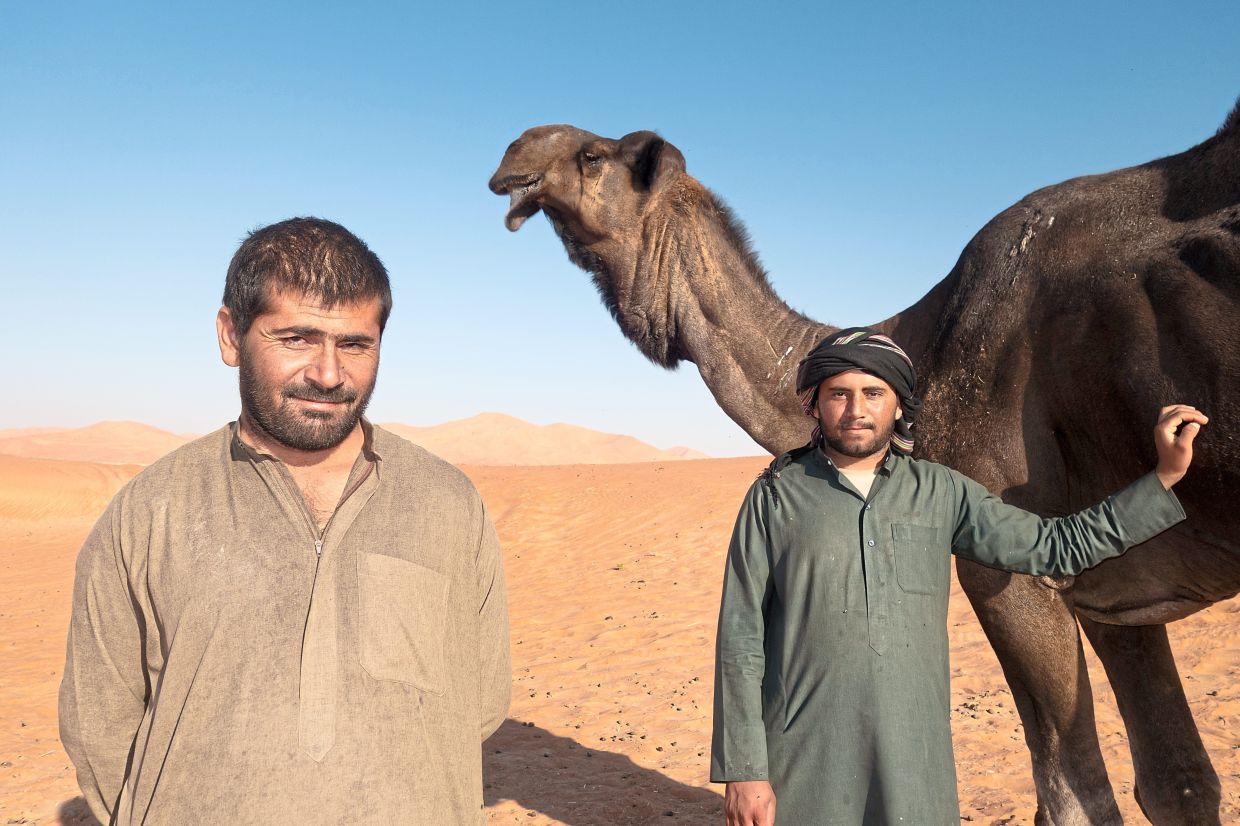
A few hours’ drive away, somewhere in the middle of nowhere, live Shear Ahmed, a 27-year-old father of four, and Nasir Ahmed, who is 21 and single.
They are camel herders from Pakistan who belong to a team of four responsible for 250 camels.
“They are modern nomads,” says al-Mahri, adding succinctly,
“Omanis would not do this work.”
Like their ancestors, they move with the herds every two to three months, but nowadays they use trucks. They are allowed to go home once every year to a year and a half.
A satellite dish for Internet reception is anchored deep in the sandy soil. Both Ahmeds are in constant contact with their families via WhatsApp.
They live in solitude in a camp made up of transportable modular units, similar to residential containers.
Today, they welcome their guests in the communal trailer, which is equipped with air conditioning and carpet. The refrigerator runs on solar energy.
Outside, they have tied a black baby camel to a truck for protection. The mother is not producing any milk, so now they are taking care of it. The afternoon sun is blazing.
After saying goodbye, Nasir and Shear retreat into the shade. They are likely to experience the desert very differently from temporary nomads.
The view into the distance with its dunes is just as dreamlike as from the tent in the morning. – dpa