


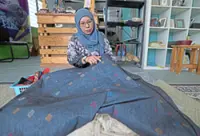
Six years ago, Asna Nabihah Aziz decided to venture into a home-based business, focussing on turning pineapple leaves into paper and thread.
Some naysayers felt she was overly ambitious and that she was chasing a pipe dream. But the determined woman from Johor Bahru woman refused to be dissuaded by anyone.
“When I first launched my business, I received many negative remarks from people living around my community. They were surprised that I was willing to take a leap of faith in starting this business despite having an engineering degree.
“Many villagers didn’t have faith in my business model nor could they understand the monetary gains from pineapple waste,” recalled Asna, who holds a degree in engineering technology in business management from Universiti Kuala Lumpur (Italy Design Institute).
She’s clinched many awards including the Agriculture Food Industries’ 2019 gold award for agriculture (state level) from the Ministry of Agriculture and Food Industries (MAFI).
Asna has launched 10 eco-friendly products made from pineapple leaves. These include photo frames, notebooks, bookmarks, key chains, handbags as well as pineapple fibre thread.
On average, she churns out over 5,000 products each month, sold to the Malaysian Pineapple Industry Board (MPIB) and government-linked companies under MAFI.
Asna’s business is now profitable, and she’s carved a name as the go-to person in this specialised art among crafters. Her community members call her “gadis nenas” (pineapple girl) for her innovative ways of transforming pineapple waste into products.
Apart from organising workshops on pineapple paper, Asna’s inspiring story has been featured on local television news programmes, Tumit Tinggi, TV3’s Malaysia Hari Ini and local Malay dailies and YouTube channel too.
“Even though many people were against my vision, I still went ahead and pursued this passion and I found my niche,” said Asna from Kampung Sinaran Baru. The village is a 20-minute drive from the state capital.
Sustainable business

According to the MPIB, in 2020, Johor churned out 59.51% of the country’s pineapple harvest, focussing on pineapple varieties like Moris, Josapine, N36, and MD2.
Pineapple, known by its scientific name ananas comosus, is largely processed to produce jam, juice and tinned fruit.
In 2020, Malaysia raked in RM641.6mil from exporting pineapples to 20 countries, from 17,228 hectares of farmland.
The figures are impressive, but the process of making pineapple products yields massive amounts of biomass waste such as leaves, peels and stems.
During harvest season, the leaves will be discarded and put aside to decompose on their own. Many farmers burn pineapple waste to clear the land, an unsustainable agricultural practice that leads to environmental pollution.

Asna was 18 when she found out about converting pineapple leaves into paper.
“After I finished my Form Five, my parents registered me for a course on making paper from pineapple leaves at the Johor Craft Complex in Larkin. I found the course intriguing, especially the idea of how pineapple leaves could be upcycled into something useful.
“As an undergraduate at UniKL, I studied sustainability management, which further fuelled my interest in working with pineapple waste. In my final year, I worked on a project titled To Rejuvenate The Potential of Pineapple Leaf Waste in Malaysia because I was familiar with this subject matter.
“As part of the project paper, I created eco-friendly products like boxes and notepads made from pineapple leaves. I also presented my report to MPIB and other government agencies in Johor. They were impressed with my creations and offered to buy my handmade products. That was the catalyst to my launching my home business,” said Asna, the youngest of four siblings.
Asna chose to chase her dream because she was confident that pineapple waste had great potential as a raw material source.
The young businesswoman says pineapple leaves can replace non-renewable fibre. Pineapple waste commercialisation, Asna said, is critical to reducing our reliance on trees for paper.
“There’s so much potential in this industry.
“By unlocking the potential of agriculture waste in Malaysia, we can do wonders in reducing our carbon footprint and move towards a sustainable lifestyle,” said Asna, who also holds a diploma in Industrial Logistics from UniKL.
On the durability of pineapple leaf paper, she explained: “It’s uncoated and is 100% absorbent. Ink doesn’t smear easily on this eco-friendly paper.
“Consumers love it because it doesn’t discolour easily. Plus, it’s locally made in my home state.”
Leaf to paper
Every three weeks, Asna receives one tonne of pineapple leaves from farms around Ulu Tiram and Pontian. The leaves are boiled in a large wok on high heat for four hours.
Once cooled, they are stored in large containers overnight. The following day, the leaves are blended into a pulp and flattened into A3 size film sheets. Next, the items are dried under the sun for several days to turn them into paper.
Asna operates from a make-shift structure in her parent’s backyard. It isn’t big, measuring 6m by 3m where Asna and three permanent staff run the operations. The business operations are not elaborate:
Several workbenches, tools, papermaking moulds and deckles (a papermaking apparatus used to collect handmade sheets of paper pulp), and 54-litre plastic containers where she stores the pulp derived from pineapple leaves.
From 100kg of leaves, Asna produces around 200 pieces of A3 sized paper.
She works closely with several factories around Johor Bahru to transform the paper pieces into gift boxes, cards, handbags and keychains.
The process of turning pineapple leaves to paper, as she explained it, seems pretty straightforward but Asna clarified that it is a laborious and time-consuming job.
Her biggest concern is the unpredictable weather conditions.
“It takes about three to seven days to dry the sheets. With continuous rain, the sheets take a longer time to dry.
“Excess moisture can lead to fungus and mould on the sheets. I make it a point to check the weather forecast to determine the quantity of sheets to produce in a day.”
Aside from producing eco-friendly paper, Asna also sells yarn derived from pineapple leaves. This too is a tedious process where leaves are put through a machine to extract the fibre. The fibres are then washed and dried.
She uses 100kg of pineapple leaves to obtain 1kg of pineapple thread. The eco-friendly thread – used to stitch embroidery for songket material – is sold at RM800 per kg.
Upcycling pineapple leaves is not without its challenges and there were many times when Asna almost gave up.
“But I’ve persevered because I am aware there’s so much potential in pineapple waste,” said Asna.
Despite it all, Asna’s glad she took the plunge. Business has been good and she’s reaping the rewards. But most of all, she has the satisfaction of successfully chasing her dream.
“It is crucial to identify your interests and work towards your dream. Follow your heart and never let anyone dampen your spirit. Anyone can succeed with lots of hard work and some luck,” Asna concluded.
Already a subscriber? Log in
Get 20% OFF The Star Digital Access
Cancel anytime. Ad-free. Unlimited access with perks.

Asna, the pineapple girl
Asna turns pineapple leaves into paper because she is aware of their potential as a new raw material source. Photo: Izreen Mukri
- ASNA NABIHAH AZIZ
Asna makes eco-friendly products like photo frames, notebooks,and pineapple fibre thread from pineapple leaves. Photos: Asna Nabihah Aziz
Leaves are blended into a pulp and flattened into A3 size film sheets. They are dried under the sun for several days.
- ASNA NABIHAH AZIZ
More business establishments are trying to create upcycled products from pineapple waste.
Photo: ASNA NABIHAH AZIZ
Pineapple leaves can be turned into thread.
Photos: ASNA NABIHAH AZIZ


