When I was small, there was a popular noodle stall below our room at the front of Nam Wah coffee shop in Kampar, Perak, in the 1960s.
It was famous for their trademark fishballs and fishcakes. It was run by a Cantonese couple in their mid-40s and their two children – a teenage daughter and a younger son.
The owner was called Fun Sook and his wife Fun Soh, literally meaning Noodle Uncle and Noodle Auntie in Cantonese, respectively.
Fun Sook was tall, thin and dark-complexioned. He had a big and scary artificial left eye. He was chopping firewood one day and one of the wood splinters pierced into his eye. His big artificial eye had a powerful hypnotising effect on us. It stared straight at us without ever blinking. His face was always still and sober, giving him a strict demeanour.
Fun Sook was born with a double thumb on each hand. Whenever he served customers, his extra little thumb tended to dip into the bowl of noodle soup. After serving his customers, he would lick his thumb. Perhaps it was his way of showing “double thumbs up” for his delicious noodles. Those days, hygiene was not a big deal and nobody seemed to mind.
In contrast, Fun Soh was a plump, cheerful and friendly woman. She stood at the stove all day, busily preparing and cooking the noodles. Although it was steaming hot, never once did she lose her cool. Besides cooking for the customers in the shop, she also cooked for those who dapao with their tingkat (tiffin carrier).
Fun Soh exuded a genuine charm that put her customers at ease. While cooking the noodles, she would happily chat with her customers. Everyone found Fun Soh to be, well, so fun! My neighbour described her chattiness as being “more saliva than tea”. Although Fun Sook and his wife were contrasting in character, they were nevertheless a happy couple.
Their 14-year-old daughter was Ah Mui (meaning rose in Cantonese). She was pleasant-looking with a fair complexion and short hair. If she had had long hair and a dash of make-up, she would have looked quite attractive. However, dolling up was the last thing on her mind.
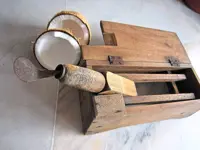
Ah Mui was my sister’s classmate but had to drop out of school after Primary Six. Their family was short-handed and could not afford to hire extra hands. The family would make all the fish balls, fishcakes and yong tau foo (YTF) by hand. Their handmade items were always tasty and bouncy.
During the 1960s, it was quite common for students to drop out of school to help their parents in their business. My mother often praised Ah Mui’s good attitude and hard work.
Mother would say, “Look, see how obedient and hardworking Ah Mui is.”
As a six-year old then, I was too young to realise that mother was attempting to promote filial piety among her children. Unfortunately, Ah Mui’s positive attributes were not appreciated by customers as they would call her Liang Mui, meaning Young Maid.
“Yat woon loh shee fun kon lo, leong woon hor fun ching tong, sam woon kali min, ka yue tan (One bowl of dry silver-needle noodles, two bowls of soupy rice noodles, three bowls of curry noodles, with extra fishballs)!”
There was a bewildering permutation of combinations of orders made by the customers. Besides the different types of noodles, there was also soup or curry, with or without fish ball, and the different types of yong tau foo. With no note pad to help her, Ah Mui had to commit all the orders to her memory. She also needed to do quick mental calculations about the total bills and the changes involved. The calculator or computer were not around then.
Ah Mui was unfailingly courteous to all her customers. Besides receiving hundreds of orders and serving them with the hot and heavy bowls of noodles, Ah Mui also had to stay back late every day to help her parents wash all the utensils. She was indeed an exemplary worker and obedient daughter.
Ah Mui’s younger brother was Ah Fatt, meaning Lucky in Cantonese. Typical of Chinese families those days, he was indeed lucky as he was the only son in the family. Ah Fatt only had to help out in the stall during weekends and holidays. His parents intended for him to stay home and study hard. However, as with young boys, he was quite playful and joined us in catching spiders and fishes.
His parents described Ah Fatt as Kai Sow Ngap Geok, meaning butter fingers. Every weekend, we would hear cling-clang sounds as he broke some fragile porcelain “cockerel” bowls (kai koong woon) and spoons. Plastic utensils were unheard of then.
When Ah Mui turned 18, her parents arranged for her to marry a rich businessman in Kuala Lumpur who was in his 50s. Despite her initial reservations, she finally agreed to her parents’ arrangement. Such filial piety and a sacrificial attitude among Chinese girls was quite common then. The businessman gave a princely $18,000 angpow to Ah Mui’s parents, $1,000 for each year of her upbringing.
On her wedding day, Ah Mui looked resplendent in her white gown. She was magically transformed from a Liang Mui to a Leng Mui (a beautiful rose). After her wedding, her family moved to KL. They were looking forward to a bright future in a big city.
After Ah Mui’s family left Kampar, a new owner took over the noodle stall. Somehow, since then, there was something missing about the flavour of the noodles and fishballs. Perhaps it was due to the absence of Ah Mui’s courtesy, Fun Soh’s friendliness or maybe the big artificial eye of Fun Sook.
Sadly, as the old owners left town, or this world, they carried the secrets of their trade with them. However, they left behind a golden taste and memory in our minds.
Satisfy your noodle craving and order in at lower costs with foodpanda Promo Code
Already a subscriber? Log in
Get 20% OFF The Star Digital Access
Cancel anytime. Ad-free. Unlimited access with perks.