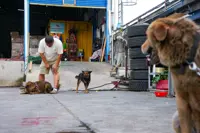
It's really up to you what you call your new pet – with animal names there are no rules, and no registry office to keep you in check.
But how do you find the right name, and how do you teach your pet to recognise it?
Pedigree puppies from breeder come with an official name. It’s in two parts. All the puppies in a litter are given individual names, which usually start with the same letter. That’s followed by the name of the breeder’s business – like a family name.
However, the names in the papers of a pedigree dog are usually not very suitable for everyday use.
“They’re often beautiful, well-sounding names, ” says Petra Caspelherr, from Germany’s Dog Breeders Association (VDH), “but they rarely become the dog’s real name.”
Her own Australian Shepherd, for example, is officially called “Black Heart of Nashagak River”, but she calls him Goofy.
Of course buyers can choose their own name for the puppy.
“It should be easy to call and be comprehensible to the dog, ” says Petra Caspelherr. She advises using two-syllabled names because they are distinctive, and can be pronounced faster than three- or four-syllabled names.
You should also avoid misunderstandings or confusion – these can arise, for example, if the dog’s name sounds similar to that of a family member.
It’s not just dogs that respond to their names – cats, rabbits, rodents and birds also react. There’s a lot of emotion involved in choosing a name, but it also has to be practical.
“Every animal can learn to listen to its name, ” says Barbara Schoening, a specialist vet from Hamburg. She stresses the importance of getting the animal used to its name, and recommends petting it while saying the name.
With birds it can be helpful to work with treats instead. If your pet experiences the situation in which its name is mentioned as pleasant, it will associate the name with something positive, and will quickly get the idea.
Up until recent times, farm animals were also given names. Damaris Nuebling is Professor of Historical Linguistics of German at the University of Mainz and has been working on the topic since 2012.
“According to what we know, cattle and horses were the first animals to be given names, ” she says. “They were work animals and they had to be well taken care of.”
Farm dogs and cats, on the other hand, were often not given names at all, even as recently as 100 years ago.
Nowadays, human names are popular with many species. Professor Nuebling believes this says a lot about the human-animal relationship, and represents a profound change in society: “They’re part of the family now”, she says. – dpa/Fabian Busch
Already a subscriber? Log in
Get 20% OFF The Star Digital Access
Cancel anytime. Ad-free. Unlimited access with perks.