‘Cyborg locusts’ to sniff out bombs


By AGENCY
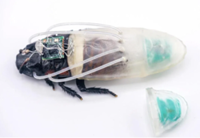
Researchers showed how they were able to hijack a locust’s olfactory system to both detect and discriminate between different explosive scents – another step in the direction toward bomb-sniffing locusts. — Raman Lab/TNS

Call the swat team.

Bomb-sniffing “cyborg locusts” could be the next wave in national security, according to military news agency Stars and Stripes.

Washington University researchers, funded by the US Navy, reportedly indicate that locusts can differentiate between TNT, ammonium nitrate and other bomb-making materials, and locate their origins almost immediately. Locusts are known to have a well-honed sense in their antennae, but scientists weren’t certain the bugs could detect objects that are foreign to their natural environment.

Biomedical engineering professor Barani Raman and his team’s US$1.1mil (RM4.58mil) study found that apparently they can.

“It turns out... the insects do have sensors for them and very exquisite sensors... because they can pick up some of these odours at extremely low concentrations – of parts per billion and below, ” Raman reportedly learned.

If scientists can better understand the brains and receptors of locusts, they might be able to develop swarms of artificial “electronic noses” superior to what’s being used to search for explosives now, according to Stars and Stripes.

Because of the simple nature of a bug’s brain, researchers are able to implant technologies that record what locusts smell and how it translates. Locusts are also physically suited to carry “backpacks” containing equipment to read their neurological calculations, the report said.

The study found American locusts worked better in teams than they did as individuals when looking for specific scents. A swarm of seven locusts reportedly turned up positive results 80% of the time. That number dropped by 20% when a single locust was put on the job.

The advancement of cyborg locusts could put regular dogs out of work. While canines make for good bomb sniffers, they come with more baggage than a locust, which is unlikely to be interested in pleasing its human counterpart. Locusts are also cheaper and easier to maintain.

A locust’s antenna is reportedly made up of 50,000 neurons with varying characteristics. Some swarms of locusts can travel more than 80 miles per day, according to National Geographic. They are believed to have been adapting and evolving since prehistoric times. – Tribune News Service/New York Daily News/Brian Niemietz

Get 20% OFF The Star Digital Access

Monthly Plan

RM 13.90/month

RM 11.12/month

Billed as RM 11.12 for the 1st month, RM 13.90 thereafter.

Best Value

Annual Plan

RM 12.33/month

RM 9.87/month

Billed as RM 118.40 for the 1st year, RM 148 thereafter.

Follow us on our official WhatsApp channel for breaking news alerts and key updates!
Cyborg locusts , locusts , insects

Next In Living

Heart And Soul: The measure of a man
'Jumping genes' in sloths may help scientists better understand human ageing
Martini time in Penang: 8 twists of the classic cocktail to try on the island
Scientists develop AI�to create the perfect burger
Heart And Soul: Food is the language of care
Did the milk expire? California bans 'sell by' food labels to cut food waste
Association in Melaka on a mission to bring Cherki game back to life
Malaysian Peranakan sisters give traditional Cherki card game a new spin
How Star Media Group's inclusive culture empowers employees with disabilities
Some coral reefs are more climate-resistant than others, scientists say

Others Also Read