




Scientists in Singapore have industrialised the production of remote-controlled cyborg cockroaches that one day could form a tiny army suitable for disaster search missions.
Last month, researchers led by Hirotaka Sato at Nanyang Technological University published their previously preprinted study describing a system for the mass production of mechanical cockroaches.
The July 28 article in Nature Communications said the team had continued with their pioneering concept of an “insect robot factory”.
They had improved the control of the robotic cockroach, increasing its turning ability from 70 degrees to over 80 degrees, and also verified this precise control through a series of experiments, it said.
The first author of the paper graduated from the Harbin Institute of Technology.
A reviewer of the article said the paper demonstrated “meaningful work on insect-computer hybrid robots, which will reduce mass production time and cost for practical applications”.
This corresponds to the efficiency of the production line. The automated system transforms live insects into steerable biobots in just 68 seconds – 13 times faster than manual surgery – with an 86.7% success rate.
“This study presents the first successful implementation of deceleration control in insect-computer hybrid robots,” another reviewer of the paper said.
That comment pointed to the key to the innovation – an upgraded control system where 3D-printed microelectrodes with electroless copper plating are implanted in the thoracic membrane of Madagascar hissing cockroaches.
Unilateral electrical pulses trigger instant leg retraction, enabling sharp 82.6-degree turns within 0.4 seconds, while bilateral pulses induce a 68.2% speed reduction in 0.33 seconds for emergency braking.
Demonstrations showed the cyborg roaches accurately tracing S-shaped paths.
The team selected cockroaches for mechanical augmentation due to their unique advantages in specialised tasks. These insects possess natural bioenergy systems, enabling hours of operation without charging, show exceptional mobility by navigating rubble and clearing obstacles three times their height (5-6cm or 2-2.3 inches), and demonstrate remarkable strength by carrying electronic backpacks weighing twice their body mass (about 15 grams or 0.5oz).
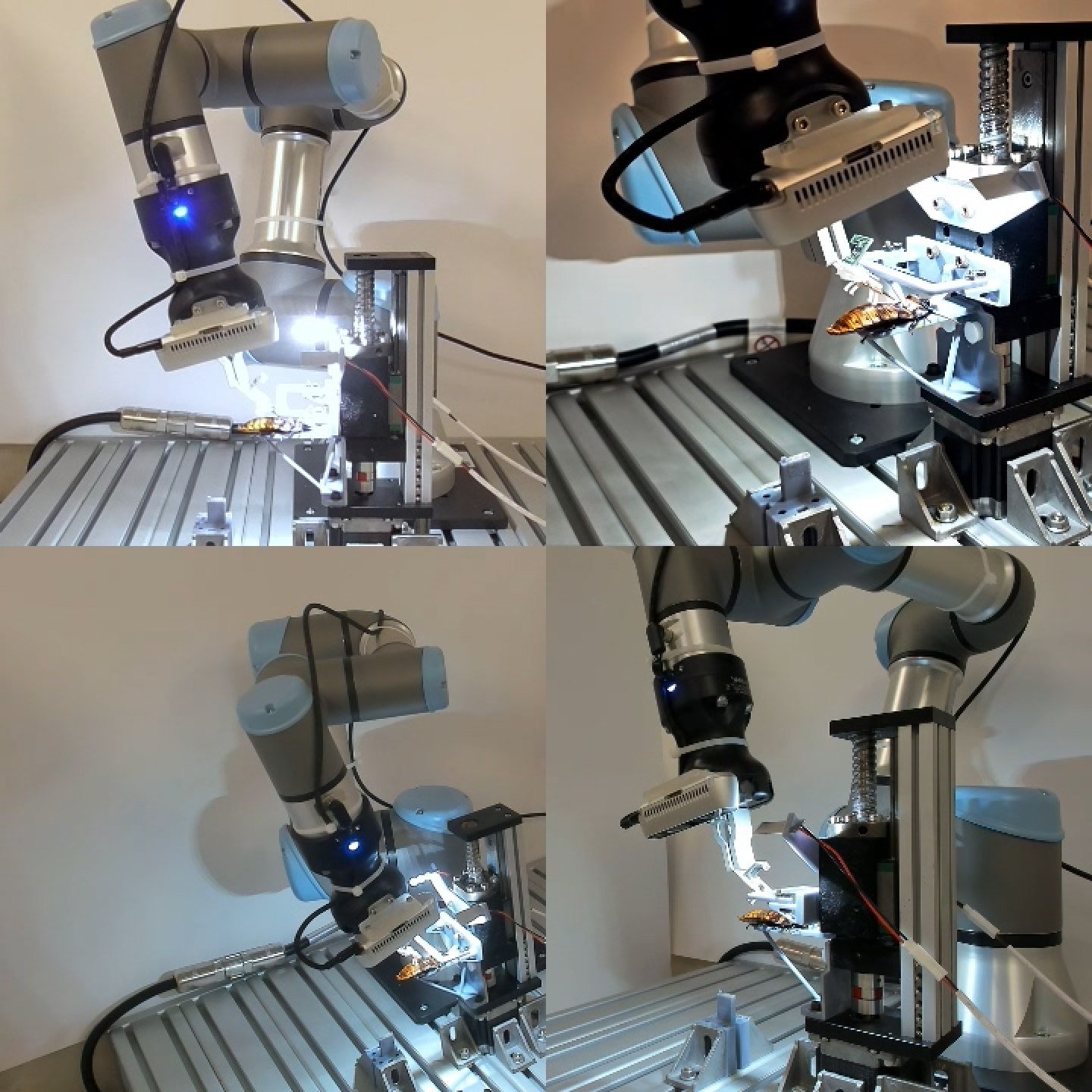
Another breakthrough of the study is the replacement of painstaking manual surgeries – taking 15 minutes per insect – with a robotic assembly line that automates the process. This innovation speeds up production while ensuring consistent quality.
The automated process starts by anaesthetising the cockroach with carbon dioxide. Then the cockroach is fixed on the machine. A vision system (Intel RealSense D435) then detects the implantation site with sub-millimetre precision. Following this, a robotic arm (Robotiq Hand-e) positions a 2.3-gram 3D-printed backpack at the cockroach’s back, while self-locking Y-shaped electrodes on the backpack pierce the cockroach’s tough outer covering and anchor to the exoskeleton.
This system achieves an 86.7% success rate for standard 5 to 6cm roaches, with modified backpacks boosting efficiency for larger specimens (6.5cm and over) to 80%, according to the paper.
During outdoor swarm testing in a 2 square metre rubble-strewn simulated disaster zone, four cyborg roaches equipped with ultra-wideband trackers collectively covered 80.25% of the area in 10½ minutes through coordinated movement. This was more than double the maximum 45.75% coverage achieved by any single unit.
“This demonstrates critical time and redundancy advantages for search operations,” the team said on their website.
The team plans to integrate thermal or RGB cameras (which capture full-colour images using red, green, and blue channels), microphones, and inertial measurement units into the backpacks to develop advanced “cockroach rescue teams”.
Sato, a professor at NTS’ school of mechanical and aerospace engineering, envisions scaled deployment.
“Mass-produced cyborg swarms could pioneer search missions in earthquakes or nuclear disasters, replacing humans in lethal environments,” he said on the website. – South China Morning Post


