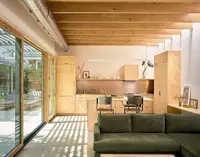
A school library in Mumbai, India, that allows people to “walk all over it” has been named a category winner (Architecture) in the Beazley Designs of the Year award by London-based Design Museum.
The Maya Somaiya Library, designed by Sameep Padora and Associates, uses a creative engineering system that pays homage to the Uruguayan engineer Eladio Dieste.
Located in Kopargaon, north-east of Mumbai, the building’s shape is defined by a complex series of arches and double curvatures created by a combination of Catalan vaulting techniques and high-tech digital form-finding software.
The library has all-brick rooms and walls, and its roof was transformed into a sloping landscape for children to walk and play on.
“We were impressed by this elegant design that was all about community. We felt the space beautifully articulated important purposes – leisure and education. Innovative and unusual, we think this design really breaks the mould for an educational building, ” said Yinka Ilori, judge and designer, in a press statement.
The Design Museum is one of the world’s leading museums devoted to contemporary architecture and design. Its work encompasses all elements of design, including fashion, product and graphic design.
In its 12th year, the Beazley Designs of the Year is an annual celebration of original products, concepts and designers across the globe. Nominators were asked to select designs that they felt “inspire, represent change in their field and capture this moment in time”. This is the first year that the public nominated together with design experts.
Taking home the coveted Beazley Design of the Year 2019 title is a map showing the impact of an AI (artificial intelligence) device, which comes under the Digital category.
The infographic and research project called Anatomy Of An AI System by Kate Crawford and Vladan Joler explores the social and environmental impact of owning a voice assistant device. This includes the amount of human labour, data and resources that are required during the lifespan of just one device.
The project investigates the three main parts required to build and operate a voice assistant – from the environmental effects of extracting rare earth metals and the wide disparity in workers’ income, to the data that these devices can gather without the users’ knowledge.
The other category winners are:

Design firm Pentagram worked closely with David Chipperfield Architects to create the architectural branding, environmental graphics and signage for the new Seoul headquarters of Amorepacific, a beauty and cosmetics company. The signage combines letterforms, numerals and pictograms that refer to the four principal geographical features outside – river, mountain, park and city – with a representation of the building itself to help orientate visitors. Pentagram also created a new typeface, Latin, that helps ensure visual consistency across the different written forms of English, Chinese and Korean.
Designed by Choi Ji-won for Adidas is this fresh and bold capsule collection of streetwear. Inspired by her Korean roots, Choi’s first set of garments features a striking palette of lilac, red, navy and green to reinvent the brand’s iconic three-stripe motif. Her second collection takes cues from the monochrome colour scheme used in Adidas’ first tracksuit. Choi was influenced by traditional Korean clothing, known as hanbok, that uses exaggerated silhouettes and architectural forms.
Created by British product designer Hans Ramzan, Catch is a low-cost, user-friendly, self-testing device that detects HIV. The product targets people in emerging nations where easy access to healthcare, education and infrastructure otherwise prevents early diagnosis. Users can operate the pocket- sized device in three easy steps in privacy.
A collaboration between minimalist Japanese lifestyle company Muji and Finnish autonomous driving company Sensible 4, Gacha is a “self-driving” bus that functions under all weather conditions. The gently rounded, square-shaped bus has no defined front or back and will serve regions with declining population and older citizens who can no longer safely drive. Now test-driving in three Finnish cities, the plan is for the vehicle to be rolled out next year.
Receiving the most votes from the public is MySleeve, an add-on to make crutches more comfortable. Designed by Marie Van den Broeck, the young Dutch student came up with the idea in response to her grandmother’s difficulties using crutches.
MySleeve is a silicone cover that is mounted onto a crutch handle to help eliminate sore hands, improve grip and prevent crutches from falling. The comfortable material protects against blisters and provides grip, and the magnet allows the crutches to snap together when freestanding or for the user to pick up a dropped crutch with the other.
The six category winners along with the 70 other nominations are on display at the Design Museum in London until Feb 9,2020. For more info, go to designmuseum.org
Already a subscriber? Log in
Get 20% OFF The Star Digital Access
Cancel anytime. Ad-free. Unlimited access with perks.