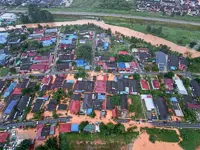
People power: When it counts, Malaysians always show they care


Soo (in black) and his team of volunteers from T.A.S.K. at the booth distributing food to flood victims who have been extracted from their submerged homes. Photo: The Assembly Soup Kitchen

A group of individuals who have been helping first those impacted by the pandemic, and more recently, the flood victims is The Assembly Soup Kitchen (T.A.S.K.).

It all started with just two good Samaritans – schoolteacher Soo Mun Keong, 41 and his engineer wife Wong Suet Beng, 39 – cooking hot meals for five families in need, out of the kitchen in their home in Subang Jaya, Selangor.

“We’d already started helping those in need by providing them with hot, cooked meals, even before the White Flag campaign that started middle of this year,” says Soo.

“It all started in Oct 2020 in the midst of the pandemic. We met a group of migrant workers and they shared about their struggles during the pandemic. They were day workers and had lost their income during the pandemic, and were struggling to put food on the table.

“So my wife and I started cooking from our kitchen at home for these four to five families just to help them out. Then, some of our friends saw what we were doing and they were inspired and wanted to help too. So we opened it up to our friends, neighbours and church members,” he says.

Word soon got out about their efforts and more people wanted to volunteer and so the couple started cooking for those affected by the pandemic.

“From about 50 meals (from home), it increased to 100 meals and now we’re able to do more – about 6,000 meals a month for those impacted by the pandemic because we now have an industrial kitchen in Glenmarie in Shah Alam, Selangor,” he says.

The White Flag campaign which started in the middle of this year created awareness among the public about the desperate need of a segment of Malaysians who were struggling to put food on the table because of the effects of the pandemic. However, even prior to that, there were already issues with people losing their jobs, having no income, burning their savings, and not being able to put food on the table, says Soo.

“But the White Flag movement created public awareness and a lot of people started calling up, asking questions, volunteering, and donating. It was those few weeks of exposure that made more members of the public step up to do something to help those impacted by the pandemic,” he said.

T.A.S.K. volunteers setting up a booth for food distribution at the edge of the waters in Taman Sri Muda, Shah Alam.  Photo: The Assembly Soup Kitchen
T.A.S.K. volunteers setting up a booth for food distribution at the edge of the waters in Taman Sri Muda, Shah Alam. Photo: The Assembly Soup Kitchen

Since the floods, they have also been providing hot meals, dried goods (biscuits, milo, packet drinks, bread, bottled water, etc), and cleaning products to flood victims.

“On the first day after the flood (Sunday morning), we - and a lot of other NGOs as well - were going in blind. We didn’t know where we would be able to access those in need. We only knew many were trapped by the flood waters. We knew there was a big group near Sekolah Kebangsaan Taman Sri Muda in Shah Alam. All the information we had was through social media and forwarded messages.

“Before we set off, we contacted the Subang Jaya Adun and some other sources, to verify the locations and based on that, we set off,” he shares.

They went in with four Hilux 4X4 vehicles and they loaded it up with supplies and headed into the areas.

“The first day was quite chaotic. No one actually knew what to do or where the people were.

“The public came out to help even on the first day. There were many SOS messages that came out on Saturday night and Sunday early morning. So when we were there on Sunday, there was already a huge crowd there – all members of the public and NGOs - ready to help out where they could.

“But there was a huge ‘bottleneck’, which was the lack of boats. So we could only get the food to the people very slowly. The boats would bring the food in to those trapped for many hours without food or water, and also help bring people out.

“There was water everywhere. It wasn’t possible for us to access the victims directly. The water levels were still very high, about six to eight feet high,” he relates.

Among the many volunteers were a group from Glenmarie Cove who own their own canoes and were helping to rescue people.

“There was also another group of people who came all the way from Port Dickson to help. They had fishing boats - flat boats with small motors. We asked them to help bring the food in so that the people could have a hot meal while waiting to be rescued. We decided to work together to help the flood victims, so it worked out well,” he says, adding that the process was very slow as the waters were very high.

“The canoes could only rescue one to two persons at a time, and the fishing boats slightly more. We were going in blind. We didn’t know where the flood victims were, how many of them there were, or their condition. So we could only do our best with what we had. There were about 50 volunteers there that day, including those with boats.

“Everyone is commending the public for sacrificing their time and effort especially on the first two days, before the army or Fire department stepped in. The response of the public was very encouraging. We were very glad to see this happen. It was really a #KitaJagaKita kind of moment,” he concludes.

Get 20% OFF The Star Digital Access

Monthly Plan

RM 13.90/month

RM 11.12/month

Billed as RM 11.12 for the 1st month, RM 13.90 thereafter.

Best Value

Annual Plan

RM 12.33/month

RM 9.87/month

Billed as RM 118.40 for the 1st year, RM 148 thereafter.

Follow us on our official WhatsApp channel for breaking news alerts and key updates!
floods , flash floods , KL , Family

Next In Family

How this retired Malaysian transformed his grief into an adventure for good
These dads are experiencing a shift in fatherhood as new norms take place
Study suggests women who do strength training will live a longer, healthier life
Are we failing neglected seniors in Malaysia?
It's time for parents to adopt these Japanese child upbringing approaches
Families in Sri Lanka are bearing the cost of the Middle East conflict
Why parents should step back and allow kids learn on their own
Helping single mothers get back on their feet
Helping single mothers build financial resilience and community
A platform for women entrepreneurs to lead and give back

Others Also Read