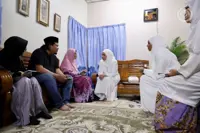
Throughout the pandemic, the National Stroke Association of Malaysia (Nasam) remains open to serve stroke survivors and their families, who may need help with rehabilitation and support.
“Although we can’t conduct group therapy sessions nor have social activities – which are a very effective means of rehabilitation and psycho-social support for stroke survivors – during this time, one-on-one therapy sessions are still ongoing, ” says Nasam communications coordinator Vanaja Dhanan.
“Our group therapy sessions are now available on Zoom, ” she adds.
Creating public awareness
Nasam’s public awareness activities such as forums on stroke prevention and awareness, educational talks, and other such events, have also been shifted online during the pandemic.
“But even though we can do this through Zoom and other online platforms, there are certain segments of the community who have no access to online facilities, ” says Vanaja.
She adds that there has also been a decrease in participation in group therapy sessions as many stroke survivors can’t access the Internet because they don’t have device nor the support to do so.
“They may not have family members who are able to support them to get online at home. Some are also unable to follow these online sessions as they’re unable to process the information after their stroke, ” she explains.
And, although Nasam is open for face-to-face support during the various MCOs, following strict Health Ministry guidelines, there is still a lot of fear among the people to come out and seek support, she says.
“This too has impacted the recovery of stroke survivors, especially those with visual, spatial and cognitive issues, ” says Vanaja.
The rehabilitation of the stroke victims also centres around social outings and gatherings at Nasam, and these are also affected by the pandemic.
Nasam’s annual events such as The Stroke Games, Walk For Health and Food & Fun Fair, have all come to a halt during the pandemic.
Embracing the new normal

There is also a Stroke Mentoring Facebook group, which is managed by Nasam founder and chairperson Janet Yeo who formed the association in 1996, when she herself was recovering from a stroke.
The mentoring group is supported by both Yeo and other stroke survivors who are able to counsel and help survivors going through difficulties because they themselves have gone through it before and understand what it involves.
Prevention is better than cure
Yeo highlights that that it’s very important for individuals in the high-risk group – smokers and those with conditions such as high blood pressure, cholesterol and diabetes – to lead a healthy lifestyle.
“There needs to be a balance between work and leisure. For those who are working from home, be sure to set clear boundaries – a time when you’re available for work and a time when it’s your free time,” she says.
“It’s also important to stay physically active and exercise regularly. Take your medications and go for your medical check-up as scheduled,” she adds.
“Stay physically and mentally active. And, most of all - seek help if you need it. Don’t go through it alone,” says Yeo.
Caregiving for a stroke survivor is no easy task and caregivers may often feel discouraged and alone. To help them, Nasam also has a Caregiver Support Group.
“Carers who are going through difficulties can be connected to a fellow caregiver or even a stroke survivor who is recovering well and able to help the family move ahead,” she says.
As an essential service, Nasam centres continue to operate throughout the pandemic, offering rehabilitation and therapy from Monday to Friday, 9am to 5pm. Stroke survivors or their family members can also call the Nasam Helpline at 018-222 1878 for support or help.
For more info, visit: nasam.org/
Already a subscriber? Log in
Get 20% OFF The Star Digital Access
Cancel anytime. Ad-free. Unlimited access with perks.