
Taylor Heine, 35, is often multitasking when she watches TV shows or movies at home.
“I’ll be playing on the phone, loving on my animals, maybe cleaning, picking up,” she says.
So she watches with the subtitles turned on.
“That way I can kind of switch back and forth, be able to listen to it or look back at the screen and I know what’s going on, Heine says. She can also catch up if she misses a piece of dialogue.
It benefits her fiance, too.
“When he’s cooking or banging around in the kitchen, that way I don’t have to blare the TV,” she says.
Closed captions or subtitles can be an acquired taste.
Some people find them distracting, and even family members in the same household can be in disagreement, resulting in tussles for the remote.
But Heine, who lives in Johnson City, Tennessee, the United States is in good company, according to a new survey from The Associated Press-NORC Center for Public Affairs Research: People under age 45 are more likely to use them than older adults.
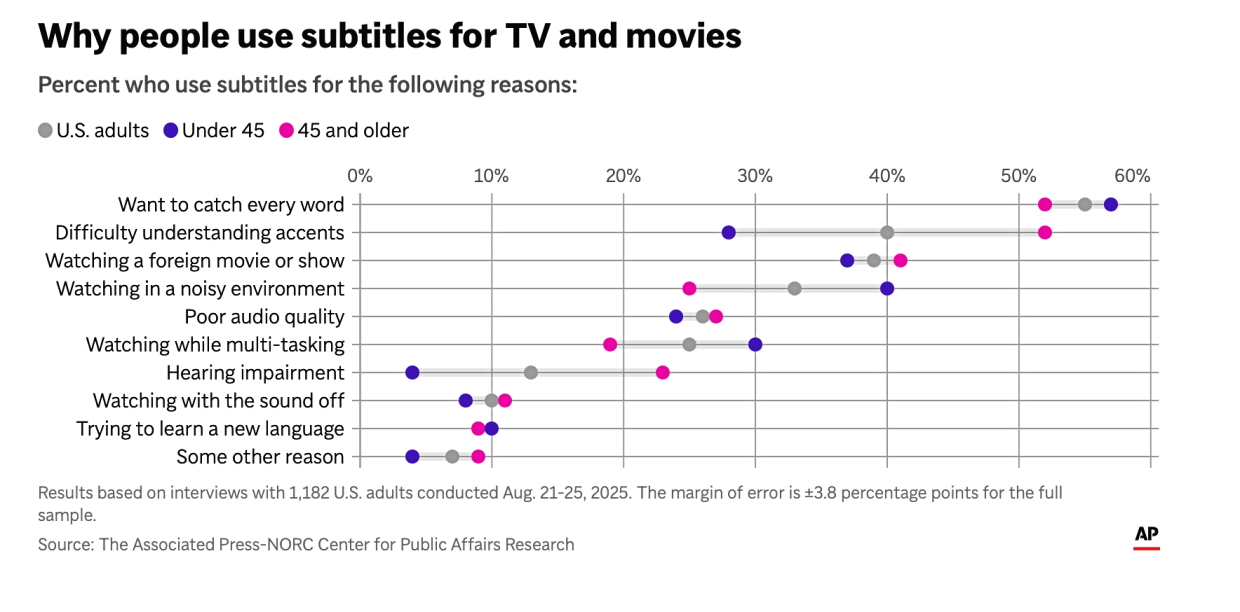
The poll finds that about four in 10 adults under 45 use subtitles at least “often” when watching TV or movies, compared with about three in 10 adults older than 45. Those 60 and older are especially likely to say they “never” use subtitles.
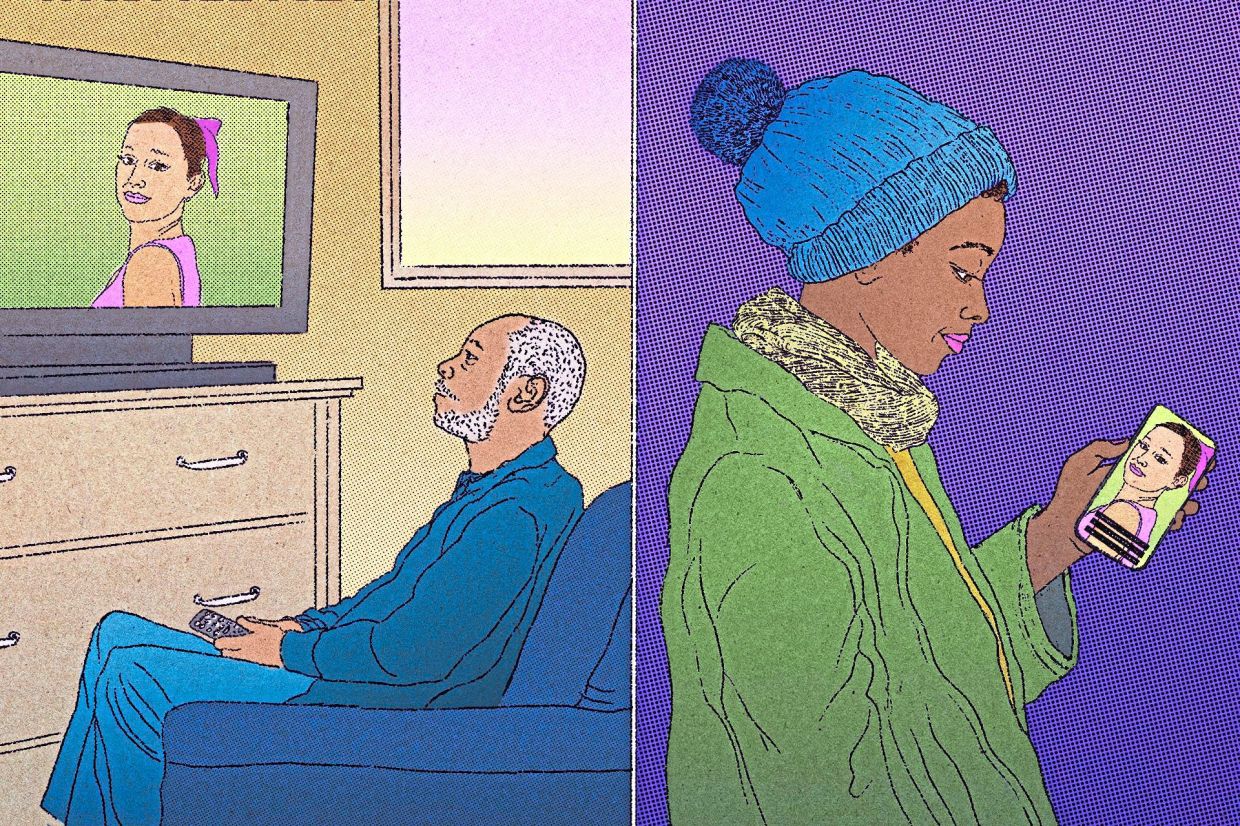
The poll suggests many young adults use subtitles because they are watching in noisy environments, whereas older adults choose them to better hear or understand what is being said.
That makes sense to David Barber, a sound editor and mixer and president of the Motion Picture Sound Editors.
“Part of it is cultural,” Barber says.
“What the younger kids are doing is, a lot of them will multitask. They’ll listen to music while they’re watching a show.
“So they’re catching bits and pieces of this, bits and pieces of that. I think they probably are half-listening and half-watching. It’s an interesting phenomenon.”
Subtitles help catch every word
Many people, regardless of age, use closed captions simply to better catch dialogue.
Most subtitle-users, 55%, say they use closed captions because they want to catch every word.
About four in 10 say they do so because of difficulty understanding accents or because they are watching a foreign movie or show.
Ariaunna Davis, 21, says she typically uses subtitles if she is in an environment where she cannot hear the audio and does not want to blast the volume, or if she cannot understand a character’s accent.
“If I want to know most of the words that are being said and the audio’s a bit iffy, then that’s the moment I’ll mostly use captions,” she says.
Adrian Alaniz, 31, of Midland, Texas, thinks his hearing was slightly damaged by the concerts he attended when he was younger.
With subtitles, he can be sure he is understanding what is going on, particularly if he is eating something crunchy like a bag of chips.
In the animated shows Alaniz watches, the subtitles are particularly helpful for translation.
There have been times, he says, when dubbed audio and subtitles do not match.
“Sometimes the audio doesn’t come across as clearly and the subtitles do help in that matter,” he says.
Bad audio or background noise?
The poll found that about three in 10 US adults use subtitles because they are watching in a noisy environment, while roughly one-quarter say they do so because of poor audio quality.
Barber says there are lots of reasons why dialogue can be hard to hear, including noise distractions in home-listening environments.
He also notes that speakers are often on the back of a flat-screen TV and project toward the wall.
“So you’re not listening on a stellar sound system to start with,” he says.
Another factor is performance- based.
Actors have “a more internal and close” style of emoting than they did decades ago, says sound designer Karol Urban, and sometimes that makes it difficult to discern dialogue.
And there is now simply a lot more sound competing with dialogue, Urban says.
“Back in the day there were a lot less sound effects, less music swells,” she notes.
“When you add more things under dialogue, you’re adding more frequencies and things that can interfere with dialogue.”
Davis, of Tampa, Florida, points to the show Game Of Thrones as one instance where she often turns on subtitles so she is not constantly adjusting the volume.
“A lot of times the speaking in that show is low and fits the dark environment if it’s in a certain scene,” she says.
“Then the next scene will be just music and it’s blasting through the walls.”
Generation gap on multitasking
About one-quarter of subtitle users say they turn on captions because they are watching while multitasking.
Fewer say the reason is a hearing impairment, trying to learn a new language or watching with the sound off.
Ask a younger or older adult, though, and you could get a very different justification.
Young adults who have used subtitles say they do this because they are watching in a noisy environment or watching while multitasking.
Older subtitle users – those 45 and older – say they use closed captions because they have difficulty understanding accents or because of a hearing impairment.
About three in 10 adults – 60 and older – say they use closed captions because of a hearing impairment, compared with only 7% for younger adults.
Patricia Gill, 67, of Columbus, Tennessee, does not use closed captions. But when her grandson comes over, Gill often notices he has subtitles on his phone when watching movies.
“He’s a typical almost-teenager, he just likes watching his phone,” she says.
The two have different approaches when it comes to subtitles. If she is interested in a show and misses an important line, she goes back and rewinds it.
“I’m old school,” she says. “I just like the regular, basic stuff.” – AP