Sarawakian musician, singer and visual artist Alena Murang will take the traditional sape to the orchestral stage in an upcoming performance with the Malaysian Philharmonic Orchestra (MPO), featuring an original composition written for the instrument.
The concert, titled Beats Of Borneo With Alena Murang, takes place at Dewan Filharmonik PETRONAS (DFP) in Kuala Lumpur on Oct 31 at 8.30pm.
The 70-minute programme, with a 20-minute intermission, opens with Ravel's elegant Le Tombeau de Couperin, followed by the premiere of a concerto for sape and orchestra written by KL-based composer Vivian Chua. Mozart's dramatic Symphony No. 40 closes the evening.
Japanese conductor Junichi Hirokami, the MPO’s music director, will lead the orchestra for the evening.
The show also marks Alena's second appearance at the venue, following her debut in Sounds Of Borneo in 2024.
"It's almost one year's worth of collaboration with composer Vivian, and it's the first work of its kind ever commissioned. Unlike my previous performance at MPO where I was playing my own songs, there was no re-arrangement for my part. In this new composition, I've been studying in the classical way, which is new to me because I don't read notes; I play by ear," says Alena, 37, at a recent interview.
She will perform alongside 60 other instrumentalists, with the concerto placing the sape at the centre of the orchestral arrangement.
"I have to credit the composer for not only being sensitive to the sound of the sape, understanding its character, but knowing what other instruments could complement it. For instance, I didn't know that the oboe and bassoon go very beautifully together," she says.
Unlike many modern instruments, the sape has no standardised method of instruction, although guides and community initiatives are making it more accessible.
For younger generations, learning the instrument has become more accessible, with sape musician Hallan Hashim's illustrated 7 Fundamental Techniques For Playing Sape (2024) offering fun, practical guidance, while non-governmental organisation Persatuan Anak Seni Sape' Kuching also helps bring sape-playing to a wider audience.
"For a long time, the instrument's history was used as part of healing, rituals and it could only be played by men, so I grew up having a lot of respect for it, while playing it in secret. In the world music space, the sape has now been recognised across the world, so this concert is another important milestone," says Alena.
Born in Kuching, Sarawak, to a Kelabit father and an English-Italian mother, Alena made her mark on Malaysia’s cultural music scene in 2016 with the release of her debut EP, Flight.
The sape has remained a constant in her musical journey, and it was through her poignant nationally televised performances during Gawai celebrations in 2020, the first year of the pandemic, that she found her way into Malaysian homes.
Since then, she has taken the sape to bigger stages and indie music events, without losing sight of its roots.The instrument's design, she says, has also evolved over the past two decades, with makers experimenting with different sizes, replacing fishing lines with guitar strings and adding pickups for amplification.
For the upcoming DFP performance, Alena will use an acoustic pickup to capture the sape's resonance, alongside techniques such as flicking, hammer-ons and tapping the wood.
"Traditional sape is in a pentatonic scale (five notes), played in the key of D, which the composer maintained. We (Vivian and I) spent some time understanding how to play it because there’s a lot of improvisation with the instrument once you know the melody," says Alena, demonstrating the instrument.
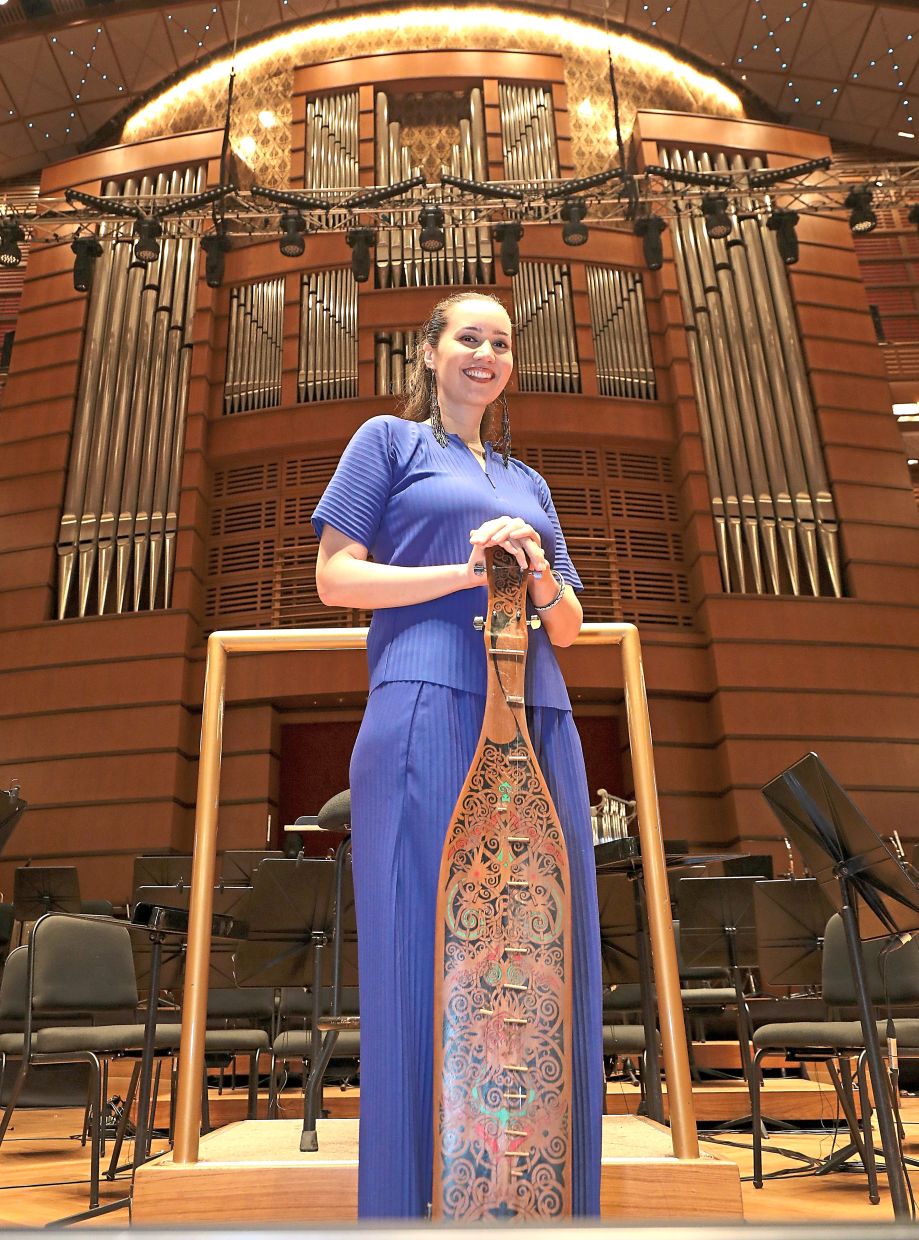
The sape's visual design also carries its own symbolism. Alena's instrument was made by Miri-based maker Mat Linggi.
"Originally, the sape was blank, these motifs began to appear in the 1920s to the 1930s. People say it imitates the Terabi shields, where the designs were also symmetrical. Every sape maker has their own style. To me, these designs symbolise balance, with the positive and negative space. Some have meaning as well, referencing dragons or dogs," says Alena, adding that she also paints in her spare time.
Beyond the concert hall, Alena has shared Borneo's living heritage with wider audiences through performances at the George Town Festival 2026 and her visual art practice, including the recent exhibition Ancestors Of The Future in Petaling Jaya.
It has been a productive year for Alena, who also received a Silver Medal for Outstanding Achievement at the US-based Global Music Awards in August for her original Kelabit-language song, Sekunuh Kamih Our Stories).
Through music and painting, she continues to explore the cultural knowledge passed down to her.
"Stories were passed down through music, for example, the head hunters' culture, when they would return bringing back the head of their enemies, there would be a celebration, and they would play music," says Alena.
"So that's why I feel like my performances are half music, half storytelling. I believe I was part of a generation that was born and grew up outside of the longhouse, which gives us a unique experience – a bridge between the two – and I'm honoured to have this opportunity to share it," she concludes.