George Town artist Lee Eng Beng spent much of his childhood, like many Penangites, exploring the familiar corners of the island – Love Lane, Lorong Stewart, the old Tai Tong kuey teow stall and the mee sotong at Pulau Tikus among his favourite haunts.
Now 59, he still takes to the streets with his watercolours. In any given week, he finds time to settle somewhere in the old town and paint, adding fragments of memory to what he sees – the stalls that have closed, hawkers who have moved on, and labourers who once crowded these places before returning to work.
Many of these familiar scenes feature in his solo exhibition, Hari Hari (Everyday), at AweGallery in Petaling Jaya. Running until Oct 14, the show brings together 39 works depicting everyday life and forgotten scenes in Penang, Ipoh and Melaka.
Despite nearly 40 years as an artist and art teacher, Lee regards this exhibition as his proper debut, with the works planned more than a year ago with curator and artist Ong Jian Yang.
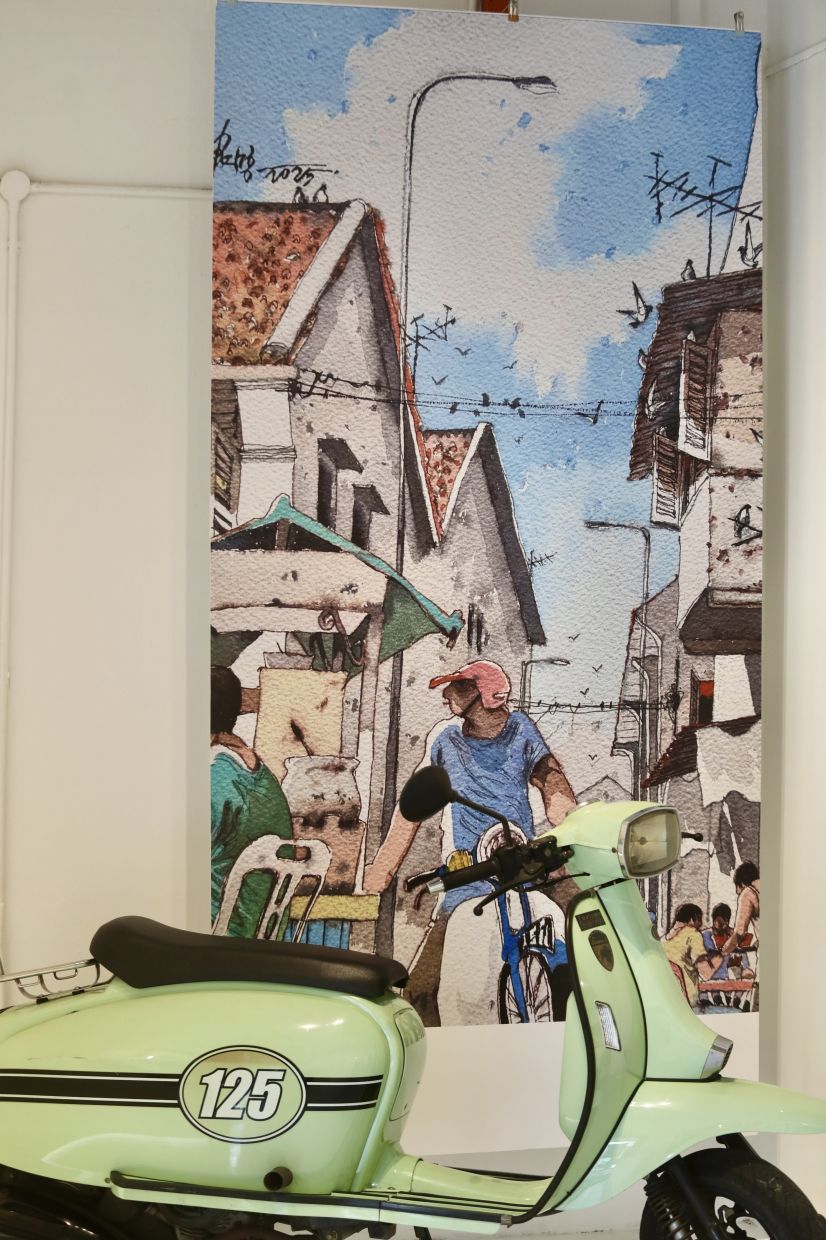
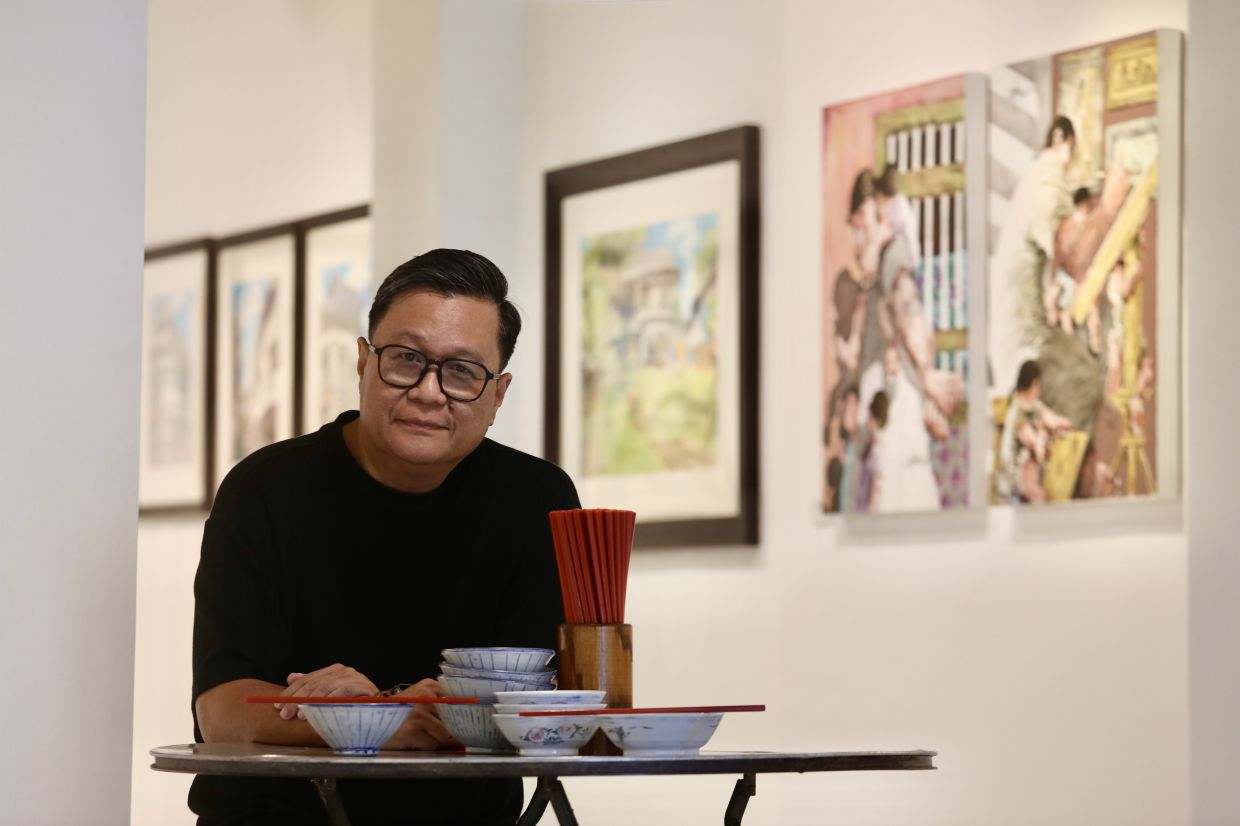
Beyond the paintings, there is also a playful touch to the Hari Hari exhibition, with a kopitiam table brought into the gallery and a scooter parked against a nearby wall. Lee’s sizeable works include watercolours of street scenes and acrylics depicting his muscular male figures.
“I would go out almost every day to paint a scene, taking three to four hours. The Penang scenes hold memories, familiarity and a strong sense of place. What makes this exhibition especially special is seeing these works alongside my paintings about fatherhood. There is a very different kind of strength and tenderness in the way I expressed the relationship between a father and his children,” says Lee in a recent interview.
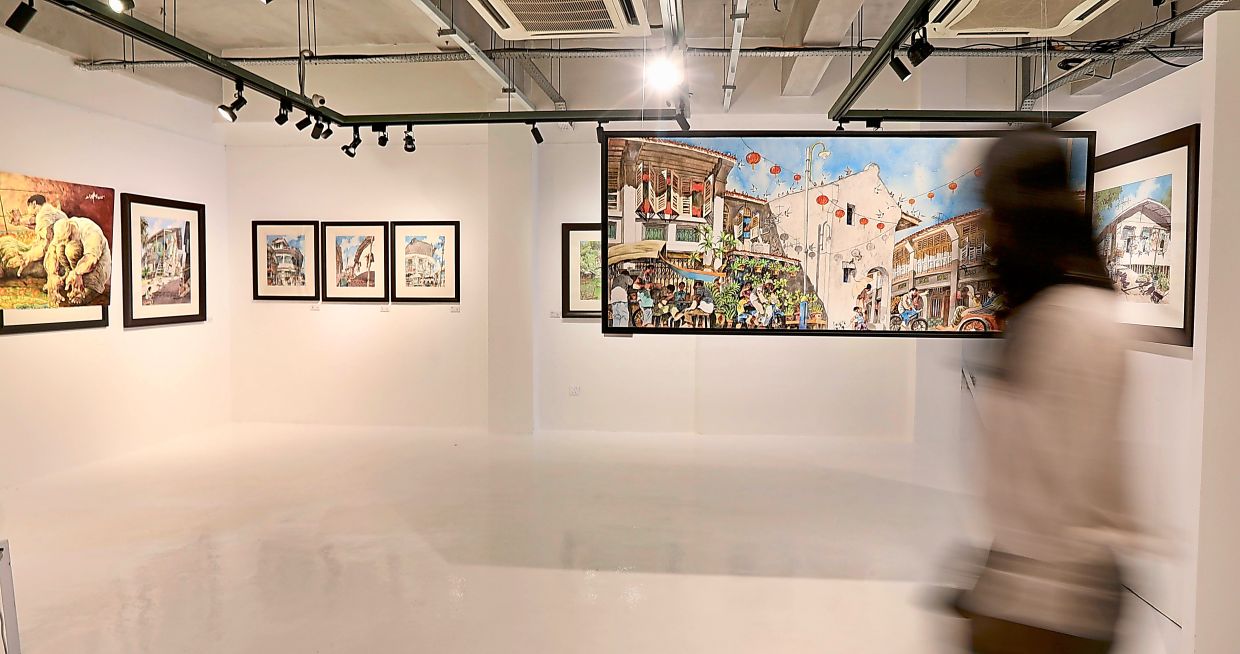
“I would say 70% of the artwork is of the actual building and scene while the other 30% is from what I remember. I’m painting what it is in the present, but what I add is from the past. The buildings may still be there but the hawker is no longer there. So I preserve the memory this way,” he adds.
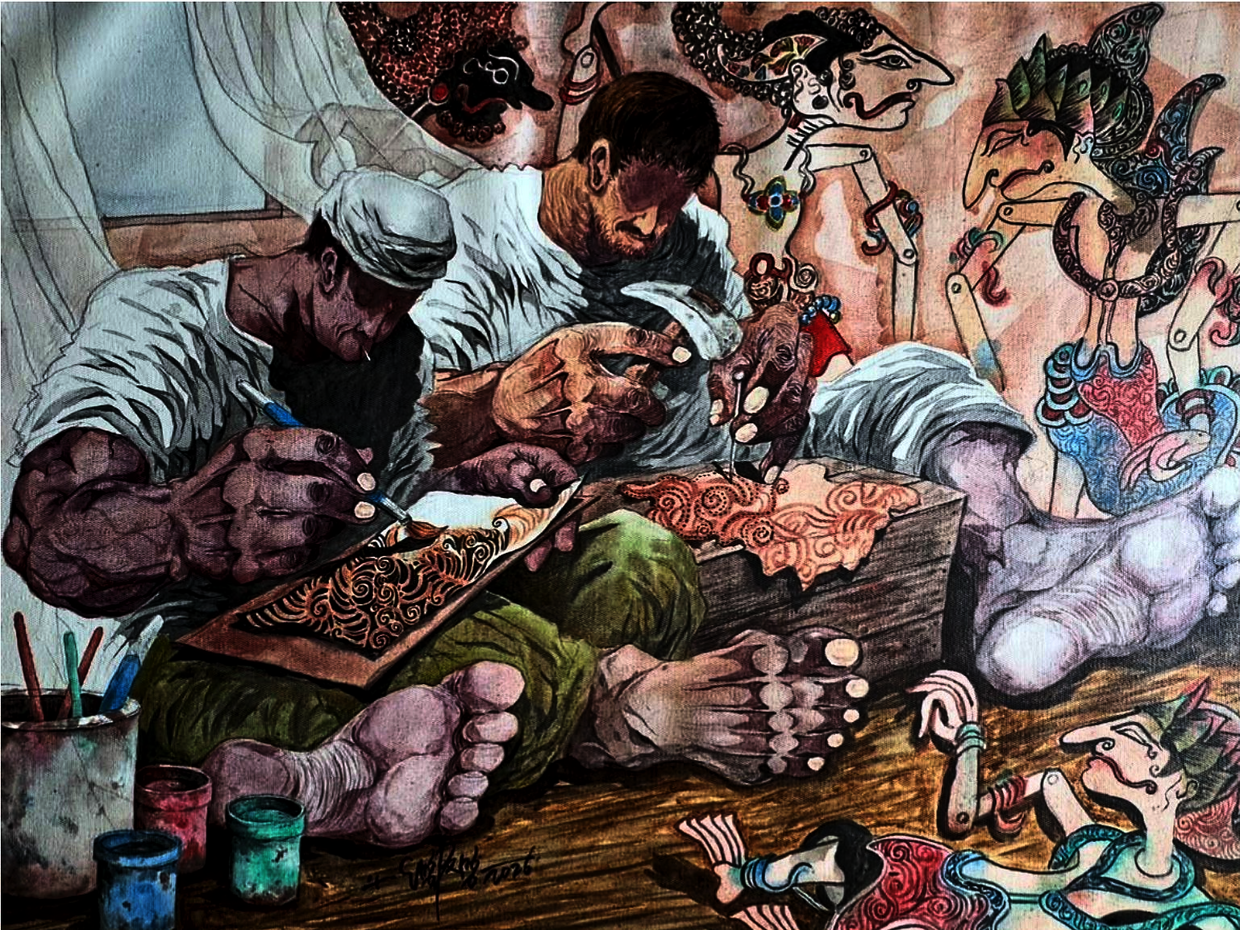
Walk through the gallery and Lee’s distinctive style quickly becomes apparent. His watercolours are bold and expressive, often arranged like comic-book panels, while his figures – especially the men – are drawn with notably muscular physiques.
Some may recall comic-book artist John Buscema’s anatomical mastery, or Christian Bale’s physically imposing on-screen Batman.
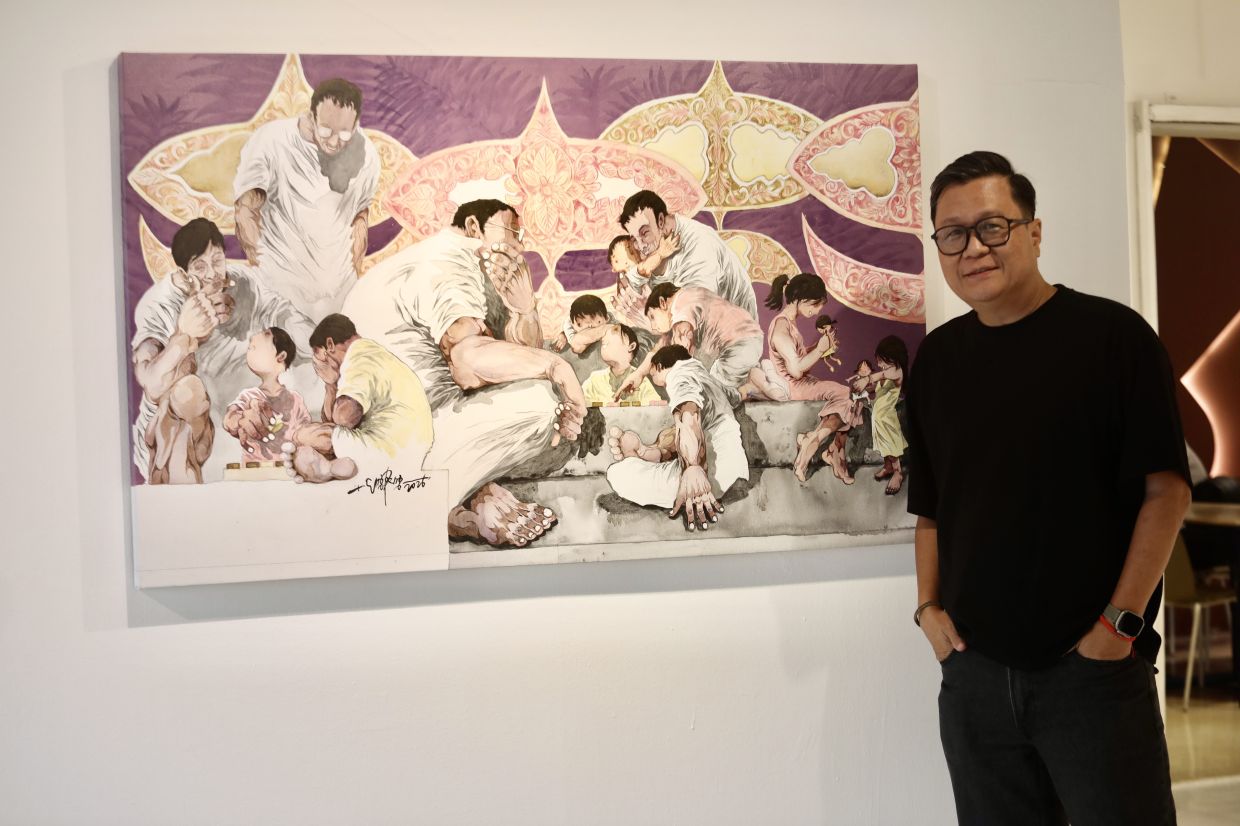
However, Lee, a self-taught artist, cites three influences: Tan Choon Ghee (1930-2010), a pioneer among Penang watercolourists, Chinese-American painter Dong Kingman, known for his vivid depictions of urban environments and Japanese manga artist Takehiko Inoue, best known for the basketball series Slam Dunk.
“I don’t need references or a model when it comes to drawing men – the poses and gestures come naturally to me,” says Lee.
One work, Spiritual Sustenance, brings together much of what Lee is interested in: place, memory, people and the passage of time.
The painting depicts a 1960s congee stall in Penang, which served hot porridge and a few simple side dishes for 20 sen a bowl. It was a lunch stop for labourers.
“Many labourers used to stop at the old Lee Tong Kee congee shop for a quick bowl before heading back to work. They would squat on those little stools, bowl in one hand, eating with the other, barely stopping before they had to leave. The shop is closed now, but the stools and tables are still there, almost like a display of the past,” says Lee.
A new series featuring wau-makers and wayang kulit craftsmen also gives Lee an opportunity to depict his exaggerated male figures while exploring the physical strength required to keep these traditions going across generations.
"Eng Beng's paintings bring the past and present together. The buildings and shophouses he paints are observed as they exist today, while many of the hawkers, vendors and everyday figures within them come from his memories of growing up in Penang. In this way, his paintings become both a record of the present and a recollection of the past," says curator Ong.
Saying ‘I love you’
Fatherhood gives the Hari-Hari exhibition another dimension. The same idea of routine and presence that runs through his street scenes appears in his paintings of fathers and children – the everyday act of showing up, caring and being there.
"The same sense of continuity can be found in his portrayal of fatherhood. His figures are often given exaggerated arms and feet, suggesting strength, labour and protection, yet behind this imposing presence is a softer side, with fathers who play with their children and find joy in the simple moments of family life," says Ong.
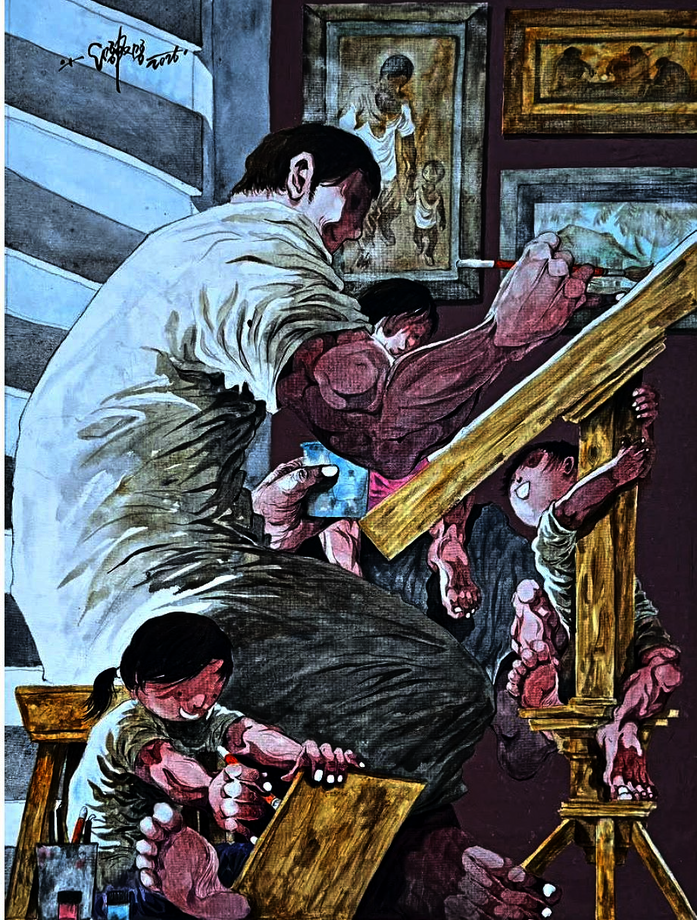
Lee is a father to two sons, now 27 and 21, and his Father And Son series deliberately keeps them at the age when they were still children.
The backdrops to these paintings are often tightly cropped, whether depicting a studio scene or a walkabout. The figures appear to gather in close, almost as if sharing a group hug, giving the works a sense of warmth and intimacy.
“When they were still kids, I would be painting at home and they used to climb on top of me and ask me questions about the artwork, so I want to keep remembering these times. I draw the figures with intense muscles to represent the power and strength needed for a father to support the family and the type of sacrifices they make to maintain it,” he says.
In Father’s Love – Dad, Did You Draw Me In Too?, Lee recreates one of those intimate moments. A girl appears in the composition for visual balance, he says, although the process has made him wonder how having a daughter might have changed his perspective.
His next challenge may be a Mother And Son series, which would require him to explore a different vocabulary of poses and gestures.
The muscularity of Lee’s figures is therefore not simply about physical strength. It is also his way of considering how men express care, responsibility and affection.
“For a long time, we (men) have not been able to feel secure in expressing ourselves emotionally, which is why it is perhaps easier to share it with mothers, while being more reserved with fathers.
"So I’m trying to be more expressive with my sons, making it normal for us to say ‘I love you’ to each other. We shouldn’t wait until something happens before we get the courage to express it. If you feel it, you should say it now,” concludes Lee.
Lee Eng Beng's Hari Hari (Everyday) is showing at AweGallery in Petaling Jaya until Oct 14. Free admission.