The awe-inspiring vistas of Huangshan, or the Yellow Mountain range in China’s southern Anhui Province to the east, have moved countless artists to attempt to capture its beauty over the centuries, particularly those specialising in the traditional Chinese shan shui (mountain water) landscape works.
Even as the mountains themselves have remained largely unchanged, the ways that they have been reimagined and reinterpreted have varied across time, geography and artistic approach.
In his new solo exhibition, contemporary artist Yeoh Choo Kuan draws on his abstract practice – beginning in the 2010s – to explore shan shui from a more personal perspective, revealing new ways of engaging with the tradition.
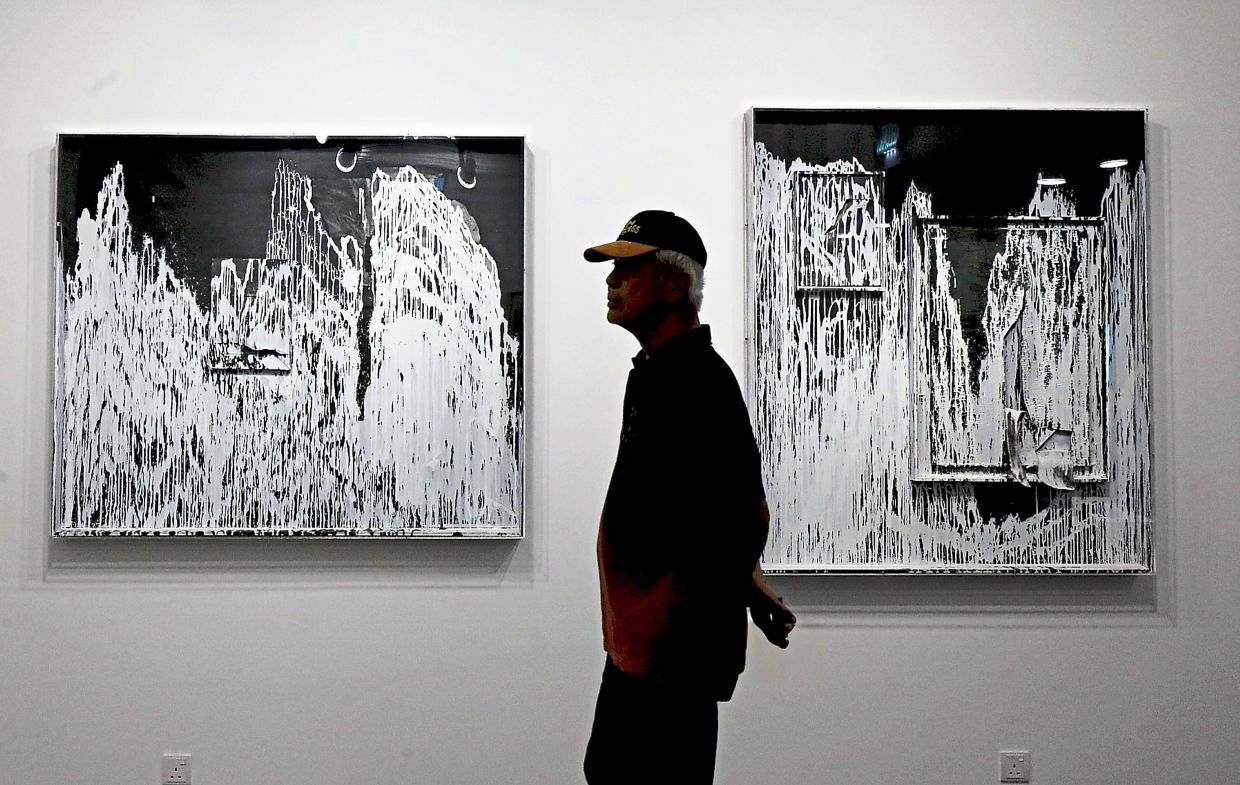
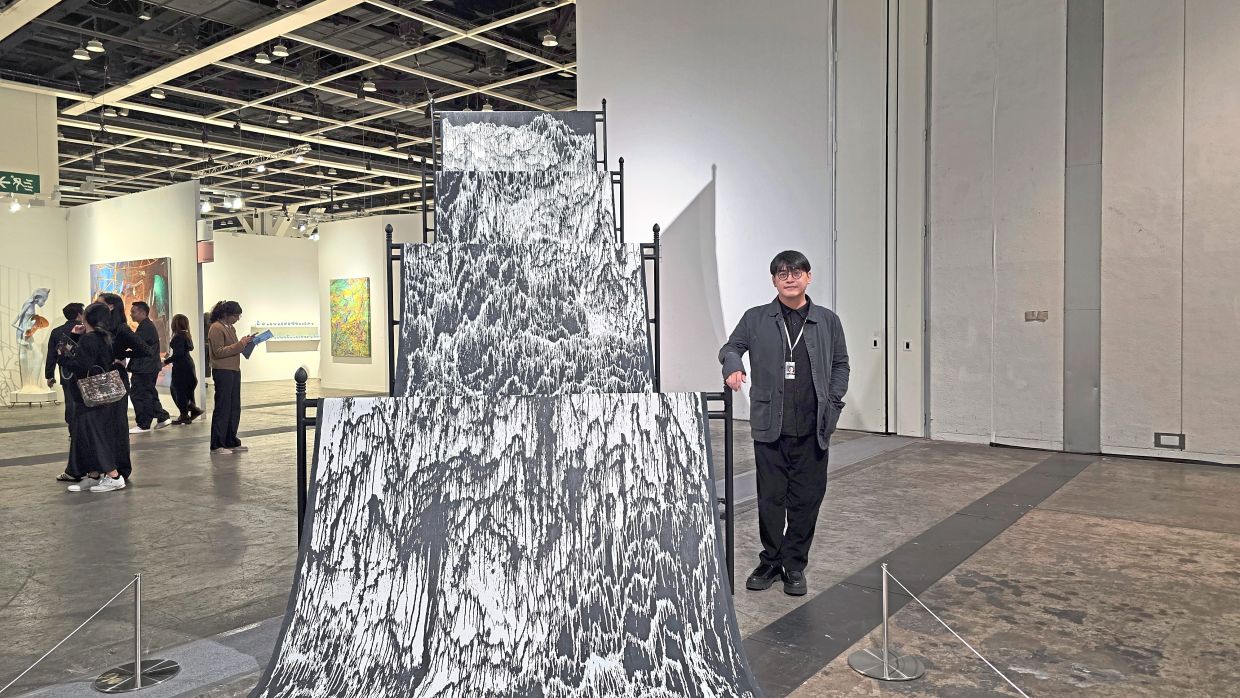
Shan Shui As Camouflage, currently showing at Richard Koh Fine Art at A Place Where in Kuala Lumpur until Oct 18, presents Yeoh’s current monochromatic journey – paintings and etchings – that evolved from his Streaming Mountain series (2018-2026), which was featured at Art Basel Hong Kong in March this year.
“I’ve been working on the Streaming Mountain series since 2018, so for the past eight years, my work has revolved around the concepts and philosophy behind shan shui.
“But in this new body of work, I’ve been trying to find ways to connect the traditional art form with my daily life,” says Yeoh, 38, in a recent interview at the gallery.
The show also marks Yeoh’s return to the KL exhibition circuit – his last show in the capital was his What Makes A Mountain solo exhibition in 2023 at the Eslite Spectrum bookstore in Bukit Bintang.
Dialogue between generations
In addition to displaying Yeoh’s newest works, Shan Shui As Camouflage offers a curatorial insight into how shan shui painting has never been a matter of merely copying what stands before the painter.
Accompanying an essay by independent curator Deborah Lim are two paintings – one by Singaporean Liu Kang (1911-2004), who founded the Nanyang style of painting that blended Western and Eastern techniques, and one by pioneering Malaysian artist Cheong Laitong (1932-2022), known for his abstract avant garde style – on loan from a private collection.
The works by Liu and Cheong, presented alongside Yeoh’s pieces, trace almost a century of artistic practice, demonstrating how differently the same landscape can be held and how far the tradition can travel while remaining recognisable.
“We wanted to show how different generations of South-East Asian artists improvised the themes of Chinese landscape paintings, such as shan shui.
“For example, in contemporary Chinese landscape paintings, I would say it’s more about how we think in the context of Chinese landscape. Instead of looking at what’s there, we focus on the visual language, trying to think about how we can connect these older art formats with the current experience,” says Yeoh, who has shown in Singapore, Hong Kong, Bangkok (Thailand) and Dubai (United Arab Emirates) in recent years.
In 2022, the KL-based artist was also selected for the Khazanah Residency Programme, which took him to Acme Studios in London for a residency.
Layers of self
For Streaming Mountain, Yeoh employs a “paint streaming” technique, directing and controlling the flow of paint to evoke mountains and rivers across large-scale, multi-panel works, while maintaining a deliberate distance from the surface.
The 2019 series, which circles through the realm of the dead in Chinese mythology, draws on Yeoh’s childhood memories of Kota Baru, Kelantan where visits to a neighbourhood Taoist temple became part of his early experience.
The hellish landscapes of Diyu have gradually given way to a calmer, more contemplative terrain.
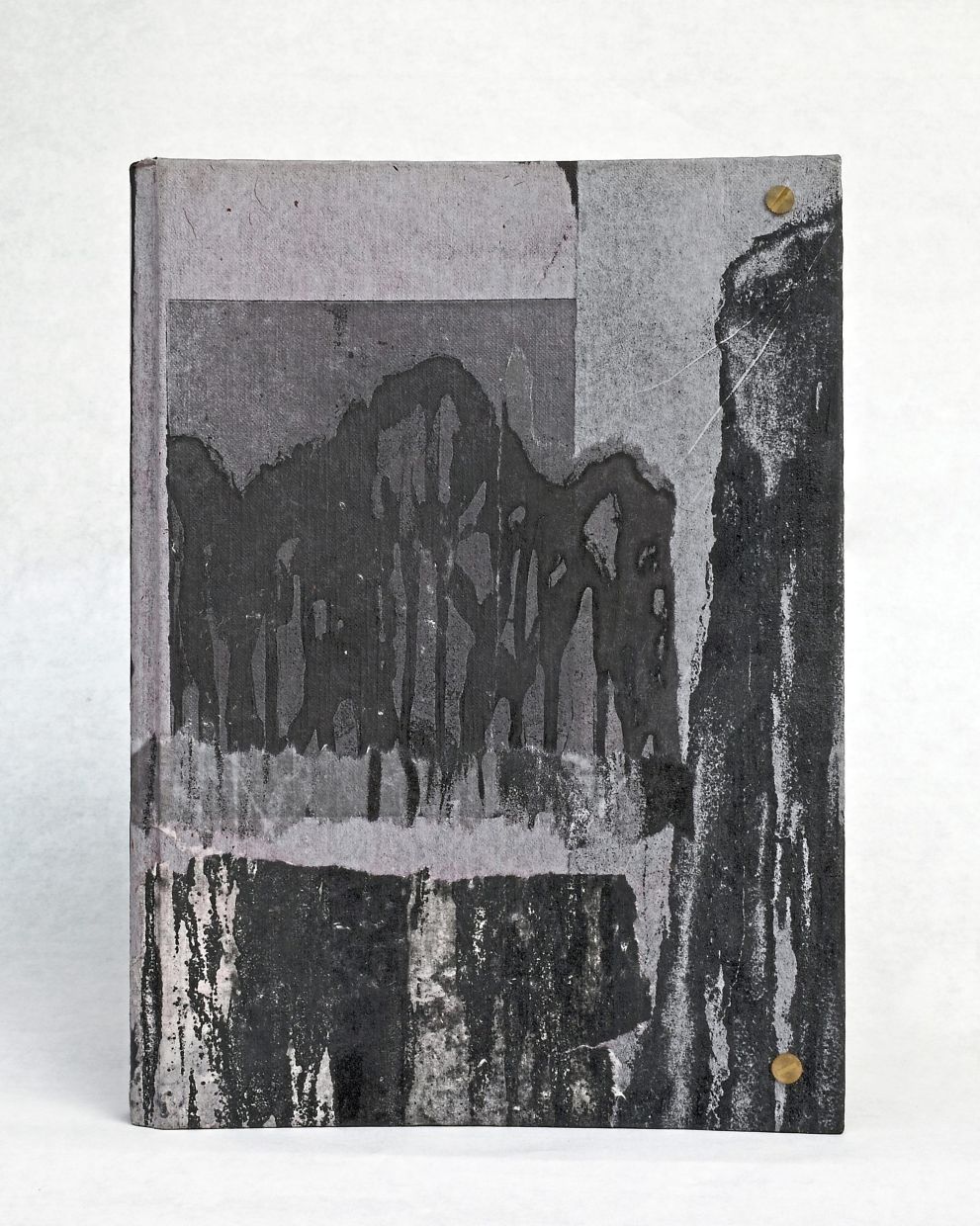
In these recent Shan Shui As Camouflage works, however, Yeoh introduces a more personal dimension to his paintings, incorporating fragments of his own artistic and personal history – including dismantled canvases from “failed” works, the folder containing his medical report, and vintage books from his collection.
These materials become integral to the landscapes he envisions, blurring the boundaries between image, memory and personal archive.
“Previously, I had to purposely build the mountain by creating the texture I needed to get the details I wanted. But now, the mountain is formed through the shape and structure of an object and letting it flow however it wants,” says Yeoh.
“Somehow, it worked better than when I was trying to create the texture myself. Now all the limitations from before have opened up to become infinite possibilities,” he adds.
Yeoh, characteristically candid, took a moment to reveal that this new painting methodology emerged from his own experience of grappling with health issues.
“The past few years, I’ve had to deal with a terrible case of gout, so this Shan Shui As Camouflage work is also about how I learned to accept the changes happening to my own body, camouflaged within these mountains.
“At first, I was in a lot of pain and had to stay in bed for months. But once I was able to go back to painting, I realised I could look back on this experience in a new way. This technique came from my coming to terms with the fact that no matter how much you try to control some things, life doesn’t always turn out the way you expected,” he shares.
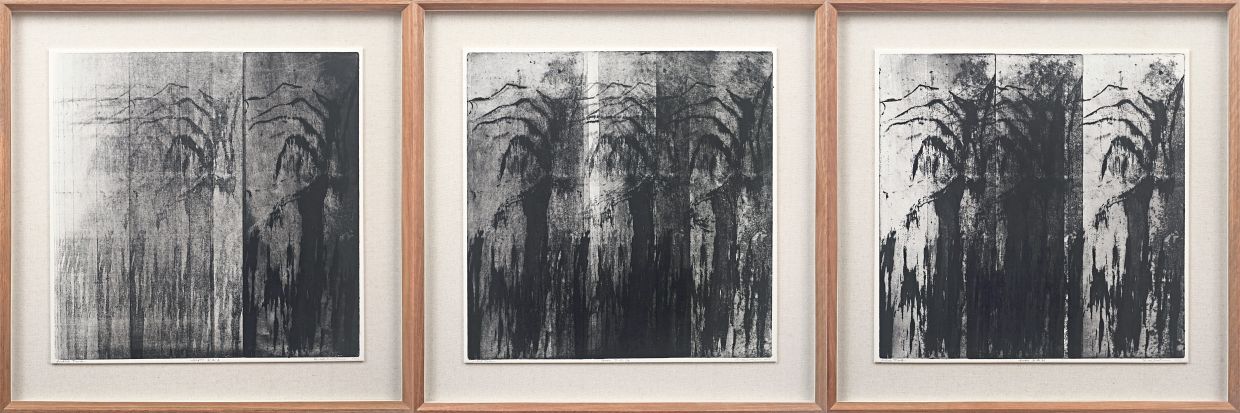
Beyond the paintings, Yeoh also created etchings on rice paper, carefully layering each impression to create the illusion of shifting mountains. He admits that the process was considerably more time-consuming than his usual dripping technique, demanding a greater degree of precision and patience.
“In printmaking, the idea is to create an exact copy, but I wanted rethink that ideology. Rather than an approximate reproduction, I wanted to overlay the lines and the forms to create the body of the mountains and give it a sense of movement,” he says.
At this KL show, presented on a relatively intimate scale, Yeoh takes a more contemplative approach to shan shui.
Where he once explored shan shui as a visual tradition, he now brings the mountains closer, allowing the landscape to take on a subtler, more inward resonance. In this painter’s hands, it becomes a space for reflecting on memory, vulnerability and the self.
“Camouflage is nature’s instinct to hide from the world. Mine is a way of embracing it,” he concludes.
Shan Shui As Camouflage is showing at Richard Koh Fine Art, A Place Where in Kuala Lumpur until Oct 18. Free entry. Open: Tuesday to Saturday, 11am-7pm. More info: rkfineart.com.