Beneath a forest floor, an entire world is quietly at work, largely invisible to human eyes yet vital to the life above.
Mycelium threads through the soil in vast, intricate networks, connecting various organisms and constantly exchanging nutrients and information.
What is occasionally seen – a mushroom pushing through the undergrowth – is merely the reproductive structure of something much larger.
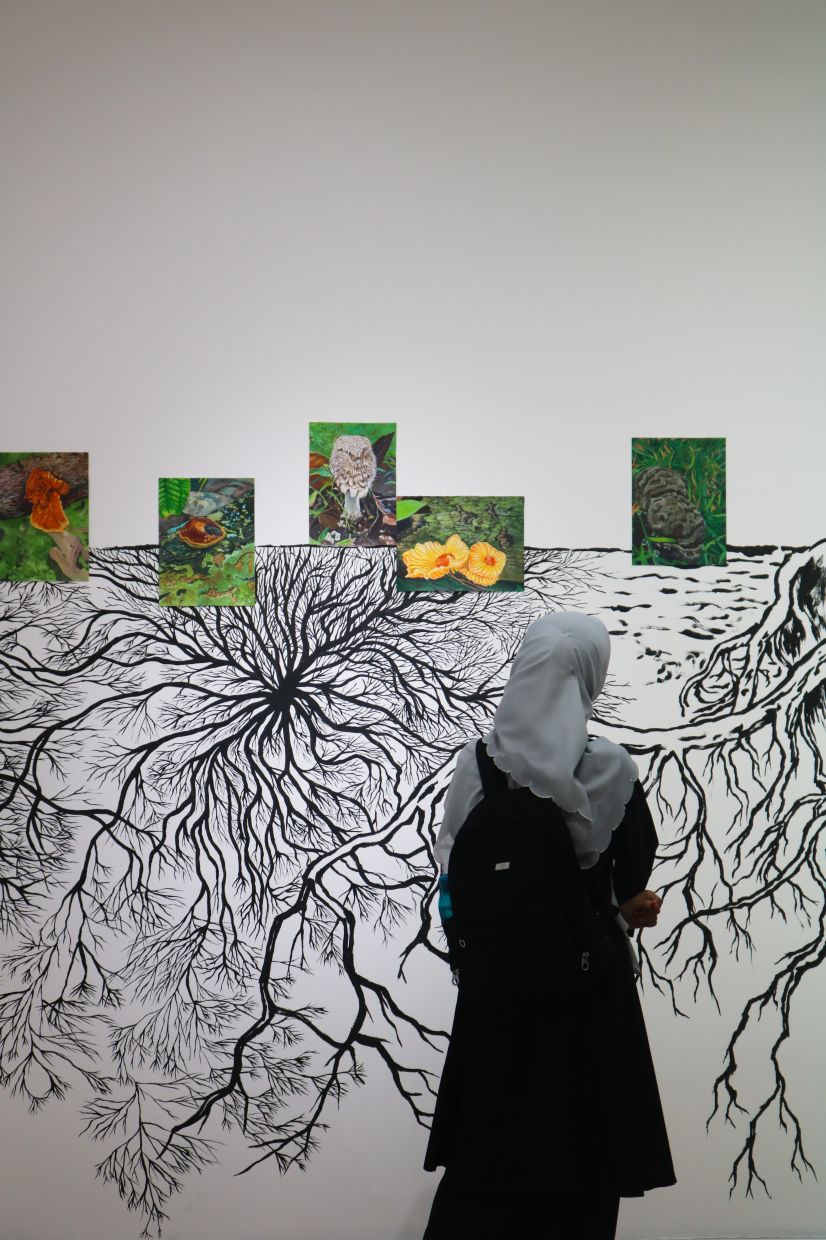
For Penang-based multidisciplinary artist Hasanul Isyraf Idris, such fungal networks represent more than an ecological curiosity. He sees them as metaphors for how ideas, influences and connections can spread beneath the surface, long before their effects become visible.
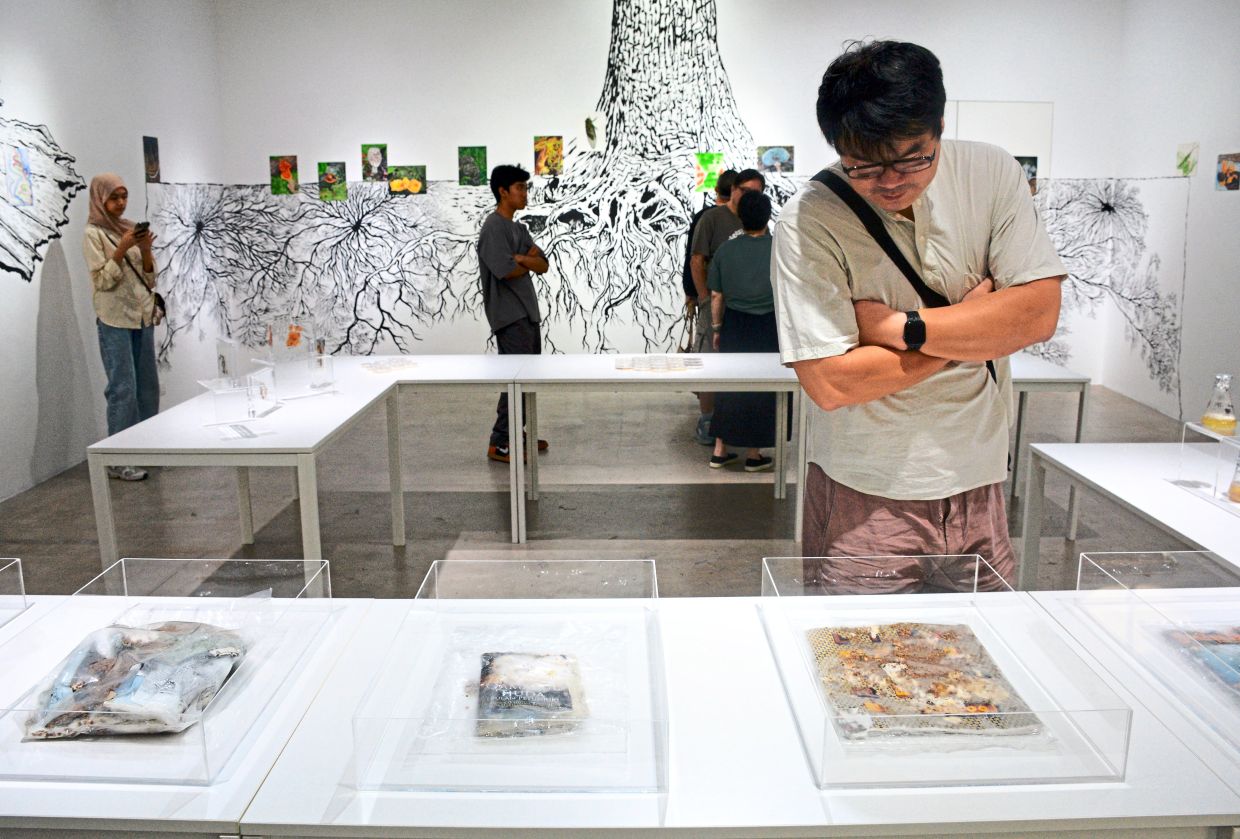
That notion lies at the heart of his latest exhibition, titled Fruiting Bodies, which is currently showing at independent arts space Blank Canvas in George Town, Penang through Nov 8.
The exhibition marks his first solo in George Town since he moved there from Kuala Lumpur in 2012.
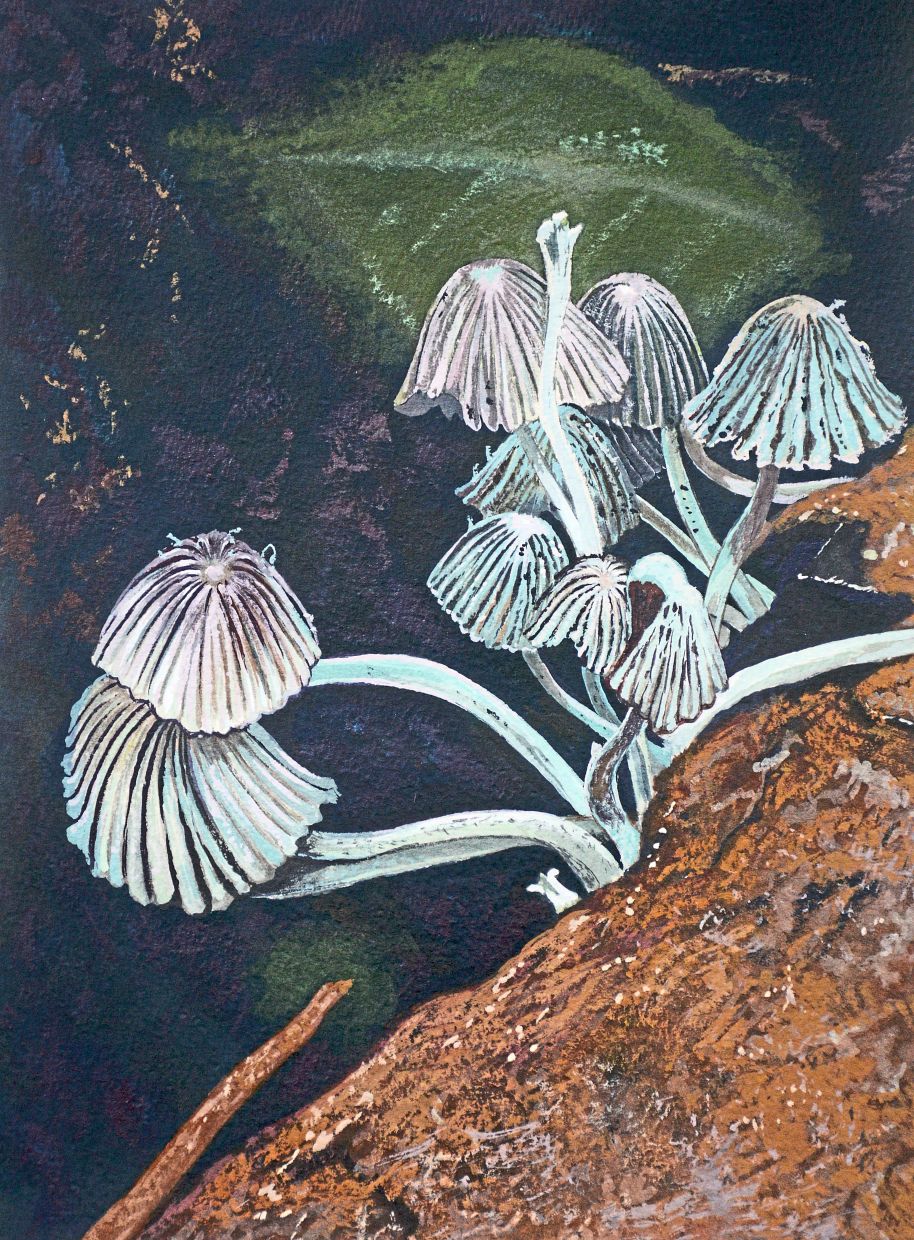
The works include large wall murals and small paintings on paper. These depict mycelium and their fruiting bodies, as well as a flowing river and insects.
The fruiting bodies are diverse in shape and form, ranging from fuzzy white parasols to brown oyster-shaped variants. For Hasanul, they are the unsung heroes of the forest – humble, small and easily overlooked, yet key to the health of the soil.
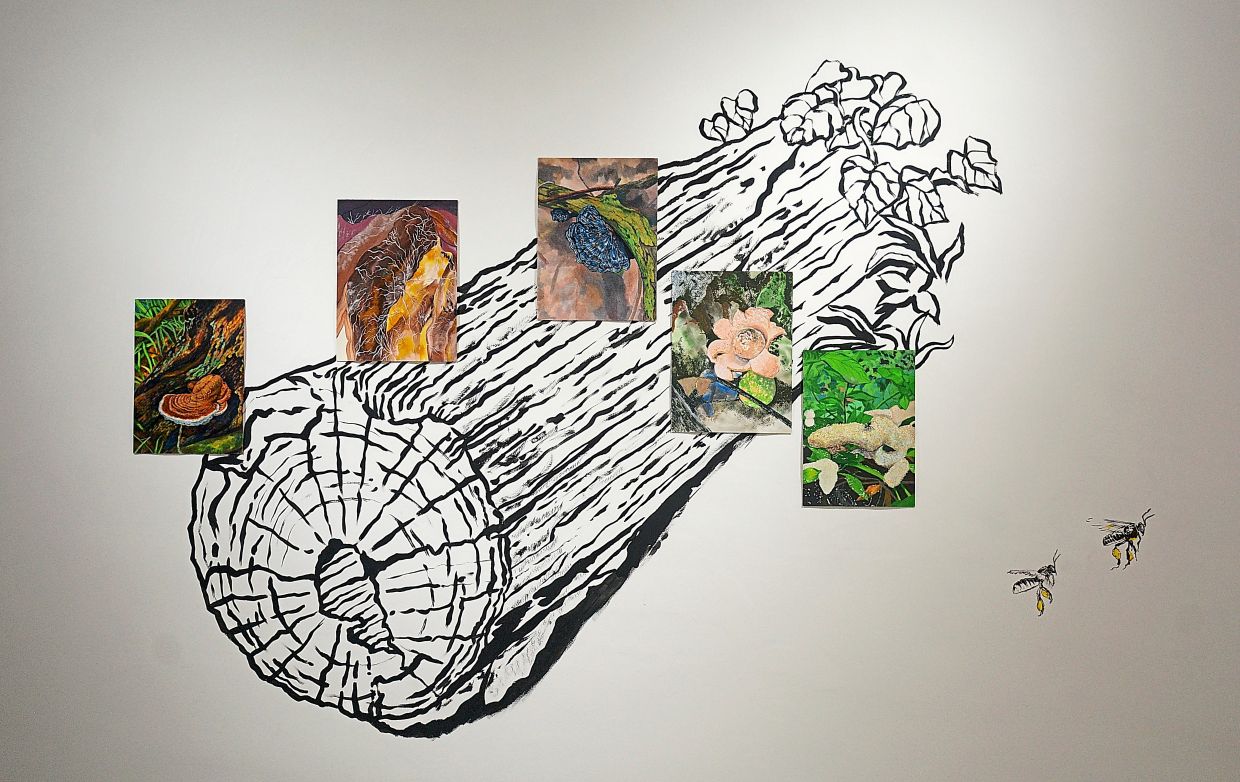
“Mycelia are among nature’s most resilient and important composters. They attach their networks to tree roots and form symbiotic relationships.
“In return for sugars produced through photosynthesis, the fungi help trees access water and other essential nutrients,” says Hasanul, 48, whose practice spans painting, drawing, installation, video and sculpture.
“And all of this happens out of sight. In many ways, this mirrors the cycle of life – where everything has a purpose and function, even if they may not be readily apparent,” he adds.
The soft-spoken artist’s works have typically explored a hybrid world of fictional and surreal iconography rooted in pop culture, but his practice has increasingly turned towards nature.
His last major exhibition, Nightwalking, held in KL in July 2023, explored nocturnal encounters with nature, featuring moths and celestial bodies such as stars and meteors.
Fruiting Bodies is a concept he has been developing for more than a year.
But Hasanul’s fascination with the mycelia started when he visited a friend’s mushroom farm in 2012. Intrigued by what he saw, he began reading about them in science journals.
In 2019, he bought a plot of land in rural Selama, Perak, roughly two hours from his hometown of Manjung.
He slowly developed it into a small vacation home for his family and also constructed a studio for himself.
Besides these two structures, the rest of the plot remained a natural wilderness with clusters of brambles, bushes and fruit trees.
“We often spent our weekends there and I began documenting what I encountered on the land. In 2021, I noticed some mushrooms growing at the base of a tree. It took my interest to another level,” he says.
Notably, the titles of his works follow the way scientists label and catalogue samples collected from research sites.
For example, SGSPTHKBH(15)20260716 refers to Sungai Seputeh, the river that flows by his studio, which he calls Kebun Bintang Hijau or KBH. Meanwhile, 15 is the sample number while the rest of the numerals refer to the date it was encountered.
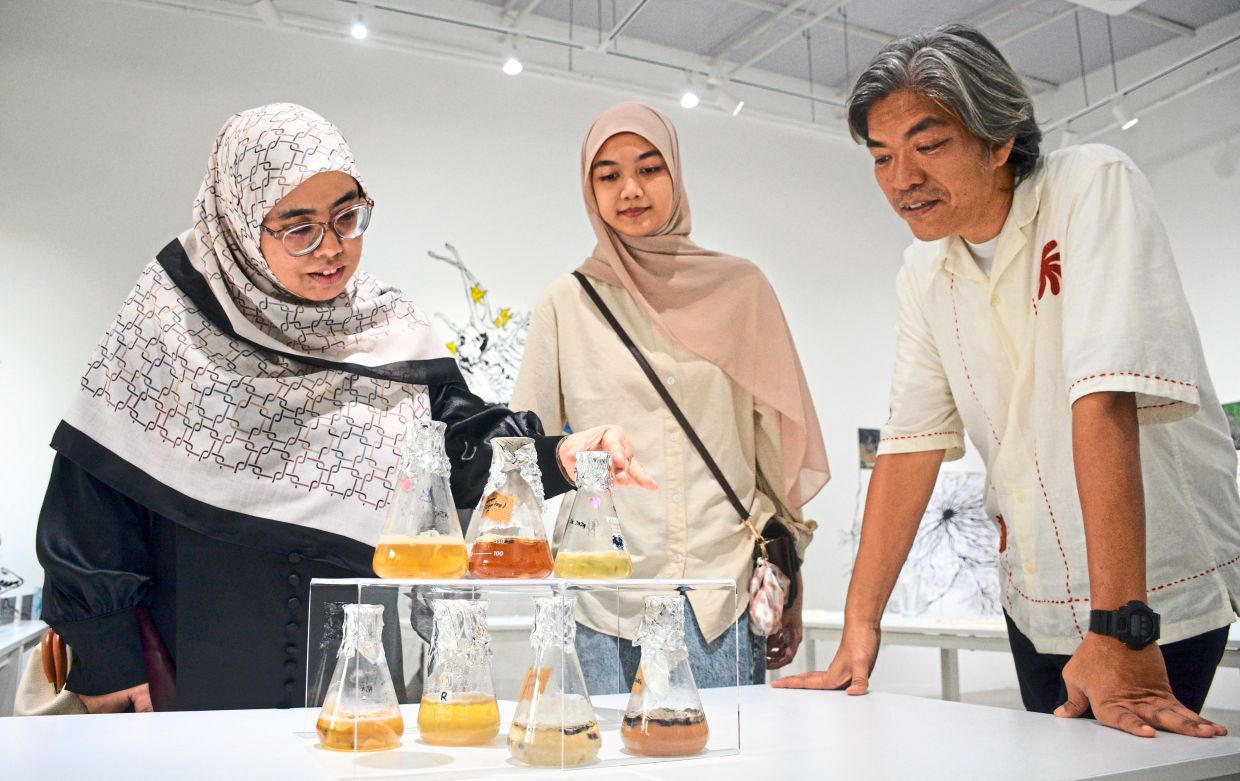
Accompanying the paintings is an installation of tactile mycelium experimentation that the artist developed in close collaboration with Dr Rosnida Tajuddin, a mycologist with Universiti Sains Malaysia’s School of Biological Sciences.
“This isn’t a typical gallery show, but mycelium has interested me for some time, so I’m glad to explore it through this work, including visits to the USM lab and conversations with Rosnida,” says Hasanul.
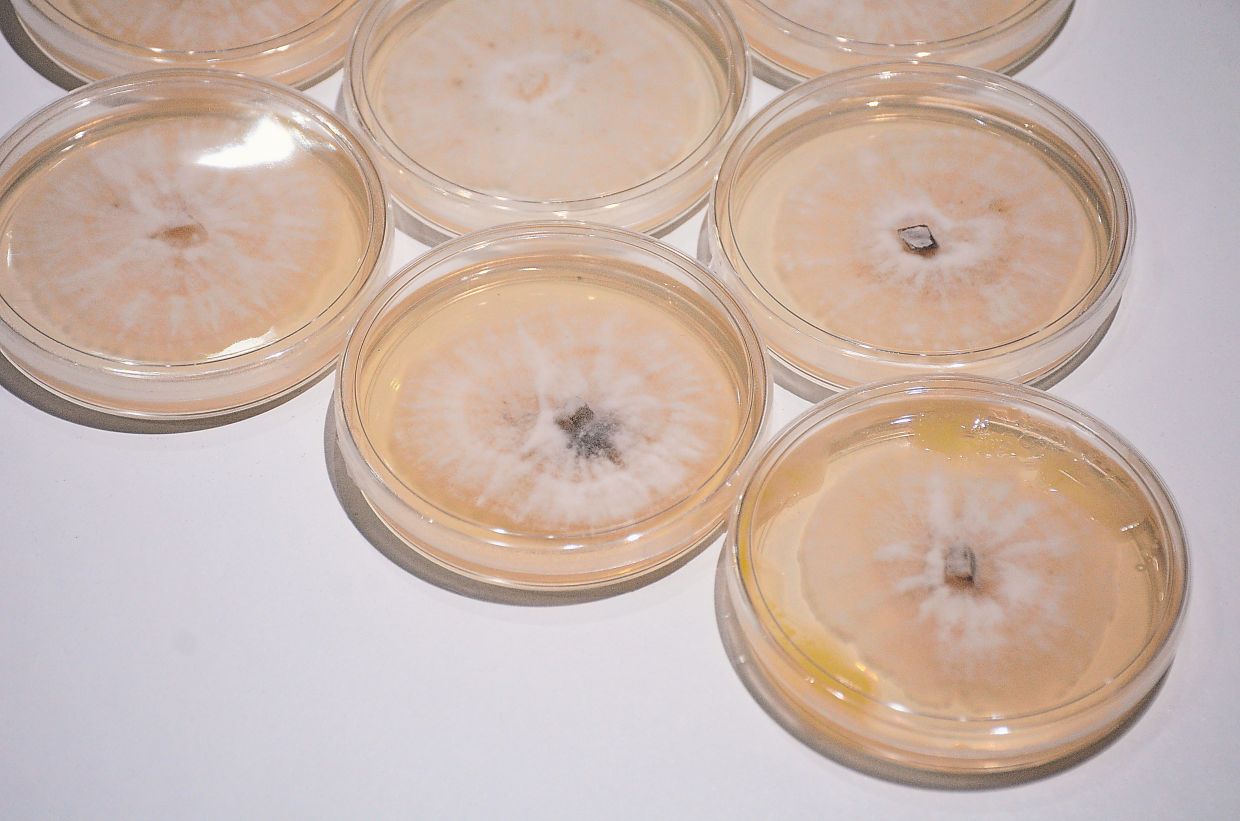
There are mycelium in various stages of growth inside petri dishes. Some have also been turned into liquid cultures or even skin-like materials.
Others are in the process of breaking down books and magazines, as paper is made of cellulose and lignin, the natural materials that some fungi feed on.
“I deliberately used books and magazines which were important to me. One was given by a departed friend. It represents the cycle of life and death, or grieving and letting go,” says Hasanul.
He also saw it as a reminder that human life will always follow nature’s inherent cycle – of growth, decay, death and renewal.
“No matter how high we build or how far we travel, ultimately the forces of nature decides what becomes of us,” he adds.
Hasanul previously won the top prize in UOB’s Painting of the Year (Malaysia) competition in 2024 for his gouache painting Durio, which depicted the life cycle of a durian tree. The current Fruiting Bodies exhibition was also made possible with the support of UOB Malaysia.
The exhibition is open for viewing from noon to 7pm every Thursday to Monday.
There will be special guided tours at 2.30pm on Oct 10, and 3pm on Oct 17, the latter in conjunction with Open Studios Penang. Both will be hosted by Hasanul and Rosnida. Slots are limited and pre-registration is required via WhatsApp at 016-246-6814. Admission is free.
Blank Canvas is located at No. 85 Lorong Soo Hong in George Town.