
Think what you may of controversial British artist Damien Hirst, but his impact and influence remain undeniable.
Arriving at the National Museum of Modern and Contemporary Art (MMCA) Seoul in South Korea last month for the ongoing Damien Hirst: Nothing Is True But Everything Is Possible exhibition, I was greeted by a long queue snaking around the basement level. It was not yet 11am, and visitors were already lining up to enter.
The exhibition, showing through June 28, allows visitors to book slots by the hour to enter, which can be purchased online. Luckily, the line moved fairly quickly. MMCA, which has collaborated with K-pop superstars BTS and the group's leader RM, is one of South Korea’s foremost cultural institutions, making it a fitting venue for a major overview of Hirst’s work.
The exhibition marks the first large-scale solo presentation of Hirst’s career in Asia, offering a comprehensive rewind of his artistic practice over the past 35 years. Exhibition notes and audio guides are available in both Korean and English.
While the crowd was predominantly Korean, what stood out was its diversity in age. From teenagers to older visitors, people of all generations had come to experience the thought-provoking works on which Hirst, now 60, has built his career.
The main exhibition, spanning over three galleries, covers Hirst’s evolution as an artist, from a young, rebellious art student to the creator of iconic works that challenged taboos and created waves in the art world.
Commenting on why MMCA Seoul decided to bring in Hirst’s works, Kim Sunghee, the museum’s director, says, “This exhibition offers a comprehensive perspective on the innovative experiments and works of an internationally renowned artist who has shaped the trajectory of contemporary art.”
“We hope the exhibition will provide an opportunity for audiences to reflect deeply on the values and conditions of existence in contemporary society,” she adds.
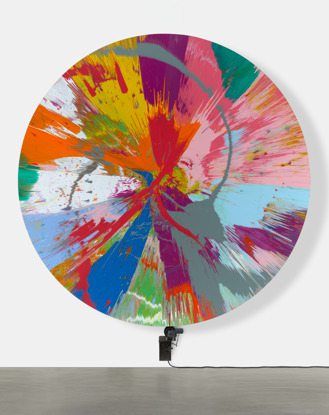
The galleries are organised into three sections: “With Every Question Comes A Doubt”, “We Live In Time” and “The Luxury Of Silence”.
In the foyer, before you enter the exhibition, you can already observe one of Hirst’s works, Myth. On one side, the sculpture depicts a pure white unicorn standing on a classical pedestal, representing sublime beauty.
From the other, the unicorn has been dissected, exposing its layers of muscles and tissues. By anatomically disassembling a mythical creature, Hirst reminds us that no matter how “sacred” a living being may seem, it is essentially made of bones and flesh, just like the rest of us.
Never-ending cycles
Though Hirst has a reputation for being a “shock jock”, what his practice truly focuses on are the complex emotions and desires with which humans confront life and death, such as the desire for eternal life, belief in transcendental forces, blind faith in medicine and science, and obsessive impulses toward collection and control.
Through his art, Hirst directs his attention to the very social structures that emerge from such human desires, suggesting that the values we often take for granted – religion, science, art, and even capital – are all founded upon remarkably similar structural foundations.
As you go through the exhibition, you’ll realise that Hirst’s works perpetually touch on this questioning of truth, reality and the systems that our lives are built on.

The first section, “With Every Question Comes A Doubt”, focuses on the artist’s early works, tracing how the artistic concepts and formal approaches central to his practice first took shape.
On view are collage works created in his late teens and early 20s as he experimented in search of an artistic language of his own, photographs taken during his teenage years that were included in his first solo exhibition, and early versions of two of his best-known series, the Spot Paintings (1986) and Spin Paintings (1999).
Together, these works offer insight into his enduring interest in death – consistently present throughout his oeuvre – as well as the development of his aesthetic inquiries into colour and form.
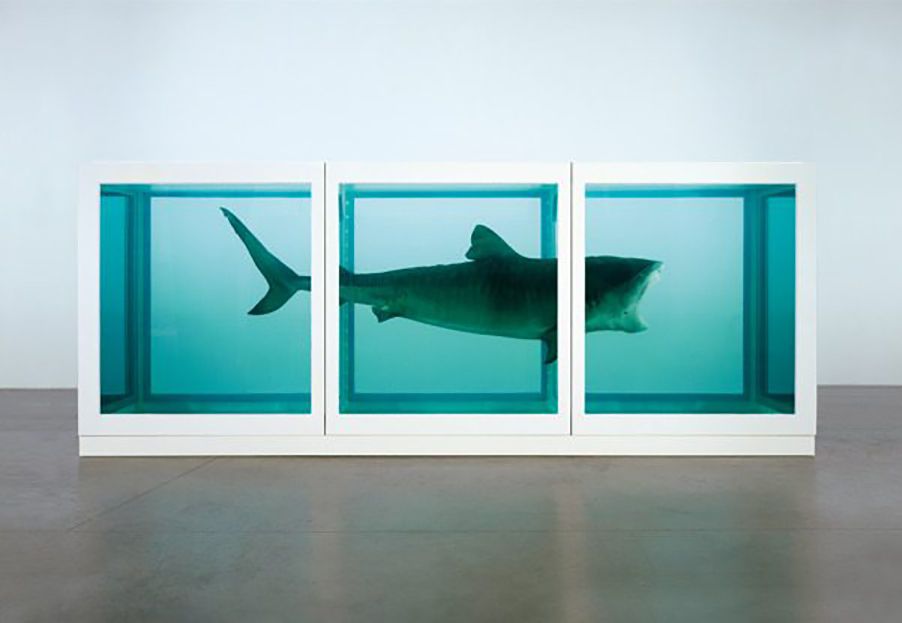
The following section, “We Live In Time”, presents large-scale installations employing the use of monumental glass vitrines.
Hirst frequently employs enclosed glass structures in his works, allowing visitors to see what lies inside while remaining unable to intervene. This device evokes the human condition of living life with death – a predetermined end – always ahead of us.
Perhaps Hirst’s most recognised piece – and the one used in all the promotional visuals for the exhibition – is The Physical Impossibility Of Death In The Mind Of Someone Living (1991), featuring a large shark suspended in a glass tank filled with formaldehyde.
The work – which is making its first appearance since it was last shown at the Tate Modern in London in 2012 – expresses the paradox that humans instinctively fear death, yet live without fully realising the reality of their own mortality. The piece drew plenty of criticism from animal rights activists when it was first unveiled.
One that’s more difficult to stomach is A Thousand Years (1990), composed of a severed cow’s head, fly larvae, and a device that electrocutes anything that comes in contact with it (referred to as an “insect-o-cutor”), visualising the cycle of life and death in raw and uncompromising terms.
Blind faith
The last gallery, “The Luxury Of Silence”, introduces works that explore the subtle and complex intersections between science, religion and art.
Born in Bristol and raised in Leeds, Hirst was raised in a Catholic household which informed his long-standing interest in the systems that shape human beliefs.
Observing that contemporary medicine and capital are increasingly replacing the authority once held by religion, Hirst visualises the human desires and obsessions underlying that faith in various ways.
Works using pills and medicine cabinets focus on the blind faith humans place in medicine and the desire for eternal life that underlies it. Their pristine surfaces and meticulously ordered arrangements reflect humanity’s obsessive desire to control life and fate.
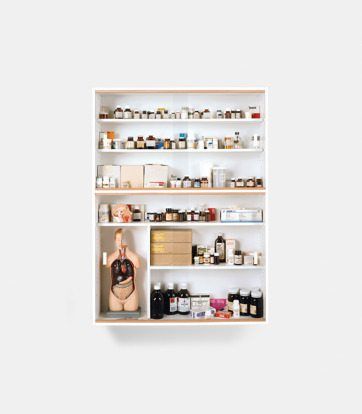
A highlight presented in this section is For The Love Of God (2007), a platinum cast of a human skull encrusted with diamonds and real human teeth, which reflects on humanity’s boundless desires and the transience of life. There was a constant crowd gathered around the display as visitors jostled for a closer look at the glittering representation of human hubris.
Also on view are the butterfly triptych Contemplating The Infinite Power And The Glory Of God (2008), composed of thousands of actual butterfly wings, and sculptural works such as Saint Bartholomew, Exquisite Pain (2007) and Anatomy Of An Angel (2008), which presented dissections of saint and angel.
Toward the end of the gallery, visitors encounter a reconstruction of Hirst’s Pharmacy restaurant. Opened in 1997, Hirst operated the restaurant in the cosmopolitan neighbourhood of Notting Hill, London for six years.
Encountered unexpectedly within the exhibition, this unusual environment prompts visitors to reflect on how the trust and authority we attribute to modern medicine are shaped by visual and spatial experience.
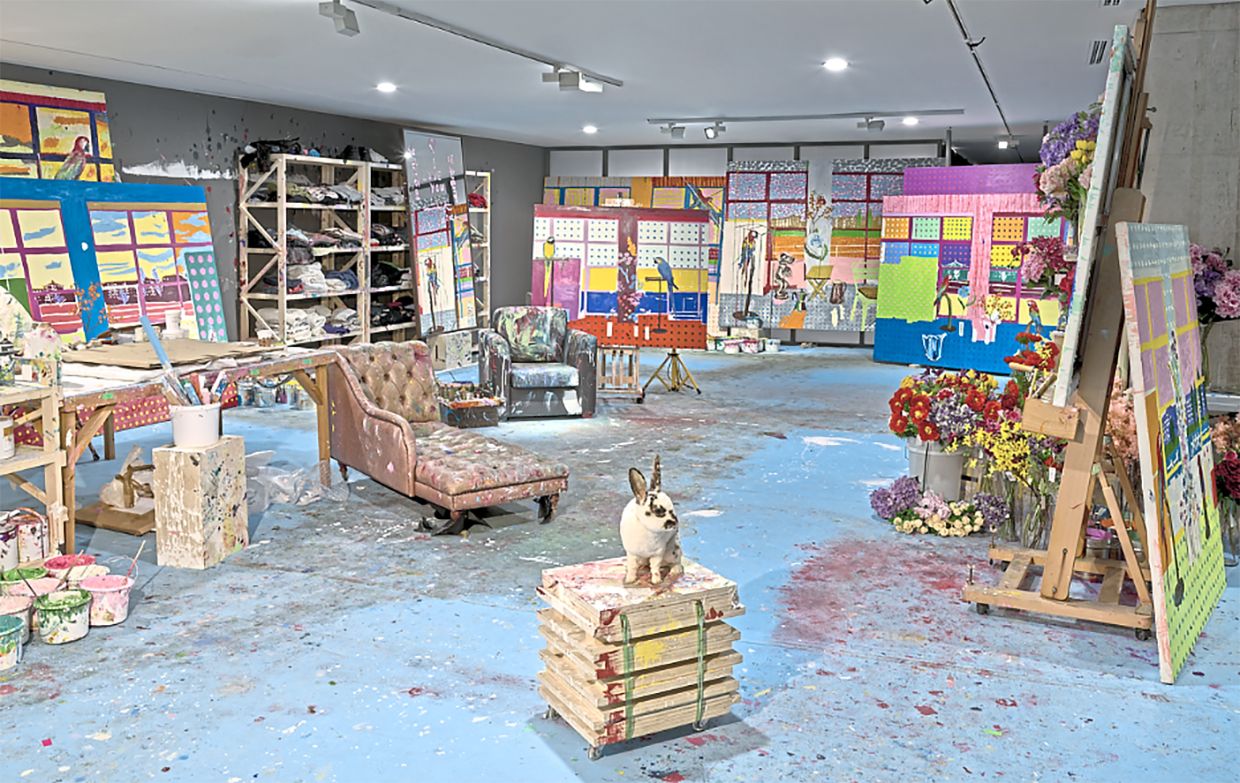
The final section presented in the MMCA Studio, “The Artist’s Studio: A Series In Progress”, recreates Hirst’s working studio in London.
Unlike conventional galleries that present finished works, this space focuses on the process of artistic creation itself, allowing the public a rare peek into where the artist’s ideas and actions come together.
Several previously unseen pieces from The River Paintings series are displayed here, some of them in an unfinished state, as the canvases were transferred directly from Hirst’s studio shortly before the exhibition opened.
Visitors are allowed to freely wander through the display, where his paintbrushes, paints, workwear and shoes – along with objects appearing in the paintings and a playlist personally selected by Hirst – bring the environment in which art comes into being vividly to life.