
At Kuala Lumpur Festival 2026's final weekend, an intimate and radical work arrives for its Malaysian premiere – one that invites audiences to look not only at dance, but at the body, memory and the shifting nature of tradition itself.
Following its world premiere in Singapore last year, Chapter 2 is set to take the stage at the Black Box, Aswara, Jalan Tun Ismail in Kuala Lumpur tomorrow and Sunday (May 30 and 31).
The show, created and performed by Pichet Klunchun, marks a significant point in the artist’s evolving practice. Known internationally for reinterpreting khon – Thailand’s classical masked dance rooted in the Ramayana – Pichet has long worked at the intersection of heritage and experimentation.
In this latest solo, he turns inward, revisiting his own artistic journey with greater vulnerability and clarity. For those encountering his work for the first time, Pichet occupies a distinctive place in the global dance landscape.
He began training in khon at 16 under master Chaiyot Khummanee, grounding himself in one of Thailand’s most codified classical forms.
Over the years, he has built a practice that bridges this tradition with contemporary performance, founding the Pichet Klunchun Dance Company in 2010 to develop new works rooted in Thai knowledge.
His contributions have earned international recognition, including the European Cultural Foundation’s Princess Margriet Award and honours from France’s Order of Arts and Letters – affirming his role as an artist who connects cultures while reimagining tradition.
Rather than presenting a conventional narrative, Chapter 2 unfolds as a process of reflection.
Following a sustained injury, Pichet found himself re-evaluating the physical precision demanded by khon. Movements once executed with certainty became something he had to renegotiate. Yet, instead of retreating, he began to see these constraints as openings.
“After the injury, my relationship with movement changed,” he explains.
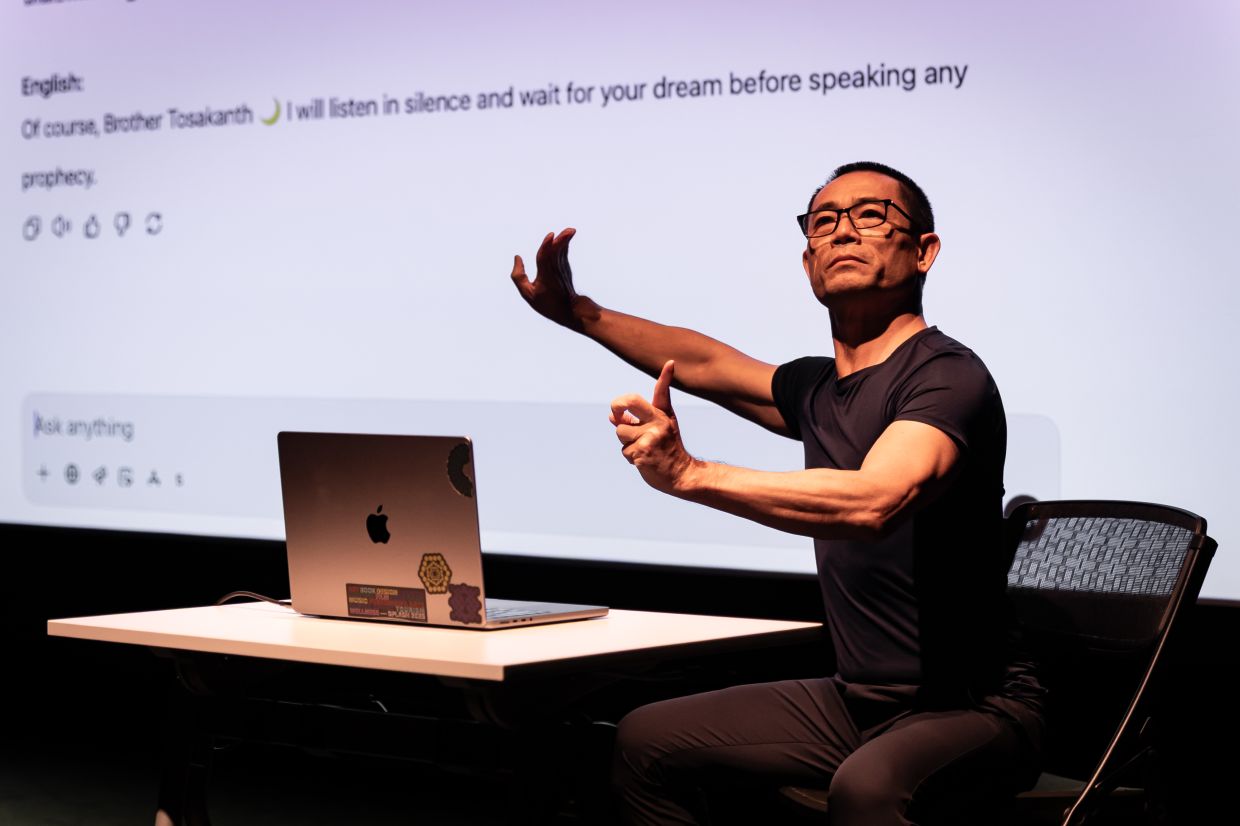
“I could no longer rely on the basic structures of khon with the same precision as before. Instead, I began to see those limitations not as boundaries, but as openings where traditional culture and technology can work together.”
This change in approach forms the core of Chapter 2. The performance brings together the discipline of classical form with contemporary tools, including the use of artificial intelligence as a creative collaborator.
What emerges is not a departure from tradition, but an expansion of it – one that questions authorship, the body and the evolving role of the performer.
On stage, the familiar story of the Ramayana is not retold in its entirety. Instead, it becomes a framework for dialogue.
Pichet engages in an ongoing exchange – with the AI system, with the inherited vocabulary of khon, and crucially, with the audience.
The result is a work that resists fixed interpretation.
“What Chapter 2 presents is not a traditional khon performance,” says Pichet.
“The story becomes a shared dialogue between myself and AI, with the audience joining as part of the conversation.”
For Kuala Lumpur audiences, the resonance may feel immediate.
In a city where multiple cultural traditions intersect and evolve, Chapter 2 speaks to broader questions of identity and continuity.
Pichet himself acknowledges this connection, describing the presentation at the festival as deeply meaningful.
“The piece is a personal exploration that also speaks to universal questions about the body, tradition and change,” he says.
“It invites audiences not only to witness my journey, but also to reflect on their own possibilities, potential and identity.”
Behind the scenes, producer Sojirat Singholka plays a key role in ensuring that the work retains its essence as it travels. Her approach is deliberately measured – maintaining the intimacy of the solo while allowing it to connect across contexts.
“I make sure the work delivers exactly what Pichet wants to say,” explains Sojirat.
“He has full freedom in his artistic choices, and I support whatever he requests during the creation process. I also provide a dramaturg who understands his vision and history, so they can work closely together and guide the piece in the right direction. My role is to protect its introspective and physically grounded essence while keeping the production simple and easy to tour.”
Sojirat adds that instead of adapting to each venue, she usually provides a clear technical rider so presenters provide the proper stage size needed to maintain the intimate atmosphere with audiences.
“I collaborate with local partners to help audiences connect with its themes and take care of Pichet’s wellbeing so he can sustain the intensity of the solo – balancing fidelity to his vision with flexibility so the work resonates internationally without losing its integrity.”
This balance is evident in the work’s design. With Pichet himself responsible for set and lighting, the staging remains spare, drawing focus to the body and its shifting states. Collaborators including dramaturg Fu Kuen Tang and stage manager Kornkarn Rungsawang support the work’s structure, ensuring that its ideas remain accessible without diminishing its complexity.
What ultimately defines this solo is its sense of openness. It does not present answers, nor does it seek to resolve the tensions it raises.
As part of an additional KL Festival programme appearance, Pichet will join a day of conversations (free admission, register here) on the arts, creativity and AI at Limapulo Terrace, Jalan Tong Shin tomorrow (May 30) at 10am, exploring how technology shapes power, memory and the societies we create. He will also be joined by artist-researcher Eddie Wong for a discussion on artists engaging with AI.
Chapter 2 plays at the Black Box, Aswara, Jalan Tun Ismail in Kuala Lumpur on May 30 and 31. More info here. The Kuala Lumpur Festival is an annual arts festival that aims to revitalise downtown Kuala Lumpur through a diverse range of programmes, featuring both local and international talent.