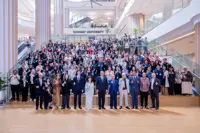
At the recent Asia ESG Summit 2026 hosted by Star Media Group, smart city stakeholders, including representatives from the government, green rating agency and design practice, gathered for a roundtable discussion themed “Building Smart and Sustainable Cities: Governance, Investment and Urban Resilience in Malaysia”.
The participants included Housing and Local Government Ministry deputy secretary (urban sustainability) Dr Sharul Nizal Sharippuddin, Green Building Index chief executive officer Sarly Adre Sarkum, Urbanice Malaysia board member Norliza Hashim, Veritas Design Group principal Alif Arif Iskandar Abd Wahab, REI International Holding Sdn Bhd chief executive officer and co-founder Dr Daniele Gambero, Malaysia Smart Cities Alliance committee member Mohamed Shajahan Mohamed Iqbal, BSI Malaysia operations, quality and compliance – assurance director Azrul Wan Azizan.
StarProperty senior content manager Joseph Wong moderated the conversation, which flowed candidly from the problems they identified and the solutions they proposed.
Here are excerpts from the roundtable:
Norliza: Property developers need to scale up their actions – not in terms of what they have built, but the quality of the built environment – and measure what are the impacts.
They are probably recording their ROI (return on investment), but what is their SROI (social return on investment)?
Sharul Nizal: If I am a property owner, I would like my neighbourhood to be safe, comfortable, and free of congestion and pollution. At the ministry, we guide and facilitate through our initiatives to achieve these.
One of our flagship programmes is Smart City Recognition Programme, assisting the local governments to achieve a smart city status, at least the basic level, because we are aiming to become a smart nation by 2040.
District councils, municipal councils and city councils have different capacity and financial resources, and we try to assist them by providing grants, handholding them and giving guidelines.
For developers, we have the Smart Township Recognition Programme to promote and stimulate smart developments.
The National Blueprint for Smart City will be launched next year as a guidance for all stakeholders, especially the local governments, to implement smart cities.
Sarly: Seventy-five local authorities in Malaysia have already claimed their smart city ratings, but how many people actually know that they are living in smart cities?
What do smart cities actually serve? Do they truly serve our liveability?
I feel that a lot of approaches for smart cities are for the sake of technologies, rather than for the sake of liveability and humanity. If we treat smart cities like infrastructure, then we are not serving our real stakeholders, the people.
Alif Arif: The most sustainable cities are 15-minute cities, which are walkable and have all basic necessities within 15 minutes of walking. Some cities are smart and sustainable, but many people then drive about one or two hours to work, and that in itself becomes unsustainable with the carbon energy, energy and time spent, and mental stress.
Making sure that the culture prospers is also a key thing. We need to have a city that’s not just for work, but also has arts, schools and studios.
Azrul: ESG has been a hot topic for us as a certification body. When it comes to ESG activities that have been implemented by the public and private sectors, including property developers, a lot of focus is on the governance of data and how the data is being collected, stored and distributed.
Measurable objectives, change management, policies ... these are already written in ISO standards.
We have success stories of providing our support to organisations towards this smart city initiative.
Bottomline and liveability
Mohamed Shajahan: Property developers are driven by bottomline. Lower carbon emission is never an incentive for them.
We need to have a game changer. Property developments cannot keep getting denser in urban areas. We should keep people where they are – it’ll be more sustainable and incur less transport and carbon costs. It needs to be more liveable and peaceful, while encouraging a social life.
Sarly: What we see now is the bottom line converging with liveability standards. Currently, property prices in the inner city, such as areas near Kuala Lumpur City Centre, are dropping, while those of townships in the outskirts are appreciating because they have implemented the right approach to technology and planning.
Gambero: I agree with the point on townships in suburban areas. However, they cannot be only (residential) townships; they have to have an economic driver which allows the resident to work where they live and live where they work.
Otherwise, these people will be condemned to a lifetime of driving back and forth (between city centres and suburbs) for four hours every day.
JB and KL
Norliza: Johor Baru’s diversity index is 0.78, so it’s very diverse in terms of land use, but its GDP (gross domestic product) is lower than some of the nearby city centres, with an average income of RM4,000.
Instead of service apartments, we want the property developers to bring in high quality jobs. They need to understand if they are operating in the city, they should be contributing to making the cities better. They should be thinking about how they are building cities in a much more responsible way.
Gambero: Cities around the world occupy less than 3% of the world land mass, but host 60% of the world population. Klang Valley had 4 million people in 1980 and now we are at more than 10 million because people are moving in from other areas.
Cities consume 75% of the world’s energy and produce 70% of energy-related greenhouse gas emissions.
Do we need Bandar Malaysia? Why don’t we talk about Bandar Malaysia Park? A green lung for Kuala Lumpur, like the Central Park in New York. I don’t think Kuala Lumpur needs another high-rise building, shopping mall or office tower.
Use of technology
Alif Arif: Digital twin can capture all these topics that we are discussing – traffic jam, sewage network and density – into one software, which we can use to make predictions and make better decisions.
(Note: A digital twin is a virtual city model that allows real-time simulations to be used for more effective urban planning and faster emergency responses.)
Sharul Nizal: When people look at other cities, they see all sorts of advanced technology and want the same in Malaysia, but we have a different set of dynamics, politics and culture.
The more technology you want, the more money you have to pay. Local governments have to take care of other priorities as well, such as the drainage systems, roads and endless floods.
We are open to suggestions, such as cost sharing for a command centre, which is very expensive.
Mohamed Shajahan: Technology for smart cities has to start with first getting the base numbers. Without it, you cannot build any model or situational awareness looking forward.
We can simulate with digital twin. Before approval is given, we look at density, whether people are working here, where the housing is and where the roads are.
Gambero: Every time a new office tower comes up, it is filled up in two, three years, leaving old towers empty and unused, and somewhere, affordable homes are not delivered.
So there is a big need to look into proptech, which covers the planning stage, construction stage, transaction stage ... and the whole lifespan of the built environment.
Smart cities for B40
Norliza: There was a programme to fit all our affordable housing with Internet connectivity, so that’s done, especially in Kuala Lumpur.
When we talk about access, we also need to talk about literacy. These two needs to come together.
When we did a digital literacy workshop in Penang about two years ago, we thought nobody would come, but it was full. A lot of them who attended were traders and senior citizens, and some worked in municipal services.
Sarly: Some of the approach needs to consider the low hanging technology, some of which are free.
The government needs to understand the technology and use the right kind to move the needle for communities, rather than partnering with companies which have their own capitalistic agenda.