AS THE world’s second-largest producer of palm oil, Malaysia has over 275,000 independent smallholder farmers that contribute toward the industry.
However, unlike organised smallholders, these independent farmers manage smaller plots of land and have limited access to knowledge, technology and guidance.
Globally, smallholders contribute over 40% of the world’s palm oil supply, yet they often face exclusion from formal supply chains due to barriers in certification, traceability, and access to knowledge.
In Malaysia, independent smallholder (ISH) farmers account for 17% of palm oil producers, and their inclusion is critical not only to national economic resilience but also for global climate, food security, and ESG goals.
These issues usually involve grassroots initiatives as well as advocacy and policy leadership, and collaboration among multiple stakeholders.
To address this gap, the Center for Sustainable Smallowners (CSS) was created as a collaboration between Asia School of Business (ASB) and Procter & Gamble (P&G) to deliver the P&G Smallholder Program for ISHs in the oil palm industry.
The P&G Smallholder Program was further catalysed when Temasek Foundation partnered with the ASB to support the programme.
It emphasises on empowering independent oil palm smallholders in Malaysia through sustainable farming practices, certification and community development.
By focusing on ISHs at the core of its sustainability efforts, the programme has gradually established an inclusive ecosystem that yields measurable outcomes aligned with global ESG priorities.
Those include fostering social equity and community resilience (Social),
encouraging environmentally responsible practices (Environmental), and promoting transparency, traceability, and good governance (Governance) within the smallholder ecosystem.
It also advances eight of the United Nation’s Sustainable Development Goals (SDGs, 2, 5, 8, 10, 12, 13, 15 and 17) through a structured approach, that is the CSS Sustainability Journey, that aligns with the RSPO (Roundtable 2 for Sustainable Palm Oil) Impact Areas, whose initiatives focus on a triple-bottom-line approach of People, Planet and Prosperity.
The programme has helped create a positive impact on a community of ISH farmers in Johor. Within its five-year journey, it has achieved multiple targets, with 892 ISHs being certified and 252 learning farms established.
It has also published several research manuscripts, posters and articles. Furthermore, diffusion initiative is strengthened with new collaborations and modules.
Transforming programme outcomes into impact
Recently, the centre published its 2025 Impact Report structured around five core impact areas: community empowerment, livelihood improvement, environmental sustainability, sourcing responsibly, and thought leadership and advocacy.
It demonstrated how the CSS Sustainability Journey has transformed policy ambitions into measurable grassroots outcomes. Among the notable achievements include:
> Livelihood gains: 892 ISHs have achieved RSPO-certification, with some achieving an average yield improvement of 20% to 25% over periods of two to three years, and up to 35% from three to four years. Collectively, 407 certified farmers have received earnings amounting to US$68,175 in sustainability-linked premiums from 2021-2024.
> Community empowerment: The programme has helped empower the
community in Johor through the establishment and support for PERTANIAGA, an ISH-led association, which now includes 892 members with 38% of leadership roles held by women. The association serves as a model for inclusive and effective grassroots governance.
> Environmental impact: Through waste management, peatland monitoring, and chemical tracking, CSS supported over 1,100 farms to implement Good Agricultural Practices aligned with RSPO and NDPE policies.
> Traceability and digitalisation: 1,106 certified farms have been traced and verified as part of the programme, improving transparency and positioning smallholders for compliance with global regulations such as the EU Deforestation Regulation (EUDR). CSS is developing an application to advance digital traceability down to the plantation level. This is being done in collaboration with collection centres in the district.
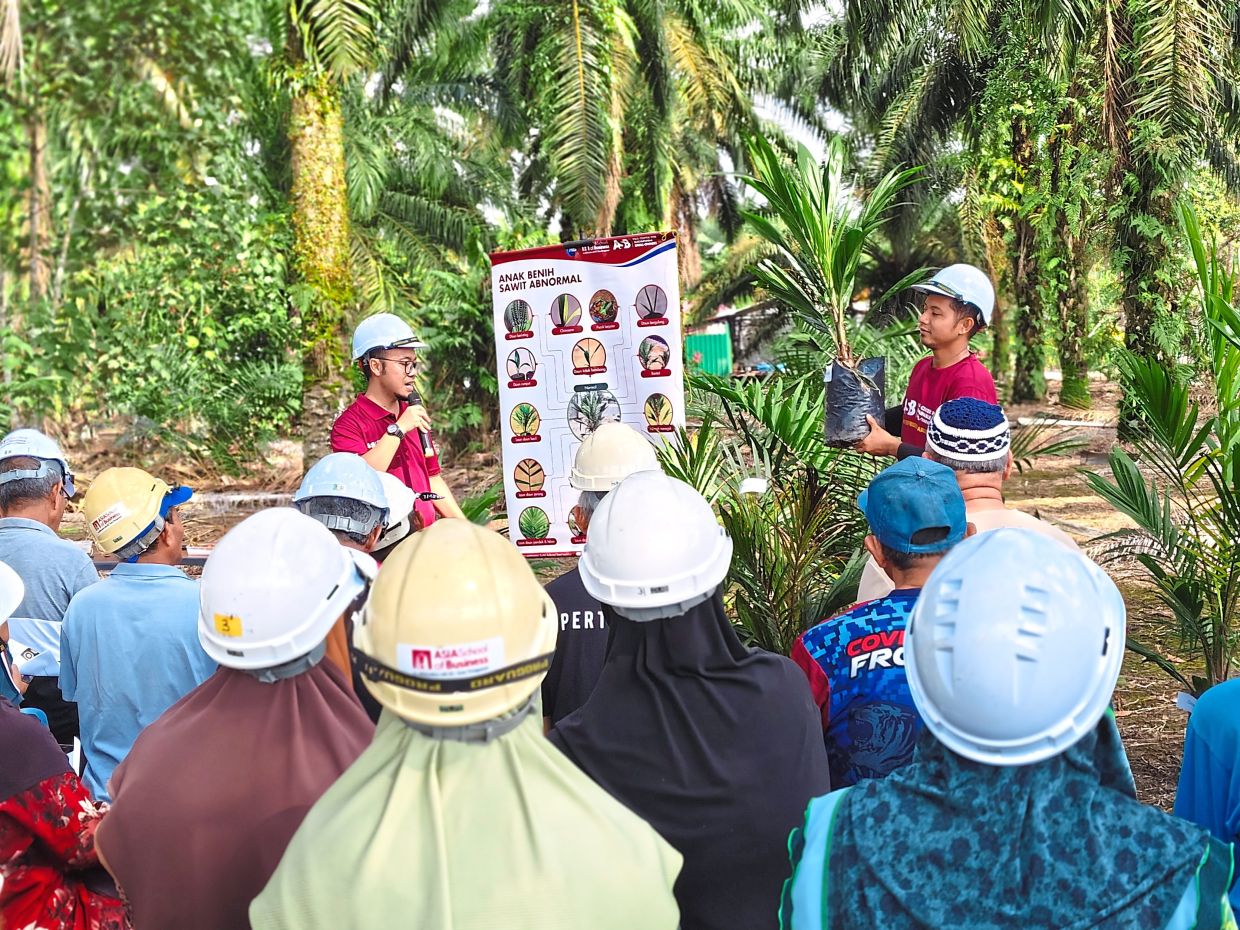
> Knowledge leadership: CSS has contributed to the global palm oil knowledge base through research, articles, curricula and publications. In high demand is the centre smallholder awareness training on Good Agricultural Practices, which has seen over 4,317 farmers trained over three years. Additionally, two simple and informative guides based on the programme’s successful practices and research findings have also been published, further adding to the body of knowledge available to smallholders.
Transforming outcomes into impact
As a response to the report, P&G Chemicals Sustainability Program director Francis Wiederkehr said, “At the heart of the 2025 report are stories of resilience and transformation—from Encik Rosli, a marathon-running farmer whose yield outpaces national averages, to Puan Hamisah, a retired civil servant championing women in agriculture. These personal journeys highlight how knowledge, support, and inclusion can unlock leadership and generational change.”
“This report highlights how consistent support and collaboration can help smallholders build more resilient livelihoods while adopting better practices,” said Temasek Foundation’s Climate and Liveability head Heng Li Lang. “We are pleased to support an approach that not only uplifts smallholders, but also contributes to reducing the environmental impact of palm oil production in the long term.”
While ASB chief executive officer, president and dean Prof Joe Cherian said: “This year’s report once again underlines the importance of academic-industry collaboration and shared responsibility in uplifting underserved communities. It demonstrates how certification—whether RSPO or national sustainability standards—can promote both genuine environmental stewardship and economic resilience among smallholders. We are pleased that this long-standing collaboration between ASB, P&G and Temasek Foundation continues to deliver high impact outcomes.”
CSS director Prof Asad Ata said, “We celebrate certificates, but more importantly, we celebrate the change they unlock for livelihoods and communities.” He added that this year’s report reflects the broader impact of certification, not just on farmers, but their families, communities and the environment.
Through CSS, ISH farmers are today advocates of sustainable and good agricultural practices, from waste and peat management to an improved nutrient management within their respective circles. Asad added that the centre aspires to scale this inclusive model across other regions in Malaysia by collaborating with like-minded partners and sponsors.