
ERM, in collaboration with Bursa Malaysia, CEO Action Network (CAN), and the World Business Council for Sustainable Development (WBCSD), organised a breakfast discussion session among sustainability experts on June 17.
With the main topic on “Navigating the Crossroads: An Executive Guide to Sustainability Impact and Value Creation,” the event, which was held at the Conference Hall in Bursa Malaysia, saw senior business leaders and sustainability professionals gathered for this discussion.
Bursa Malaysia chief executive officer and CAN Interim chair, Datuk Fad’l Mohamed in his opening remarks said he hopes the event can “support conversations of how businesses can unlock truly transformative impact and create enduring value creation through sustainability.”
Malaysia’s target in green investments by 2030 translate into tangible investment opportunities for businesses to step up and play a meaningful role in addressing sustainability needs.
“As we look ahead in this journey, it does call for all of us to look beyond just incremental adjustments and to have the ability to think and take a more systemic approach.
“Let us explore how we can fortify our business models to navigate volatility with greater resilience. By collaborating as an ecosystem, we can collectively build a stronger, more resilient, and truly sustainable Malaysia.“
Adapting to global regulation
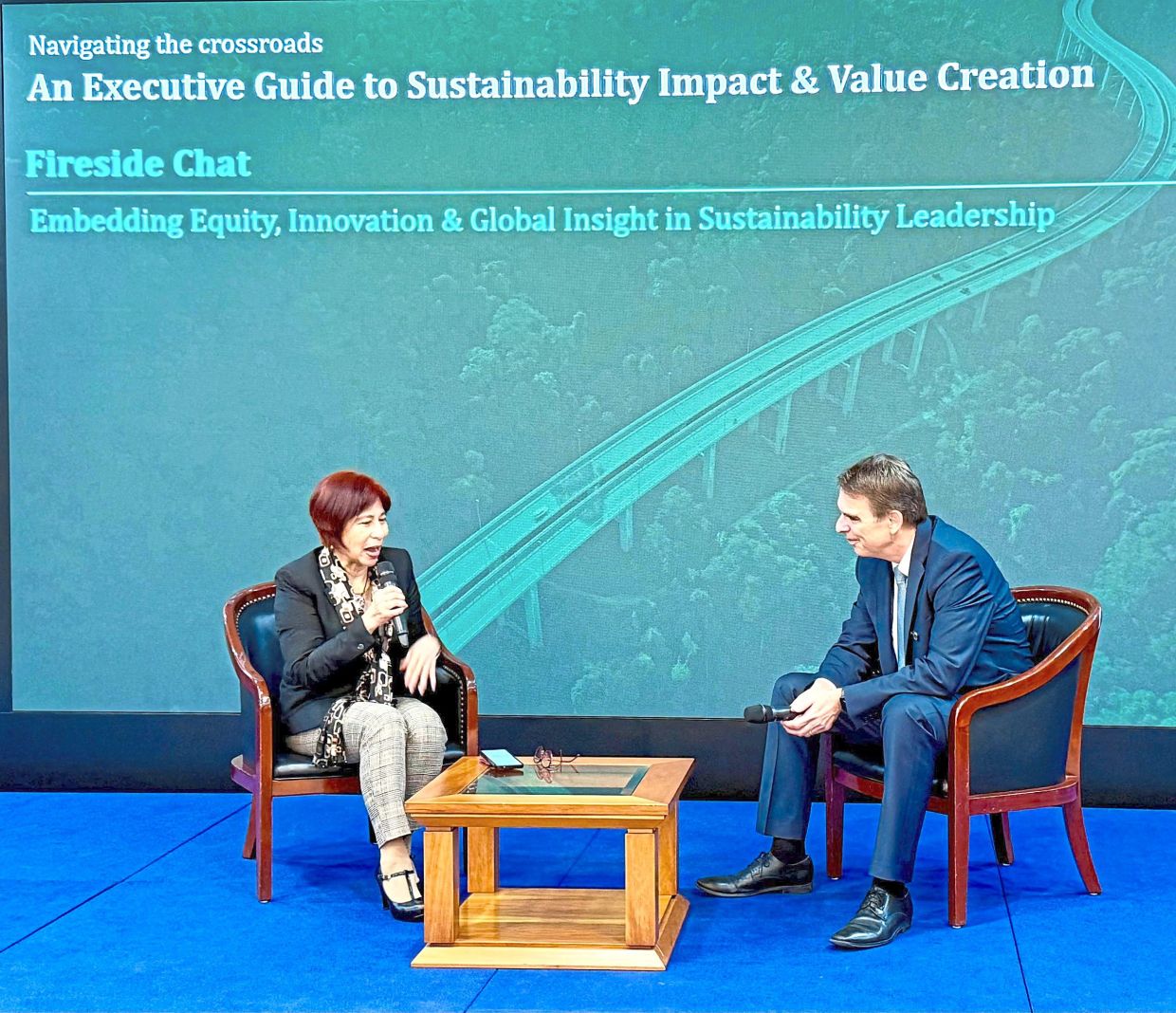
In the “fireside chat” session, IOI Group chief sustainability officer Dr Surina Ismail quizzed ERM group CEO Tom Reichert on several topics related to “Embedding Equity, Innovation and Global Insight in Sustainability Leadership”.
Surina asked how companies can operate when sustainability regulation accelerates within the region while it slows in the United States.
“How can companies that operate in both geographies navigate diverging regulatory standards while still creating value from their sustainability efforts?”
Reichert pointed out that the situation has been nonlinear for some time and that care has to be taken when extrapolating using single datapoints.
“If you extrapolate after Glasgow, you’d think we’re going to run faster in 2050. And if you look at the situation now, if you extrapolate that all over with sustainability and probably none [of these scenarios] are a true reflection of the journey.”
He also reminded that one of the reasons targets are set in the distant 2050 timeline was to allow industrial systems to change gradually, from energy to production, and more.
“Many of these targets depend on capital investments that take 10, 20, 30 years,” he added.
Reichert also believes that solid regulatory frameworks are essential, although he noted that regulation has very different meanings in different parts of the world.
“You operate in the Asean system quite a lot. And while I’d say Malaysia should do what it feels is the most appropriate path for the country, figuring out how to operate in ecosystems that are relevant for you in geopolitics and economics is an important part.
“Because if you want trade moving backwards and forwards and everything has different regulations, it’s going to be problematic for people to operate.”
Surina asked if geopolitics are going to be the determinant on how companies operate, Reichert advised that companies should first figure out how to “play” in the world before integrating the sustainability piece.
“Sustainability is an element of how you compete, it’s not a separate thing [from the business].”
He also said that most organisations are finding ways to integrate sustainability into their business. And while there is a need to educate CEOs and board members, sustainability professionals should conversely understand what drives the companies they work in.
He opined that sustainability leaders should understand the importance of returns of investment for the business they are in, as that forms the basis of how companies operate.
ESG survival guide
In next panel discussion on the topic of “The Sustainability-Business Survival Strategy” featured Cenviro managing director Dr Johari Jalil, World Business Council for Sustainable Development (WBCSD) Asia Pacific executive director Joe Phelan, PETRONAS Chemicals Group chief sustainability officer Gretchen Govoni, ERM Asia social performance lead Rutuja Tendolkar, moderated by regional CEO Nat Vanitchyangkul.
Opening the discussion with a question from Nat on what the current tone among business leaders concerning corporate sustainability and energy transition, Govoni declared that sustainability is not dead, in fact it is accelerating.
“We need to shift from a nice to have, a reporting obligation, to sustainability as a growth driver,” she said, quoting examples of employing used cooking oil as aviation fuel and extracting biogas from unusual sources.
Johari’s observation was that there is an intensity of the government towards veering people to move towards recycling.
“It is [an] established aspiration of the government towards moving disposal or rather looking at 40% of waste to be recycled,” he said, but, among other aspects, customer understanding on how to embrace sustainability is important.
Rutuja, who attended PETRONAS’ Energy and Nature Forum and Energy Asia, noted that while industry stakeholders had top-of-mind concerns such as continued geopolitical tensions and global trade dynamics, a majority of the energy transition conversations were ultimately grounded in hope and with the intent to operationalise sustainability.
“People were keen to provide examples instead of rhetoric, and there was a perceptible spirit that having these conferences and forums should catalyse actions.”
She also noticed that companies have to realise that sustainability needs to intersect climate, nature and people.
“That is making them relook at their goals, at the strategy that they’ve set to see what can be done differently.”
Phelan noticed that while businesses operate in a world where everything has gone transactional, they understand that Nature won’t do deals—it just is.
And what we do decides the state of nature. “That’s the dichotomy in which companies and our members are operating.”
He also mentioned that companies are navigating a difficult time with trade uncertainties and lastly the disruption that artificial intelligence brings to the table for businesses and sustainability. For him, having a business case is critical for what companies are doing in sustainable businesses.
Govoni mentioned when it comes to a decarbonisation strategy, it pays to collaborate with other organisations.
“You get more entities connected to solve their problems, their challenges.”
Johari shared his viewpoint that embracing sustainability cannot simply come from an economic point of view, because it’s not sustainable. Instead he felt it should “come from a very in-depth understanding.”
Phelan however disagreed, emphasising that the “business case” for sustainability is essential, citing how circular economy approaches are allowing land sector companies to get into the sustainable fuels sector.”
Rutuja then was asked to define the term “just transition”, which she admitted was something they are still “figuring out”.
However she pointed out the pace and scale energy transitions occurring in Asia have caused systemic inequalities in certain marginalised communities.