
How green data centres power Malaysia’s digital future
AS the country accelerates its ambitions to become Asean’s leading digital hub, the data centre sector faces a critical challenge: balancing rapid growth with environmental pressures.
In response, Telekom Malaysia (TM) is placing sustainability and sovereignty at the core of its data centre growth strategy.
With new builds, increased renewable sourcing and direct ownership of its data centres, TM aims to create responsible digital infrastructure, with an emphasis on secure, low-carbon and proudly “Made in Malaysia” assets.
Risks and opportunities
The country’s data centre market is forecasted to grow to RM19.27bil at a compound annual growth rate of 20.22% between 2023 and 2028.
This rapid trajectory, however, is accompanied by increasing environmental and operational challenges.
One primary concern is the escalating power demand. Malaysia’s data centre consumption is estimated to surge from 9 Terawatt-hours (TWh) in 2024 to approximately 68 TWh by 2030.
This increase could account for over 50% of the national renewable energy capacity by 2035.
Despite these pressures, opportunities for green energy integration exist.
Global energy think tank Ember estimates that up to 30% of Asean data centre demand could be met by solar and wind by 2030.
This outlook underscores Malaysia’s own efforts to transition to cleaner energy sources.
Smarter infrastructure
TM’s data centre strategy provides a framework for Malaysia’s digital future that is secure and driven by innovation, bringing together sustainability, sovereignty and scalability.
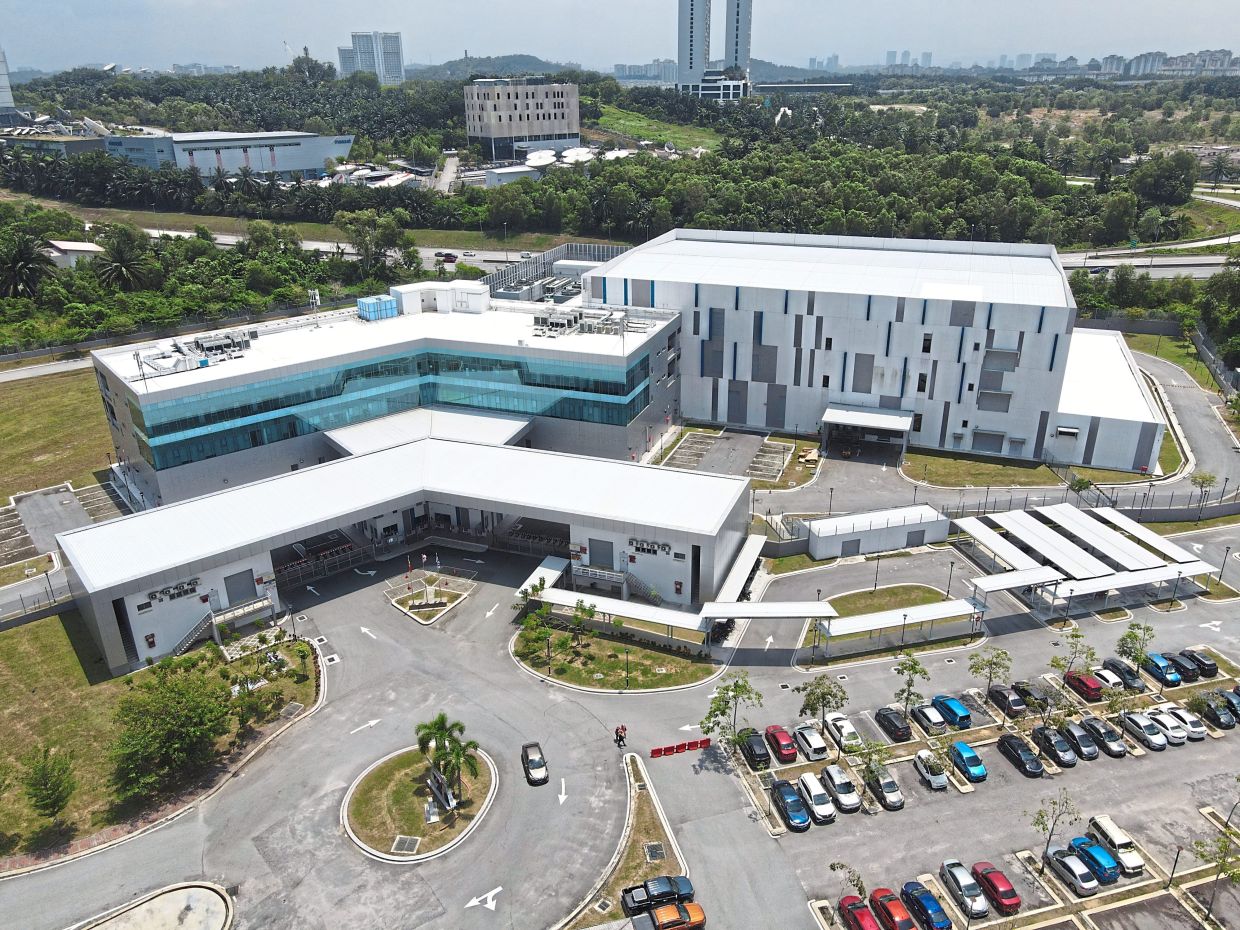
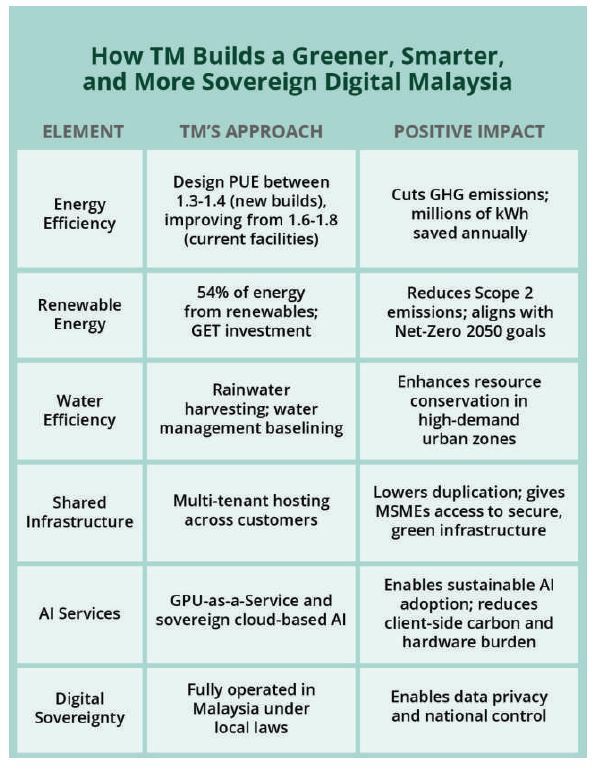
Its newest facilities, including the TM Nxera Data Centre in Johor, and expansions to the Klang Valley Data Centre (KVDC) and Iskandar Puteri Data Centre (IPDC), are designed for power usage effectiveness (PUE) between 1.3 and 1.4, improving from 1.6-1.8 presently.
PUE gains at this scale translate to millions of kilowatt-hours (KWh) saved annually, reducing both emissions and operational costs.

In 2024, 54% of TM’s data centre energy came from renewable sources, supported by the Green Electricity Tariff (GET).
TM also introduced measures like rainwater harvesting for non-essential use such as irrigation, and better water management baselining.
These efforts were further supported by TM’s globally recognised certifications: EnMS (Energy Management System), EMS (Environmental Management System), LEED Silver (Leadership in Energy and Environmental Design) and TIA-942 (Telecommunications Infrastructure Standard for Data Centres).
Digital sovereignty
Beyond environmental considerations, the principle of sovereignty and shared resources is equally crucial to TM’s data centre strategy.
A key aspect of this approach is that its data centres are developed, owned and operated within the country.
This ensures data remains under national jurisdiction, and is governed by local laws and cybersecurity regulations.
TM employs a shared infrastructure model to consolidate hosting needs across multiple customers, reducing energy duplication and equipment waste, while addressing the unique needs of hyperscalers at the same time.
Consequently, enterprises and hyperscalers gain cost-effective access to green and secure infrastructure, without having to build and manage their own facilities.
TM also enables businesses to digitally transform sustainably and securely through its growing edge computing network.
Its network of localised data centres and edge facilities reduce latency for real-time applications, such as smart city controls, autonomous vehicles and industrial analytics, enhancing performance while optimising bandwidth and energy use.
Additionally, TM’s GPU-as-a-Service architecture allows customers to access high-performance artificial intelligence (AI) computing without increasing carbon footprint through individually owned high-energy graphics processing units (GPUs).
The company’s sovereign Cloud Alpha Edge platform also powers enterprise AI tools that optimise operations, reduce inefficiencies and generate real-time insights, while safeguarding data sovereignty through local hosting and compliance.
This ensures that cricital data and AI workloads are governed and processed within Malaysia’s borders.
This also supports environmental, social and governance (ESG) reporting, lowers carbon impact and ensures compliance with local data protection standards, which is valuable for regulated and export-oriented businesses.
Catalyst for transformation
The nation’s rise as a data centre destination will hinge on its ability to balance digital expansion with climate responsibility.
TM’s group chief executive officer Amar Huzaimi Md Deris said that the company’s efforts align with national aspirations to elevate green technology and climate resilience.
“Amid the country’s efforts for clean energy and ESG integration, our data centres address not only corporate goals but also national emissions and resource-efficiency objectives,” he said.
“By embedding sustainability and sovereignty into our infrastructure and services, we are helping Malaysia—and our customers—grow responsibly, securely and with long-term resilience in mind.
“Our data centres reflect a ‘build local, scale global’ philosophy that reinforces the country as a regional hub for digital and ESG transformation.
“With the completion of our KVDC and IPDC expansions this year, TM’s aspiration of becoming a digital powerhouse by 2030 is taking shape—delivering climate-aligned, locally governed digital infrastructure for Malaysia and beyond.”