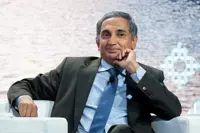
TOKYO: The Bank of Japan (BoJ) will probably raise its benchmark interest rate next month, validating widespread market speculation, and follow up with another increase as early as January, according to a former BoJ board member.
As of Monday afternoon in Tokyo, traders were assigning a roughly 80% probability of a rate hike when the board delivers its next policy decision on Sept 18.
With the yen still weak even after US- Japan coordinated intervention, a decision to hold settings steady could reignite a sell-off of the currency, raising the risk of faster inflation due to costly imports, Seiji Adachi, who served on the board until March 2025, said in an interview.
“The BoJ is pretty much boxed in. Markets have almost fully priced-in a hike,” Adachi said.
“If the BoJ doesn’t hike, the yen could weaken sharply again.”
The yen was trading around 159.20 per US dollar on Monday afternoon in Tokyo, not far from the psychologically key level of 160.
US Treasury Secretary Scott Bessent has noted the need for policy action to follow the currency intervention, expressing his hopes that governor Kazuo Ueda will move rates higher.
That input from Bessent gives Ueda a “nice opportunity” to raise the key rate by making it harder for Prime Minister Sanae Takaichi’s pro-stimulus government to object to a move.
“Bessent has repeatedly indicated the BoJ is the next one to move,” Adachi said.
“Given that, the government can’t say ‘stop it’ to the BoJ.”
Adachi said Japan’s inflation is strong and the BoJ is likely to keep raising rates after the expected increase in September.
“My feeling is that the BoJ will aim to move again in January,” Adachi said. “The chance is becoming extremely high for the rate hike cycle to continue for a while, going beyond around 1.25% or 1.5% – the level once considered the terminal rate for this cycle,” Adachi said.
Pricing in the overnight index swaps market is more or less consistent with Adachi’s view, indicating the rate will rise to 1.25% by September and then increase another 25 basis points by January.
Such market expectations ease the BoJ’s burden for communications to factor in a looming change, Adachi said.
“The easiest approach is to have talk of a rate hike emerge beforehand in the market and then, in a sense, gradually lay the groundwork for that action themselves,” Adachi said.
“That way, the BoJ avoids attracting too much criticism. If inflation were clearly low, they’d be criticised for doing that, but that’s not the case at all.”
Japan’s core inflation accelerated to 1.8% in July, according to government data last week.
The second straight monthly pickup convinced many private sector economists that the Middle East conflict is starting to drive inflation in the nation, which is heavily reliant on imports for energy and food.
Adachi forecasts inflation could accelerate to a pace exceeding 2.5%.
The former board member, who is also an economist, said that a follow-up hike could come in December, but that would seem a little “too fast”.
Assuming a move in September, another move at year-end would represent the fourth increase in just 12 months.
In a simple calculation using the Taylor rule, Adachi sees the potential need for the rate to rise to around 2.75%.
In that case, the BoJ’s policy rate could be sitting at 2% or a little higher by the end of next year, he said.
That’s higher than the median economist forecast of 1.5% in a Bloomberg survey.
A key concern is sluggish consumer spending, Adachi said.
Data earlier this month showed that personal consumption fell by 0.1% from a year earlier in the April to June quarter, despite a one-off boost from factors including front-loaded demand for air conditioners ahead a change in regulations.
“Consumer spending is lacking momentum,” Adachi said.
“A key point to watch is whether the BoJ can keep raising aggressively if consumer spending remains weak due to the hit from higher inflation and higher rates.” — Bloomberg