TECHNOLOGY firm THMY Holdings Bhd
’s 400% surge in its share price since its initial public offering (IPO) last October is one of its kind on Bursa Malaysia.
Today, the stock trades at a historical PE of 111.1 times, making it the most expensive technology stock on the local bourse.
On a forward basis, and going by the one research house that covers the stock – Affin Hwang Investment Bank – THMY trades at 58.6 times its financial year 2027 earnings.
What exactly does THMY do that got investors going gaga over it?
It could be that it has one of the top three global hyperscalers as its client, which contributes about 40% to 50% of the group’s revenue. Word on the street is that it is Google.
THMY manufactures testers for the global hyperscaler’s tensor processing units’ before deployment in data centres (DC).
TPU is a type of application-specific integrated circuit, which is a custom built chip designed for a specific task – in this case, accelerating artificial intelligence (AI) workloads.
THMY sits within the midstream to downstream segments of the electrical and electronics manufacturing value chain, operating at the testing and validation stage.
The group designs, builds, and installs customised testing machines for companies to test printed circuit boards (PCB) before final deployment.
With the rise of AI, cloud computing and high-performance networking, the complexity and volume of testing required in PCBs has increased.
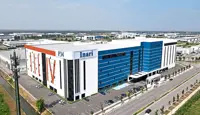
THMY is expanding its manufacturing footprint with plans for a new 300,000 sq ft facility in Batu Kawan, Penang.
THMY had initially planned to build an 88,000 sq ft facility, as outlined in its IPO prospectus.
However, chief executive officer Ooi Can Nix tells StarBiz 7 the rapid advancement across the tech space has prompted the company to revise its expansion plans.
“Technology is moving very fast and the requirements are becoming increasingly advanced. The facility we initially planned may not be sufficient to meet the needs of DC-related products, as these products require higher power and load capacity,” he says.
According to Ooi, the new facility was originally intended to carry out the traditional automated test solutions business.
However, the group is seeing growing opportunities in system-level testing, that involves testing entire server rack systems, which require significantly larger floor space and power capacity.
“We carried out system-level testing in the past but it was not as complex as today. As technology evolves, we see the need to scale ourselves to meet these new demands.
“We cannot tell our customers that we only do board-level testing. If we want to increase the company’s value, we need to move further up the value chain and explore higher-value opportunities,” he says.
This new facility, which is located about 3km from THMY’s existing Batu Kawan plant, is expected to commence construction by July or August this year.
While the DC and hyperscaler segment remains a key growth driver, Ooi notes the plant is not dedicated to any single customer or sector, with the group also serving the semiconductor, consumer electronics, healthcare and electric vehicles industries.
That said, THMY mainly sells its offerings to electronics manufacturing service (EMS) customers and original design manufacturers (ODMs).
However, Ooi says the company is increasingly shifting its focus from lower-margin EMS projects towards higher-value opportunities with original equipment manufacturers (OEMs) and hyperscalers.
“When we started the business, most of our customers were EMS companies. However, as we focus on our technical capabilities, we gradually gained recognition from some of the leading OEMs, and we have been receiving more orders from OEMs rather than from EMS customers.
“We work directly with OEMs at the product design stage itself, positioning ourselves higher up the value chain,” he says.
According to Ooi, the group’s value proposition lies in its ability to work with customers during the prototype and validation stage of product development.
For instance, when a customer is developing a next-generation AI chip, server or DC system, THMY is often brought in early to help design the testing process.
“For example, we are already working on the next-generation graphics processing unit by the time the current-generation is launched in the market.
“Customers cannot wait until the product design is complete before engaging us, as that would be too slow and risky.
“Such early involvement is one of the reasons we have been able to secure and grow our hyperscaler projects,” Ooi says.
Thailand and Taiwan are the group’s largest overseas markets by revenue contribution, followed by the United States, Singapore and China.
THMY also has a presence in India, Mexico, the Philippines, Sweden and Vietnam.
The group has plans to set up a new Thailand support office by the end of the third quarter or early fourth quarter of this year, funded by its IPO proceeds.
According to Ooi, Thailand has grown into one of the group’s fastest-growing markets, supported by the country’s emergence as a regional EMS hub.
“We have been serving Thailand for more than a decade through local partners and agents. However, as the business continues to grow, customers increasingly prefer direct support from us, which is why we are establishing a local presence there,” he says.
As for Taiwan, Ooi says it is “one of the hottest markets for data centre solutions” and is a hub for many ODM players like Foxconn, Wistron and Quanta, as well as semiconductor giant TSMC.
“Taiwan is good in the semiconductor sector. However, when it comes to high complexity board-level testing, we are comparatively more advanced,” he says.
Nonetheless, Ooi sees differing prospects across the group’s other overseas markets.
He says Singapore’s high operating costs have led many manufacturers to shift high-value electronics manufacturing activity elsewhere, particularly to Malaysia.
China, meanwhile, remains a sizeable market, but Ooi notes that the group is focused on higher-value opportunities elsewhere, as intense competition and thin profit margins make the Chinese domestic market less attractive.
On the China+1 strategy, Ooi says the spillover effects are mixed, as manufacturers shifting out from China often bring along their existing supply chains, limiting the spillover benefits to local players.
“We stand to benefit when the relocation involves higher value and more complex products, and particularly when companies develop local supply chains,” he says.
As for the US, Ooi says “there are always opportunities”, particularly in the North American market, given the group’s existing relationships with US-based OEMs, MNCs and hyperscalers.
However, the group is taking a measured approach towards establishing a presence there, citing regulatory, tax and operational considerations.
Ooi says the group’s confirmed purchase orders are roughly two to 2.5 times higher than in the previous quarter, providing order visibility for the next three to six months.
Affin Hwang Investment Bank maintained its “buy” call for THMY, citing the group’s position as a global niche leader in high-complexity ICT and system-level test solutions, engagement with new customers and robust order visibility through 2026.
Already a subscriber? Log in
Get 20% OFF The Star Digital Access
Cancel anytime. Ad-free. Unlimited access with perks.