
BUDGET 2026 reflects a government torn between two competing instincts: the need to project fiscal discipline, and the fear of the political and economic consequences of pursuing genuine fiscal reform.
It is a budget that trims at the margins, not cuts to the core.
The fiscal deficit, projected to narrow to 3.5% of gross domestic product (GDP) in 2026 from the Covid-19 peak of 6.4%, signals prudence on paper.
In absolute terms, however, the pace of deficit reduction – the gap between revenue and spending – seems to have slowed.
When Datuk Seri Anwar Ibrahim took office in 2022, the shortfall was RM99.5bil.
By end-2024, it had been trimmed to RM79.2bil, but the pace tapers off from there, with the gap falling only to RM74.6bil by end-2026.
It would have been faster with bolder moves to broaden the tax base, lift spending efficiency and press ahead with a more aggressive RON95 subsidy reform that excludes the top 15% income earners.
Savings from subsidy rationalisation, including fuel and electricity, could then be redirected to higher-priority outlays rather than, as critics argue, populist cash credits like the RM100 Sumbangan Asas Rahmah for all adults regardless of income levels.
However, it looks like Anwar is already preparing for the 16th general election, which can be held anytime before February 2028.
Budget 2026 has been designed to present “feel-good” vibes to the voters, although the Institute for Democracy and Economic Affairs (Ideas) criticised the budget for lacking “serious fiscal reform”.
The country still has a long way to go before cutting the deficit to pre-pandemic levels or lower, for example, RM51.5bil in 2019.
This brings forth the question of whether Putrajaya is brave enough to confront the structural fiscal frailties weighing down South-East Asia’s fifth-largest economy?
Already faced with legacy issues, the Anwar government also has to deal with Malaysia’s growing debt burden.
To his credit, the federal government’s new debt annually has been declining in quantum. Nevertheless, overall debt continues to rise.
By mid-2025, the debt had risen to RM1.3 trillion, equivalent to 64.7% of GDP.
This is projected to increase further to 65.8% next year, under the baseline scenario by the Finance Ministry.
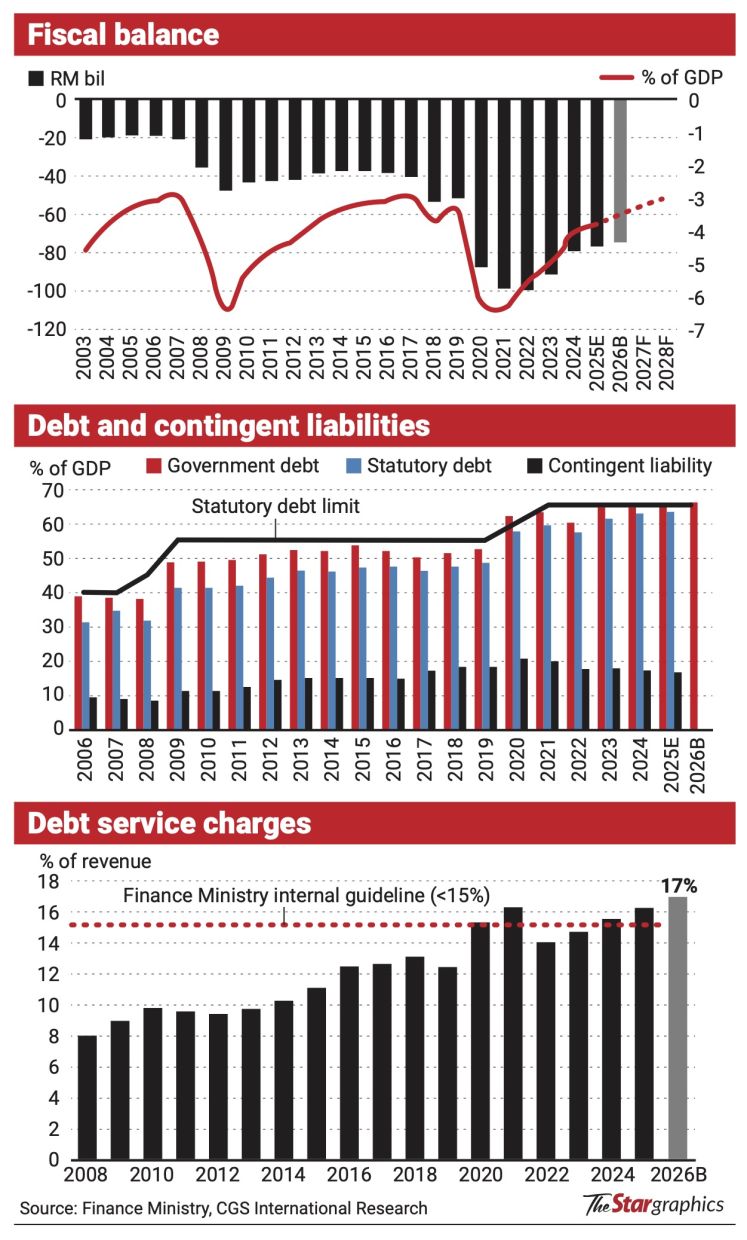
As for statutory debt, which refers to debt excluding those used for liquidity purposes, the ratio stood at 63.5% as of end-June 2025, according to CGS International (CGSI) Research.
“While the Finance Ministry did not provide a forecast for statutory debt in 2026, we think it will likely inch closer to the debt limit of 65% in tandem with the increase in government debt,” according to CGSI Research head economist Nazmi Idrus.
Despite the projected rise in federal government debt-to-GDP level next year, the ratio is expected to gradually decline to 60% by 2030, achieving the target in the 13th Malaysia Plan.
Of course, severe shocks to the economy affecting GDP growth or a sudden spike in global food and commodity prices would derail this expectation.
Debt costs outpacing public priorities
The most striking figure in Budget 2026 isn’t the deficit ratio or the growth projection, it’s the debt service charges.
Malaysia will spend more on interest payments next year than on the entire healthcare system, and this a sobering reflection of how debt has quietly become one of the biggest claimants on the national purse.
Debt servicing, projected at RM58.3bil in 2026, has more than doubled from a decade ago.
In percentage terms, this stands at about 17% of revenue in 2026, remaining above the 15% internal guideline set by the Finance Ministry for the third consecutive year.
Growth in 2026 debt service charges surpasses nominal GDP growth, implying that the nation is spending more to service its past than to secure its future.
Every ringgit spent on interest is one less ringgit available for schools, hospitals or infrastructure, and this is a crowding-out effect that is beginning to shape Malaysia’s development path.
The continued increase in debt service charges is a structural warning.
As the government’s borrowing needs persist, the fiscal space for social and development spending is eroding.
In fact, Ideas warns that Malaysia’s development expenditure (DE) for education and health is set to fall in real and relative terms.
For years, Malaysia has tiptoed around its self-imposed debt ceiling, adjusting it higher whenever circumstances required.
The 2026 projections suggest federal government debt will rise to 65.8% of GDP.
This isn’t catastrophic by global standards. Japan’s ratio is well above 200%, the United States sits at about 120%.
But for an emerging economy with a narrow tax base and high development aspirations, such levels carry real consequences for Malaysia.
High debt limits future fiscal agility. It constrains the ability to respond to shocks, whether from global recessions, geopolitical disruptions, or natural disasters.
And it also raises the cost of borrowing, with markets demanding a premium to fund a government increasingly reliant on debt rollovers.
Anwar’s administration insists that debt remains “manageable.” Yet that term risks losing meaning when interest costs overtake social spending priorities.
Development spending: Underwhelming?
One may argue that Malaysia’s development spending is underwhelming.
In 2026, DE is projected to increase by RM1bil or slightly more than 1% to RM81bil.
In Budget 2026, DE accounts for 3.8% of GDP in 2026, a drop from 4.0% in 2025, yet above the 3% threshold as mandated under the Fiscal Responsibility Act.
That said, the Anwar government is getting the government-linked investment companies and statutory bodies to invest more in developing Malaysia.
Economist Geoffrey Williams calls the government’s move “smart” by putting part of DE off-budget. These will take on the more commercial DE such as artificial intelligence infrastructure, green technologies and others.
“This approach reduces the deficit, puts commercial DE into the hands of business and investment professionals, and captures the returns in dividends for fund members.
“The DE without a commercial return such as school buildings is kept in the public works department. This is much more sensible,” says Williams.
Socio-Economic Research Centre (SERC) executive director Lee Heng Guie thinks the RM81bil DE allocation is “adequate”, pointing out that it covers the implementation of approximately 2,300 newly approved programmes and projects.
He tells Starbiz 7 that allocating a high DE is ineffective if the capacity to implement them is weak.
Allocating more resources without a corresponding improvement in implementation capacity is futile, as the increased funding cannot be effectively used.
“For example, in Budget 2025, a total of RM86bil was allocated, but it was revised lower by RM6bil or 7% to RM80bil,” he says.
Collect more, cut more
To spend more on development without exerting too much pressure on the debt levels, Malaysia has no choice but to cut its operating expenditure where necessary and collect more revenue.
On that note, Malaysia’s fiscal reform agenda under Anwar has made notable strides. The introduction of targeted subsidies and plans to widen the tax base mark progress.
In 2026, subsidies and social assistance are projected to record a third consecutive year of decline – 14.1% year-on-year to RM49bil.
Yet there is room for further cuts, considering that it remains the third largest item on the government’s operating expenditure, right after emoluments and debt service charges.
Distinguished professor of economics Datuk Rajah Rasiah tells Starbiz 7 that while the targeted subsidies in the budget, including confining subsidies to Malaysians and prorating its provision per individual – are certainly not without loopholes – it should significantly lower the leakage to foreign tourists and across borders.
“However, the Customs will need massive upgrading in monitoring and enforcement to reduce leakage. I surely think much more can be done here.”
Going forward, a key positive is the government has said that RON95 petrol subsidies will eventually be limited to the bottom 85% income earners, although no timeframe has been provided.
This would deliver more to public coffers.
As for taxes, the country’s tax-to-GDP ratio, at around 12% in 2026, lags behind regional peers like Singapore, Thailand and Vietnam.
SERC’s Lee says Malaysia’s tax-to-GDP ratio is low to barely cover the government’s high committed operating expenditure and insufficient to fund reasonable development.
Lee says according to the World Bank, a country ideally should collect tax revenue of at least 15% of its GDP.
This level of taxation is an important tipping point to make a state viable and put the tax revenue on a sustainable growth path.
Lee adds that Malaysia needs a “sustainable and predictable” source of revenue to meet the growing DE needs and strengthen fiscal resilience to build a buffer against economic shocks.
In order to achieve this, the transition from the sales and service tax to the goods and services tax (GST) is necessary.
“Our analysis showed that a broad-based consumption tax, GST, is a viable option as it is proven globally to be a better tax system as it is more effective, efficient and transparent.
“The regressive impact of GST on households must be addressed. Mitigating measures are required to soften the impact of GST on the cost of living.”
However, Rajah says the current government almost regards the GST as “taboo”.
In that sense, the options available to strengthen Malaysia’s fiscal position include a profound review of all social and innovation rents distributed by the government, which is what South Korea and Taiwan do, he says.
“There should also be a ledger to evaluate social rents, such as affordable housing, and subsidies given to electricity and water.
“A similar ledger is also needed for incentives and grants given to stimulate innovation.”
Williams suggests that Malaysia should introduce an e-payments tax or EPT to expand the tax base.
“The EPT could raise RM28.8bil at 1%, so this should be piloted.”
He also says that the falling income from PETRONAS is a concern.
“The government should change tack on that and save it rather than spend it,” he adds.
The Finance Ministry projects oil-related revenue to fall to RM43bil in 2026 (12.5% of total revenue) from RM56.6bil in 2025 (16.9% of total revenue), reflecting the impact from the expected lower average fuel prices as well as lower PETRONAS dividend.
The dividend is projected to drop from RM32bil in 2025 to RM20bil in 2026.
Regardless, the country’s overall revenue is still expected to increase in 2026, and this provides some room for the government to continue its welfare spending, especially via cash credits and handouts as well as subsidies.
CGSI’s Nazmi notes that Malaysia’s welfare spending to GDP is still well below the Organisation for Economic Cooperation and Development’s average.
“I’m not worried (about Malaysia’s welfare spending), I think there are frictions in the economy which puts the poor at a disadvantage and the cash support helps to even it out.”
Nazmi also highlights that the Anwar government is trying to balance the need for each economic player in Malaysia.
“But considering that we have a weaker economic growth outlook for next year, having a lower fiscal commitment (deficit) is something to applaud.
“That said, I am concerned however if we are fiscally resilient to face an economic shock.
“The Finance Ministry in its report did mention the potential for the debt ratio rising to over 90% under an extreme scenario.
“Given this potential risk, I do feel that the government should steer towards a more risk-adverse position,” says Nazmi, pointing out that a fiscal deficit of below 3.5% in 2026 – lower than the government’s projection – is desirable.
For now, the government’s Fiscal Responsibility Act and Medium-Term Fiscal Framework are certainly steps in the right direction, but they must be paired with stronger political resolve.
A credible reform narrative would also reassure investors, strengthen the ringgit and boost Malaysia’s fiscal credibility in the region.
Will Malaysia be brave enough to push through bolder reforms, with or without elections on the horizon?
Already a subscriber? Log in
Get 20% OFF The Star Digital Access
Cancel anytime. Ad-free. Unlimited access with perks.