THE next employee wage statistics for the formal sector will be published on Oct 25, a week after the tabling of Budget 2025. The statistics provides a view of the generally low wages of the Malaysian workforce and gives a better understanding tied to cost-of-living issues.
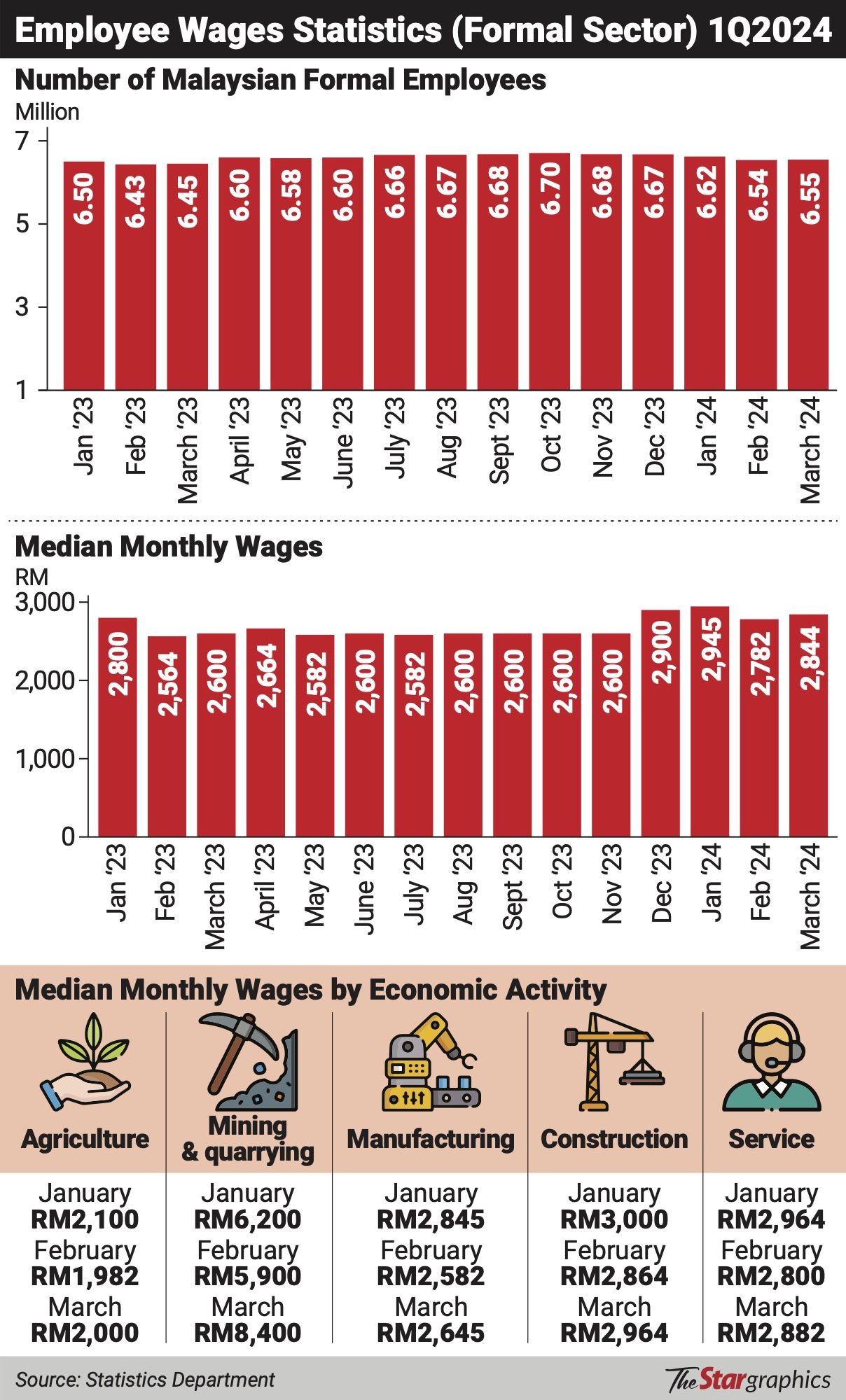
The government has indicated that cost-of-living issues will be the main focus of the upcoming budget as it strives to implement reforms to support economic growth through high-value industries that offer higher wages, while cutting or rationalising subsidies that many in Malaysia have grown accustomed to over the decades. There were 6.54 million employees in the formal sector in the first quarter of 2024.
In a pre-budget statement, the government laid out three short-term priorities for the budget under “Raise the Ceiling”, “Raise the Floor” and “Good Governance and Public Sector Reform”, which comes under the Madani Economy framework. Under the “Raise the Floor” thrust, the government promises “to improve the quality of life for all Malaysians to ensure equitable benefits and opportunities, a decent standard of living and social protection for the rakyat”.
This will involve a comprehensive set of measures and targeted policies to uplift disadvantaged communities, improve access to essential services such as education and healthcare as well as create sustainable income opportunities.Tackling low wages
From the latest available Statistics Department data on employee wages for the formal sector, median wage growth for the first quarter seems pretty encouraging at first glance, rising by 9.4% to RM2,844 in March, after wage gains of 8.5% and 5.2% in February and January to RM2,782 and RM2,945 respectively.
The median wage in this respect refers to half of Malaysians in formal sector employment earning above the wage range indicated and the other half drawing below the indicated range.
Despite the pace of wage rises among formal sector employees, the reality is that inflation has outpaced wage growth. According to the employee wages statistics, nearly a third of formal employees earned below RM2,000 in March 2024 while employees aged 45 to 49 years had the highest median monthly wages, recording RM3,818 in March 2024. Kuala Lumpur and Selangor recorded higher than the March national median monthly wage of RM2,844 at RM4,256 and RM3,164 respectively.
There are no comparison for overall median wages outside of the formal sector. The next report on the informal sector would only be released on Nov 28, while the last update on the sector came out in July 2020 reporting on 2019 statistics.
According to this last update, there were 1.26 million people working in the informal sector in 2019, which was a decline from 2017. In 2015, a tenth of all workers in the country were classified as informal workers, where wage data is much more difficult to capture.
The formal sector wage growth is taking place against a backdrop of rising economic activities that has contributed to the 5.0% gross domestic product (GDP) growth in the first-half of this year against 4.1% growth in the same period of 2023.
There is optimism that economic growth this year could at least rise to the upper range of the government’s 4% to 5% GDP forecast. Similarly, wages are growing against the slower rise in both headline and core inflation, although there are expectations of inflation picking up in the second-half of 2024 on more subsidy cuts or rationalisation.
The government forecast for headline inflation this year is in the range of 2.0% to 3.5% and for core inflation (excluding fresh food and government-administered goods) to be in the range of 2.0% to 3.0%. The subsidy on diesel was removed on June 1 and against all expectations, headline and core inflation has remained steady for June and July compared with May.
On a granular level, transportation costs did rise in June compared with May as did prices of fresh seafood and vegetables but July fresh food prices were lower.
When compared with Belanjawanku 2022/2023, a reference budget for a socially acceptable living standard, singles in the Klang Valley, whether car owners or users of public transport, can scrape by as the estimated monthly expenses were RM1,700 and RM2,600 respectively.
Compare this with a widely cited report, “The Living Wage: Beyond Making Ends Meet”, which was published by Bank Negara in March 2018 showing the provisional living estimates in Kuala Lumpur for 2016 ranging from RM2,700 for a single adult to RM4,500 for a couple without children and RM6,500 for a couple with two children.
Notably, there are no homeowners in all three household scenarios.
The findings from Belanjawanku 2022/2023 indicated that household expenses mostly went to basic needs such as food, housing and transport, with the estimated expenses for all household categories having increased between 2019 and 2022. The increase is most visible in food and housing, where there is a rising trend cutting across all household categories in the Klang Valley.
The Bank Negara report remains relevant today, as the report’s authors noted that “these findings underscore the importance of creating a high-skilled workforce in Malaysia that is equipped with the necessary competencies for higher-paying jobs”. Findings showed that those earning below the living wage were mostly secondary school-leavers with low to mid-skilled jobs, while those earning above the living wage were mostly tertiary graduates with high-skilled jobs.
In answer to these findings, the Progressive Wage Policy (PWP) was rolled out, with the pilot programme launched recently for employees earning wages of between RM1,500 and RM4,999. The PWP aims to boost employee income through upgrading skills and raising productivity levels, which the government is encouraging businesses to implement through a co-funding incentive structure over a period of 12 months for employees to help with the wage increases.
Lee Heng Guie, executive director at the Socio-Economic Research Centre, says the pilot programme is not up to expectations as only 144 companies covering 1,038 employees have met the eligibility to get the co-sharing wage incentive. Nearly 1,100 companies are voluntarily participating in the PWP.
“The budget is expected to enhance the PWP scheme to encourage sustainable wage enhancement and skill improvement,” he says, adding that there would also be a focus on technical and vocational skills development in collaborations with government-linked companies, industry groups as well as education institutions.
“The focus on upskilling and reskilling investments not only create a broad-base innovation and startup culture, but also produce a tech-savvy workforce to support the generative artificial intelligence (AI) system. The budget is expected to allocate fund for investment in AI, tech skills, data quality and public information technology infrastructure,” Lee says.
He says it is not surprising that the budget will announce higher minimum wage (currently at RM1,500 per month) and introduce a multi-tiered foreign levy.
“Micro, small and medium enterprises (MSMEs) hope that the quantum of increases must not be too steep so as not to burden them. The levy can be applied to SMEs only two years after its initial implementation for large companies,” he says.
As a reference, according to the Graduate Statistics 2022, employed graduates earned a median monthly salary of RM4,128 in 2022, with the median growing by 5.5%.
When broken down into skills categories, graduates in skilled occupations saw a 7.9% increase in median monthly salaries and wages for 2022, reaching RM5,913, those in semi-skilled occupations recorded a 5.4% increase in median monthly salaries and wages amounting to RM2,159 and those in low-skilled occupations saw median monthly salaries and wages grew by 7.0% to RM1,817.
Sunway University economics professor Yeah Kim Leng, who is also economic adviser to Prime Minister Datuk Seri Anwar Ibrahim, says more collaborative efforts with the private sector will be needed to ensure sustainable wage increases that are in line with improvements in labour productivity.
“Wage and income increases are tied to labour market conditions that in turn are shaped by skilled labour employment stemming from high value-added business expansion and investment activities,” he says.
Yeah noted that sustaining the rise in quality domestic and foreign direct investment (FDI) is crucial to address the cost-of-living issues from the employment and income-side of development.
“On the cost aspect, fostering competitive markets and ensuring adequate production capacities and supplies to meet consumer demand, particularly in essential goods and services, are important objectives that Budget 2025 seeks to achieve to contain cost-of-living pressures,” he says, adding that food production is where there are opportunities to expand scale and productivity both to strengthen food security and reduce dependence on imports.‘Raise the Floor’
Acknowledging that benefits from the faster economic growth this year has been concentrated, with the households at the lower-to-middle-income levels being burdened by higher expenses, Lee says Budget 2025 will announce more enhancements to the Sumbangan Asas Rahmah and Sumbangan Tunai Rahmah to help households with cost-of-living concerns while the salary increments for the 1.7 million civil servants will come in handy.
BIMB Securities Research deputy chief economist Zafri Zulkeffeli says, in a report, that direct cash payments to vulnerable groups will continue, with potentially higher payments based on factors such as location and household size. “The fiscal policy also will address education and healthcare issues including preparing for ageing society and upgrading of healthcare facilities. We opine there are incentives for affordable housing and homebuyers especially the new ones,” he says.
Lee suggests that Budget 2025 consider several measures to rein in escalating healthcare costs, which increased by 12.6% last year and significantly higher than the global average of 5.6%. He says the measures include the establishment of a universal healthcare insurance fund, introducing hospital fee benchmarks for 21 common surgical procedures and eight common medical conditions to make the bills more transparent, capping the level of prices by setting maximum amounts that hospitals and physicians could receive from commercial insurers, capping the annual growth rate of these prices and, subsidies for medical insurance.
He believes cost-of-living pressures for middle-class households can be mitigated through targeted tax reliefs and rebates to help them cope with immediate financial pressures. To that effect, he suggests an increase in personal income tax relief, which has not been revised since 2010, to RM12,000 from RM9,000. Other measures to alleviate financial pressures include reintroducing parental care tax relief last given in the years of assessment 2016 to 2020, extending the tax rebate to individuals with chargeable income not exceeding RM70,000 and, personal tax relief of up to RM4,000 annually for house rental payment.

Turning off the tap
Taking the Public Finance and Fiscal Responsibility Act passed last year as a guide and understanding that high government debt together with low economic growth puts off investors, the government’s commitment to cut or rationalise subsidies will not make tackling cost-of-living issues any easier. While the pace of growth of government debt has actually slowed to 8.6% last year compared with 10.2% in 2022, government debt together with liabilities stood at RM1.53 trillion or 84.0% of GDP as of December 2023.
The fiscal deficit has steadily been whittled down to 5.0% of GDP or RM91.4bil in 2023 compared with 5.6% or RM99.5bil in 2022. The Budget 2024 goal is to have the fiscal deficit narrow to 4.3% and to 3.0% in the medium term while still ensuring fiscal policy remains supportive of economic growth.
To recap, among the key aims of the Public Finance and Fiscal Responsibility Act are that the fiscal deficit should not be more than 3.0% while government debt level should not be higher than 60.0% as a percentage of GDP and financial guarantees as a percentage of GDP should not be more than 25.0%.
Julia Goh, senior economist at United Overseas Bank (M) Bhd, expects more details on subsidy rationalisation measures as subsidy rationalisation is one of the 17 strategies under the mid-term review of the 12th Malaysia Plan. In particular, she expects further details on subsidy rationalisation measures related to food subsidies for chicken and sugar as well as subsidy reforms for RON95 petrol and diesel for Sabah and Sarawak. There will also be a need to cap higher operating expenditure as a result of higher emoluments and pensions payments from the raising of civil service salaries and readjusting pension payments.
Yeah says the inclusion of the RON95 subsidy rationalisation in Budget 2025 will attest to the government’s commitment to the structural reforms that are crucial to the nation’s sustainable development and high income trajectory. It is estimated that cutting the diesel subsidy enabled the government to save RM4bil annually and directing the money saved to targeted groups. Estimated fuel subsidies of both RON95 and diesel usually come up to 60% of total subsidy bill, with last year’s total subsidy bill coming to RM80bil.
CGS International Securities Malaysia Sdn Bhd analysts Nazmi Idrus and Mas Aida Che Mansor say, in a report, that “the stars are aligned” for the government to implement the RON95 subsidy rationalisation and has suggested for the adjustments to be done all at once. The move could save around RM4bil and lower the fiscal deficit by as much as 0.2% of GDP assuming no offsetting measures. They estimated total fuel subsidy in 2024 at RM26.3bil, of which RON95 subsidy formed RM16.3bil.
“We think a major holdback for the government is whether the fall in global oil prices and the strength in ringgit are consistent enough to avoid any policy backtracking,” they said, adding that ringgit strength and weaker crude oil prices leading to a significant narrowing of the margin between subsidised retail fuel and the market price together with robust domestic economic growth and stable political conditions makes implementing the subsidy reform the least disruptive.
Besides subsidy rationalisation, there will also need to be new revenue sources, especially given the country’s relatively lower tax revenue to GDP ratio of 12%. This is not only to ensure that the fiscal and debt targets under the Public Finance and Fiscal Responsibility Act are met, but it is also to ensure that economic growth plans and measures to ease the burdens of less fortunate Malaysians can be funded. Goh, citing the trend of the last three budgets, does not rule out potential new progressive taxes or expanding the scope of current taxes to shore up overall revenue in view of potentially lower Brent oil prices next year that would affect oil royalties and dividend incomes.
“The rationale of any new tax measures needs to be supported by broad industry engagement, comprehensive study on the costs and benefits, viability and ultimately how much additional revenue the government can collect from the new tax measures. Without sufficient clarity and transparency, new tax measures can create uncertainty for businesses, dampen investor sentiment and capital markets. In some instances, it may also result in delays or deferred investments if the tax policies proposed are major,” she adds.
Already a subscriber? Log in
Get 20% OFF The Star Digital Access
Cancel anytime. Ad-free. Unlimited access with perks.