
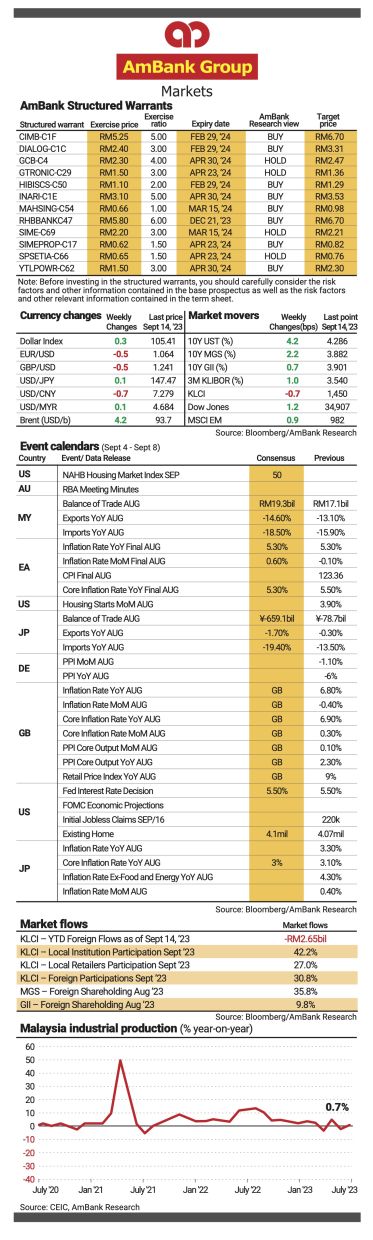
MALAYSIA’S government bonds and the ringgit were on modestly weaker footing on a weekly basis.
The major influence on ringgit government bonds and ringgit currency weakness was the lack of risk appetite in the region, which also saw weakness in Indonesia’s rupiah and the Thai baht.
Over the past week, investor appetite for risk assets was lacking as they awaited the monetary policy decision by the European Central Bank (ECB) and ahead of the Federal Reserve (Fed) policy meeting scheduled for Sept 20-21.
Investors also digested the latest policy move by the People’s Bank of China (PBoC) to stimulate China’s growth outlook.
The PBoC action (to boost liquidity by reducing the amount banks are required to set aside in reserve) aided the Chinese yuan, but the ongoing general lack of confidence in China’s economy as well as its credit market still contributed to the cautious regional markets, and which sustained the pressure on the ringgit, rupiah and baht.
In addition, markets were cautious as investors awaited the releases of pertinent US macroeconomic numbers for inflation (August consumer price index or CPI and producer price index) and retail sales.
The US headline CPI rose 0.6% month-on-month (m-o-m) in August, as expected, led by rising petrol prices, and core CPI rose 0.3% versus the consensus estimate of 0.2%.
However, on a year-on-year (y-o-y) basis, headline CPI was up 3.7% versus 3.2% in the previous month while core CPI was up 4.3% versus 4.7%.
Retail sales in the United States rose by 0.6% in August, surpassing expectations and indicating strong consumer spending despite rising prices and borrowing costs.
Nevertheless, we note the baht’s weakness was also driven by the Thai government announcing an upward revision to its spending plan for the next fiscal year starting Oct 1, 2023.
Thailand set its budget deficit higher at 693 billion baht compared with the prior target of 593 billion baht.
As for the ringgit, there has been a lack of positive drivers after Bank Negara earlier this month held its overnight policy rate (OPR) at 3% while it warned of incoming global economic uncertainty.
The PBoC announced a cut in the reserve requirement ratio (RRR) for banks for the second time this year, by 25 basis points (bps) effective yesterday, intended to boost liquidity and aid the country’s economic growth.
The weighted average RRR will be 7.4% after the reduction.
On the other hand, against market speculation, the PBoC maintained China’s one-year, medium-term lending facility rate at 2.5%. The yuan was seen at 7.279 against the US dollar last Thursday or stronger by 0.7% on a weekly basis.
For the week, the ringgit hovered at 4.682 against the US dollar and was set to show a depreciation of about 0.1%, the rupiah about 0.2% weaker and baht 0.5% weaker.
There was some support for the ringgit at the start of the week, closing last Monday at 4.674, when data released showed Malaysia’s industrial production growing 0.7% y-o-y in July, a rebound from the 2.2% y-o-y contraction in the prior month.
As for government bonds, the modest weakness saw yields higher within a relatively small range of two to three bps. The 10-year Malaysian Government Securities (MGS) benchmark paper rose three bps week-on-week to 3.88%.
Nevertheless, despite the lukewarm interest in the secondary market, the primary market for government bonds was healthy. The government sold RM4.5bil of the three-year Islamic government investment issue (GII) maturing September 2026.
Incoming bids totalled RM9.8bil, which translates into a bid-to-cover (BTC) ratio of 2.17 times. In comparison, the average BTC of the 26 government auctions completed this year was 2.16 times.
In the coming week, global markets will focus on the Fed’s policy meeting.
Alongside scrutiny over the interest rate decision, scheduled policy statement and comments from chairman Jerome Powell, investors will analyse the Fed’s latest economic projections.
Of particular interest would be the interest rate projections of each Fed policymaker, ie, the so-called Fed dot-plots.
For FX enquiries, please contact: ambank-fx-research@ambankgroup.com.
For Fixed Income enquiries, please contact: bond-research@ambankgroup.com.
Already a subscriber? Log in
Get 20% OFF The Star Digital Access
Cancel anytime. Ad-free. Unlimited access with perks.