‘Sustainability company’ transforms palm mill wastes into fuel for electricity


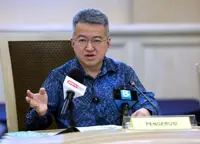
Energy source: ‘We have these pellets, a source of fuel, and we burn it to create energy,’ says Hyper Fusion Intl CEO C. Dinesh of his biofuel pellets, which are exported to South Korea. – Azman Ghani/The Star

A MALAYSIAN company has come up with a method that accelerates the process to convert palm oil mill effluent (POME) into fuel for electricity to power mill operations.

Calling itself a “sustainability company”, Hyper Fusion International says its method to create biofuel pellets from the effluent is the first of its kind for POME.

Set up in 2012, the Kuala Lumpur-based company is currently exporting these pellets to its business partner in South Korea.

Having previously been involved in the waste water management business, Hyper Fusion International CEO C. Dinesh said the company realised that the future in waste management is in the palm oil business.

“Palm mill waste is very difficult to manage. We spoke to many mill owners about our sustainable solution to managing their waste, but they were not interested in spending money on sustainability. We are not a renewable energy company; we are looking at sustainability.

“In 2013, we found a palm oil mill owner in Klang who was willing to give us a chance, and a Korean company agreed to invest in us,” he told StarBizWeek.

‘We are not a renewable energy company; we are looking at sustainability,’ says Dinesh.

Hyper Fusion treats the waste water sludge and separates the solid particles from the mix. The remaining sludge is then turned into pellets.

A palm oil mill generates four kinds of waste: empty fruit bunches, oil palm mesocarp fibre (OPMF), kernel shells (PKS) and POME – collectively known as biomass.

The company takes all the four by-products and processes them by removing up to 90% of moisture, thereby transforming them into an efficient form of fuel for the boilers.

“A mill usually has at least 10 ponds, and the ponds take up about two-thirds of the mill area.

“What we do eliminates the need for so many ponds. All we need is the first pond, and the last two ponds,” said Dinesh.

Not only was Hyper Fusion’s method better for the environment, he said, but also saved a lot of space in the mill area, which could be used for other operations such as farming.

The process treats the effluent and reduces the chemical oxygen demand (COD) and BOD (biochemical oxygen demand) by 80% in less than 10 minutes. The remainder is then sent into the last two ponds to complete the clarification process which takes about two weeks. When it is done using the traditional ponding method, the entire process usually takes between 90 and 120 days.

Up to 90 of moisture is removed from palm mill wastes. The remaining sludge is then turned into pellets.
‘We are not a renewable energy company; we are looking at sustainability,’ says Dinesh.


“Currently, mill owners look to biogas as a way to trap greenhouse gases before they escape into the atmosphere. But after that, you still need to remove the sludge. This is a very reactive process, while ours is more proactive,” he said.

Hyper Fusion is currently working with a mill in Gua Musang, Kelantan, which is about to commence farming with land which was previously ponds.

“The land is very fertile as the ponds are naturally rich with nutrients. Once they go into farming, they have a mixed income. We can even de-sludge the ponds, clean them up and rear fish,” said Dinesh.

“The downstream business is additional income. However, the company does not stop at this; the amount of energy created is used to power the mill as well as its machinery.

“We have these pellets, a source of fuel, and we burn it to create energy again. With that energy, we can run that same system. Now, the loop is closed.

“We do a barter trade with mill owners. We do not pay for their waste, but we give them energy to power their operations in return.

“This is sustainability. We process their waste and give them back clean, efficient fuel.

“Efficient fuel means it is dry. The drier it is, the more efficient because you use less energy to ignite it,” he said

The mill in Gua Musang will be the first self-sustaining and power-generating mill in Malaysia, Dinesh claimed.

“With this model, mills can become micro IPPs (independent power producers). This will localise power generation, which is a more efficient way of distributing electricity.

“It is a more sustainable process as there are no logistic costs involved, since the micro power plants will be located in the vicinity of the mills.

“These micro IPPs can generate between one and two megawatts of electricity, which is sufficient for the mill – with the excess supplied to the surrounding areas. We now can realise rural electrification for Malaysians through palm biomass,” he said.

Get 20% OFF The Star Digital Access

Monthly Plan

RM 13.90/month

RM 11.12/month

Billed as RM 11.12 for the 1st month, RM 13.90 thereafter.

Best Value

Annual Plan

RM 12.33/month

RM 9.87/month

Billed as RM 118.40 for the 1st year, RM 148 thereafter.

Follow us on our official WhatsApp channel for breaking news alerts and key updates!
Business , palm oil , oil palm , biofuel , Hyper Fusion

Next In Business News

Oil hits multi-week high as US-Iran truce falters
Pan Merchant in RM17mil contract win
Pekat Group bags RM47mil DC contracts
AI adoption needs stronger guardrails
SunCon’s�near-term earnings to be backloaded
Chin Hin Group to acquire land in KL for RM455mil
EITA lands RM21mil Indonesian job
High CPO prices set for extended run
Optimistic outlook for building sector in 2H
Blue Owl buys RM7bil UK private hospital assets

Others Also Read