



THE Lion group had a run of bad luck. It took several years to put together a debt restructuring scheme that deferred repayment for most of its huge bank borrowings. It is still in the process of disposing assets to repay those debts.
In its scheme, the plan was also to rely on three manufacturing units to generate cash flow to trim the debts.
These three units were Megasteel, the country's sole producer of flat steel, Lion Forest Industries Bhd (LionFIB) which churns out writing paper and Silverstone, the tyre manufacturer. The last-mentioned is not doing well, leaving the cash generation task to Megasteel and LionFIB.
Now, a new, third member has emerged from within the Lion group. This is the hot briquetted iron (HBI) plant of Amsteel Mills Sdn Bhd, a 99%-owned subsidiary of Lion Industries Corp Bhd. HBI is a semi-processed product that is used as a substitute for iron scrap for further processing into finished steel products.
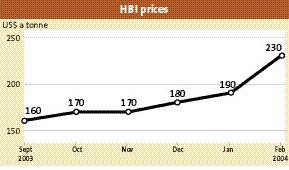 |
Like scrap prices which have gone through the roof, prices of HBI have also moved up sharply. It is understood that in the last six months, HBI prices have increased by over 40% from US$160 a tonne to US$230.
This does not mean the price increase will boost Amsteel's earnings by as much. The prices of iron ore, the feedstock for HBI, have also moved up, but only by about 10% to 15%. Hence, there is an expansion in the plant's profit margins.
The HBI plant in Labuan has a rated capacity of 786,000 tonnes. It can, however, produce more than that, with effective productivity measures. Thus, the plant produced 825,000 tonnes of HBI last year.
With HBI prices rising substantially from this year, the margin expansion will be felt only in the second half of Lion Ind's financial year (FY) ending June 30, 2004. A full year's impact will be found only in its FY2005.
In the next financial year, the maths might work this way. The Labuan HBI plant will enjoy an increase of about RM150mil in its earnings, taking a net margin increase of US$50 a tonne, an output of 825,000 tonnes and conversion to ringgit on the pegged exchange rate.
It is noted that the HBI operation was already a profitable business. It made an operating profit of RM100mil in FY03, according to Lion Ind's annual report. That could rise by two-and-a-half-times next year if HBI prices are sustained.
This will not be all of the Lion Ind group's earnings because it also owns rolling mills in Klang and Banting, that produces steel bars and wire rods. The group also owns Antara Steel Mills, located in Johor, that makes a range of steel products.
It is known that the earnings of steel bar producers have come under pressure due to a mismatch between the controlled price of round bars being much lower than the current high prices of scrap iron, the main feedstock for steel mills in this region.
Lion Ind's steel bar operations face margin compression, possibly even losses. Malayawata Steel Bhd, for instance, was in the red in its latest reported quarter.
A distinction, however, should be made from manufacturers of other steel products. Southern Steel Bhd, for instance, reported firm earnings in its latest quarter. The reason for the differing performance is that Southern Steel produces a lot more wire rods than steel bars. The prices of wire rods are not controlled by the Government. Hence, wire prices were raised in proportion to the higher scrap costs.
Lion Ind produces wire rods too. This takes up close to 50% of the capacities of its rolling mills while slightly over half is used for round bars. It would be profitable in its wire rod operations. Additionally, Antara makes angle bars that are also not price-controlled.
On this basis, Lion Ind's results should be closer to Southern Steel's than Malayawata's. It is understood the Lion Ind group uses some of the HBI from its Labuan plant as feedstock for its rolling mills. The rest, over 60% of the HBI output, is exported.
The HBI operation is therefore one particularly useful part of the country's iron and steel industry as it is bringing in export earnings.
There is also improvement in another part of the Lion group. LionFIB's earnings should also be rising, as can be inferred from its share price. The stock rose from the RM1.50 level early this year to RM2.69 on Friday.
With paper prices having increased from US$570 a tonne in 2002 to almost US$700 a tonne, LionFIB is generating tremendous cash flow for the group. LionFIB is also a subsidiary of Lion Ind.
While the news flow from the Lion group has been bleak, there are core divisions in the diversified group that are operating in a much brighter setting.
Stock Watch On LIONCOR Stock Watch On LIONCOR-O Stock Watch On LIONCOR-W
Already a subscriber? Log in
Get 20% OFF The Star Digital Access
Cancel anytime. Ad-free. Unlimited access with perks.
