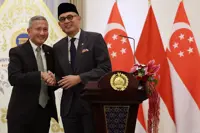
JAKARTA: West Java governor Dedi Mulyadi, popularly known as Kang Dedi Mulyadi, or “KDM”, has emerged as a serious presidential contender whose electability keeps climbing in public opinion surveys.
In a semi-open simulation with a list of 24 names, KDM received 35.5 per cent support, far ahead of President Prabowo Subianto, who got only 9.8 per cent, according to a survey by Saiful Mujani Research and Consulting (SMRC) in October.
Tempo Data Science found a similar pattern in August, with KDM at 42 per cent and Prabowo at 15 per cent. This sharp shift took place in less than a year.
In November 2025, Prabowo still led with 34.9 per cent support, while KDM stood at only 19.7 per cent.
Support for Prabowo has continued to fall over the past year. In February-March 2026, he was still at 33.3 per cent. That figure fell to 14.5 per cent in July and to 9.8 per cent in October.
Over the same period, by contrast, KDM’s electability rose to 35.5 per cent. In a two-name simulation, KDM’s lead over Prabowo is even larger. In February-March 2026, Prabowo still led with 50.5 per cent support against 42.6 per cent for KDM.
By July, the situation had reversed: KDM rose to 59 per cent while Prabowo fell to 28.3 per cent. By October, KDM had 69.3 percent, while Prabowo had only 18.8 percent.
Prabowo’s declining support can be explained by economic voting theory. This starts from a simple idea: When the public appreciates macro conditions, especially the state of the economy, it tends to reward the government with high approval ratings and strong electability.
Conversely, when the public judges those conditions negatively, it tends to blame the government and ultimately punishes it by not voting for it again. This pattern has been documented in many studies since the classic work of Anthony Downs, An Economic Theory of Democracy (1957), which saw voters as rational actors weighing the costs and benefits of political support.
Surveys by several polling institutions now show that Indonesians currently hold largely negative views of a number of macro conditions. SMRC, for example, found in October that around 50.8 per cent of citizens rated the current state of the economy as bad or very bad, while only 17.4 per cent rated it good or very good.
The same tendency appears in assessments of the government’s two flagship programmes, the free nutritious meal (MBG) programme and the Red and White Cooperatives. According to SMRC, 61.4 per cent of citizens who know of the MBG are dissatisfied with its implementation, and 71 per cent of those who know of the cooperatives doubt they will thrive in their village or region.
These negative sentiments about the economy and the government’s two flagship programmes run parallel to the President’s approval rating and public satisfaction with his performance.
In November 2025, satisfaction with the President’s performance stood at around 81.2 per cent. It had fallen by around 37 percentage points to 44.5 per cent by October 2026.
Statistical tests show that public evaluations of national conditions and the President’s performance are significantly associated with his sharply declining electability. Up to this point, the theory of economic voting works as expected.
The question, then, is why does Prabowo’s falling electability go hand in hand with rising support for KDM, who, after all, belongs to Prabowo’s Gerindra Party? Why do citizens who are increasingly disappointed with the government favour a figure from within the government camp?
The answer can be traced to the concept of clarity of responsibility, developed by G. Bingham Powell and Guy Whitten (1993), among others. The concept holds that the political consequences of public evaluations depend heavily on how clearly responsibility can be assigned.
In a two-party system such as that of the United States, a negative evaluation of the government directly benefits the opposition politically, and it is clear which political party is in power. In a multiparty system, citizens who evaluate conditions find it more difficult to allocate punishments or rewards because many parties sit together in coalitions.
Indonesia sits at an extreme. Beyond having a multiparty system, it now has almost no opposition.
Of the eight parties in the House of Representatives, seven are partners in the governing coalition. The only party formally outside Prabowo’s government is the Indonesian Democratic Party of Struggle (PDI-P), but even it does not clearly position itself as an opposition party and often votes with the government.
Without an opposition camp, it is unclear to disappointed voters who to support as an alternative. This explains the anomaly in voter behaviour: On one hand, voters are disappointed with the government, yet they tend to choose figures who are close to, or even part of, the government camp.
Without a clear opposition, public dissatisfaction with how the government is run has no clear political outlet, and this can even flow to an alternative figure in the same political party as the president.
SMRC’s July 2026 study cited above shows that so far, KDM draws the largest share of votes from those critical of the government. This means that the larger the group of citizens critical of the government, the wider KDM’s opportunity to gain more votes.
What is interesting and unique about KDM is that he not only absorbs votes from those disappointed with the government, but he also faces almost no resistance from those who appreciate the government’s performance: Votes from government supporters are also flowing strongly to KDM, as Tempo Data Science found in August 2026.
The next question is why the vote spillover goes to KDM rather than other figures. One possible answer is KDM’s position as a governor whose performance his constituents appreciate.
West Java is home to around 18 per cent of the national population. In the country’s largest province, public satisfaction with KDM’s performance is very high: 95.4 per cent according to a survey by Lembaga Survei Indonesia (LSI) in July 2026 and 95.5 per cent according to Indikator Politik Indonesia in January-February 2026.
This means KDM already starts with an initial political capital of around 18 per cent, something no other alternative figure has. When the public loses clarity about which camp offers an alternative, it does not look for one in an empty space.
It finds a figure whose performance is widely appreciated in his province who enjoys an image that stands in sharp contrast to the public’s negative assessment of the president.
The logic of economic voting still holds; the reward has simply changed address: from a president who is punished to a governor who is rewarded.
In the absence of opposition, performance at the regional level becomes a key form of national political capital.
This is a pattern seen before: Joko “Jokowi” Widodo used his performance as mayor of Surakarta in Central Java, and then governor of Jakarta, to launch his successful bid for the presidency. The big question now is: Will KDM challenge Prabowo, his party leader, in 2029? - The Jakarta Post/ANN
The writer is a political analyst and researcher at Saiful Mujani Research and Consulting (SMRC). This article is republished under a Creative Commons licence.