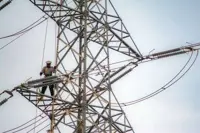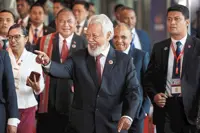
JAKARTA: Indonesia will not export electricity to Singapore unless the two countries can agree on a suitable price, Energy and Mineral Resources Minister Bahlil Lahadalia said on Nov 2, casting uncertainty over plans to supply up to 3.4 gigawatts (GW) of low-carbon electricity to the Republic.
Both countries are working towards bringing the projects into operation by 2035, although pricing remains a key sticking point.
Speaking to reporters at the Presidential Palace in Jakarta on Nov 2, Bahlil said Indonesia remained open to exporting electricity, but would prioritise domestic needs if buyers were unwilling to meet its pricing terms.
“As long as the price is right, follow our prices, that is possible. But if the price is not right, we will prioritise domestic needs,” he said, according to state news agency Antara.
Bahlil, who also serves as Coordinating Minister for Downstreaming and Energy Transition, said his ministry had already calculated the proposed export price. He did not disclose the price or indicate when exports could begin.
The minister’s latest comments come amid recent tensions between Singapore and Indonesia over transboundary haze and natural gas supplies.
Earlier on Nov 2, Bahlil, who is also chairman of the Golkar Party, had said Indonesia would not export electricity in the near future because it still needed the power for domestic consumption.
“I have announced that Indonesia will not be able to export electricity in the near future. We still need electricity,” he said at the Mineral and Coal Convention and Exhibition in Jakarta.
He also warned sovereign investment agency Danantara against yielding to lobbying over electricity export decisions, stressing that the authority to issue permits rested with his ministry.
“I have told Danantara not to entertain lobbying. The permits are issued by the Energy and Mineral Resources Ministry, not Danantara,” he said.
His remarks come as Indonesia and Singapore work to implement a major bilateral energy initiative announced in June 2025, when Bahlil and Tan See Leng, then Singapore’s Minister-in-charge of Energy and Science and Technology, signed three memorandums of understanding in Jakarta.
The agreements covered cross-border electricity trade, carbon capture and storage, and the development of a sustainable industrial zone in Indonesia’s Riau Islands.
At the Singapore-Indonesia Leaders’ Retreat in July 2026, Prime Minister Lawrence Wong and President Prabowo Subianto reaffirmed their commitment to accelerating cross-border electricity trade, with Danantara designated by Jakarta to spearhead the initiative.
The two leaders also witnessed the exchange of agreements covering electricity offtake and transmission infrastructure, alongside a roadmap to advance cross-border electricity trade.
Singapore’s Energy Market Authority had earlier granted conditional licences for 2GW of electricity imports from Indonesia and conditional approvals for another 1.4GW, bringing the total planned capacity to 3.4GW.
The proposed electricity trade would help Singapore reduce its reliance on fossil fuels, while attracting investment in renewable energy generation and supporting infrastructure in Indonesia.
In May 2026, Bahlil said Indonesia remained open to supplying electricity to Singapore, but stressed that the terms must be mutually beneficial.
“We will also export to Singapore, but the price must be fair. As long as we have not reached a win-win arrangement, I think it is important to conduct a more thorough assessment,” he said on May 11.
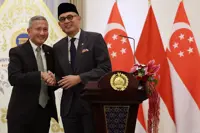
During a visit to Jakarta on Oct 28, Singapore Foreign Minister Vivian Balakrishnan said governments had a responsibility to secure essential supplies, including energy, for their populations, but stressed that meeting domestic needs and pursuing cross-border cooperation were not mutually exclusive.
He said cross-border energy contracts could help attract investment, expand infrastructure and lower costs through economies of scale.
“Working together and looking after your own needs. It’s not either or. It’s not a binary,” he told reporters.
Separately on Nov 2, Bahlil called for Indonesian natural resources, including minerals and liquefied natural gas (LNG), to be exported directly to destination countries rather than passing through intermediary nations.
Speaking at the same mining convention, he argued that Indonesia should not allow others to benefit from trade involving its natural resources.
“Why must we use another country? They get the taxes, they get the trade balance,” he said. Although he did not explicitly name Singapore, Bahlil suggested that his audience would know which country he was referring to.
The remarks follow his accusations in late October that Singapore was reselling some of the LNG it purchased from Indonesia to other countries.
Singapore’s Ministry of Energy, Trade and Industry clarified on Oct 30 that LNG traded by Singapore-based companies usually moves directly from its source to the destination country, without physically passing through Singapore.
The ministry said more than 50 Singapore-based companies buy, market and trade LNG sourced globally, including from Indonesia. It added that piped natural gas imported from Indonesia is used domestically and not exported.
The latest remarks also follow Indonesia’s decision to reduce piped natural gas exports to Singapore from Oct 24 to prioritise domestic demand.
Singapore’s Energy Market Authority said importers had informed it of a reduction of 17 billion British thermal units per day over 18 days, equivalent to less than two per cent of the Republic’s daily gas demand. - The Straits Times/ANN