
Hong Kong’s leader has said the housing minister’s resignation was his “comprehensive political decision” in establishing accountability for the city’s deadliest fire in decades, with a three-member team to also investigate up to 50 civil servants.
Chief Executive John Lee Ka-chiu also said on Thursday that he had decided to stay on to spearhead comprehensive reforms.
Nearly a year after last November’s Tai Po inferno, which claimed 168 lives and displaced about 5,000 residents, Lee announced that Secretary for Housing Winnie Ho Wing-yin had tendered her resignation a day before.
Her departure preceded the release of an independent committee’s report examining the cause of the blaze. The report criticised the bureau’s Independent Checking Unit (ICU) for lax enforcement and systemic failures as a regulatory authority and said it should bear the biggest responsibility among four government bodies.
The long-awaited report into accountability for the blaze left Ho as the sole minister held politically accountable. Development minister Bernadette Linn Hon-ho, Security Minister Chris Tang Ping-keung and Labour and Welfare minister Chris Sun Yuk-han remained in their posts, even though the judge-led panel also slammed their departments for working in silos and “passing the ball” on residents’ complaints.
At a press conference, Lee said that although Ho had committed no personal wrongdoing, she had decided to step down to shoulder political accountability because the ICU had oversight of the renovation project at Wang Fuk Court when the fire broke out.
Lee also said the political accountability measure was his “personal political decision” following comprehensive considerations.
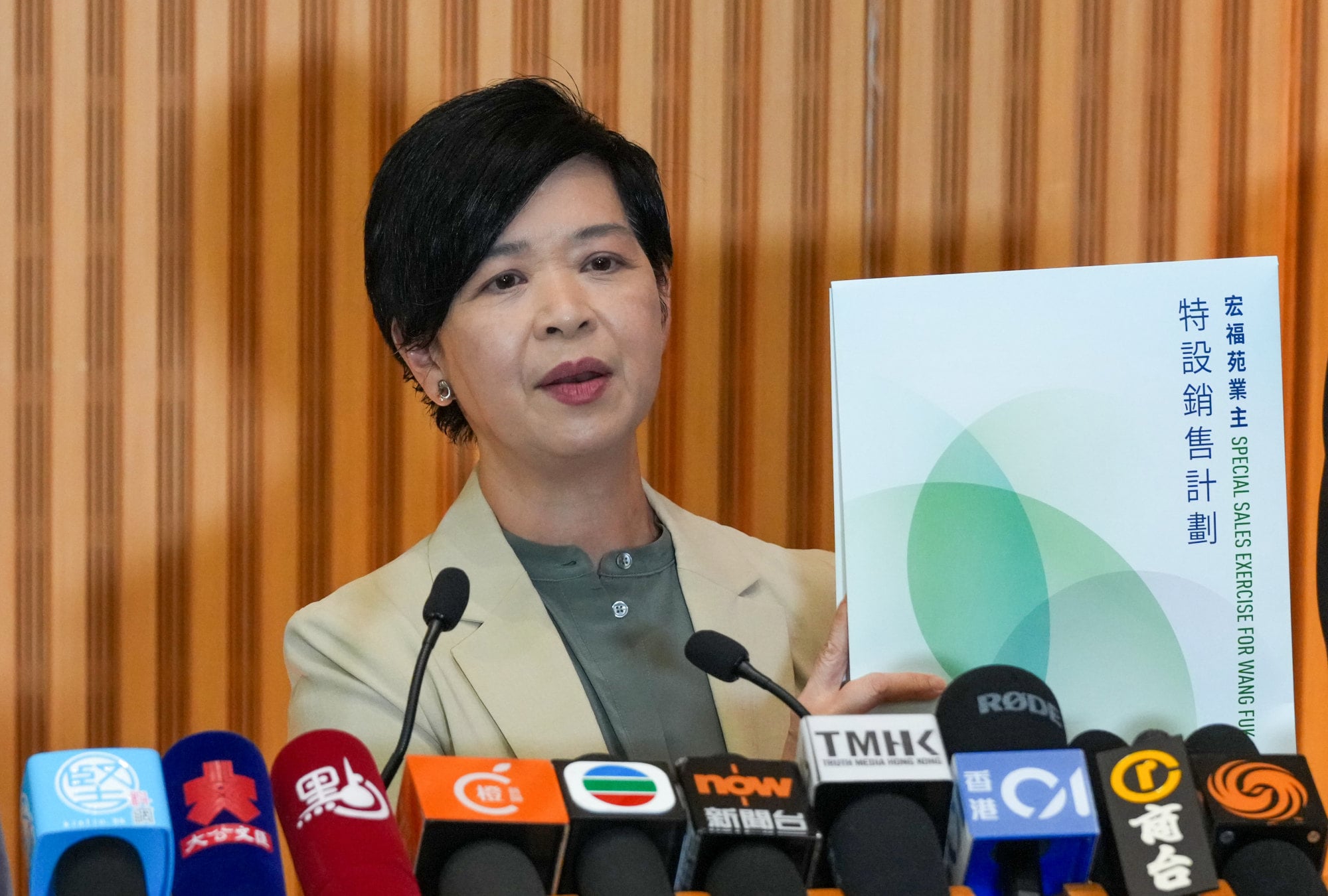
“The fire resulted in the death of 168 people, including a firefighter who lost his life while bravely fighting the fire; it has caused pain and sorrow to the affected families and the community. The political team will take political accountability,” Lee said.
“I have considered a wide range of factors including the officials’ role in the matter, the officials’ policy portfolio and its relation to the incident, whether the problem relates to policy or execution, the performance of the subordinates [and] the large amount of work the political team will have to do in the time ahead.”
When asked whether the other three ministers should also be held accountable, Lee said: “I have made this political decision after considering all the factors ... I balanced all these factors.”
Lee said that he had instructed his cabinet to make every effort to execute the reforms in the wake of the blaze, draw lessons from the tragedy to strengthen leadership and adopt a results-oriented governance approach.
On his own political career, the city leader dismissed the question of whether he should assume accountability and said he decided to carry on after “self-reflection”.
“As the person primarily responsible for the government, one of my most important duties is to lead the administration in confronting the problems, resolving the problems and carrying out the substantial tasks ahead,” Lee said.
“In my capacity as head of the government and chief executive, I apologise to the victims and the public. I will fulfil my responsibility, lead the government to address the problems, implement the extensive work ahead and carry out comprehensive reforms so that similar tragedies will never happen again.”
Deputy Financial Secretary Michael Wong Wai-lun concurrently assumed the post of acting secretary for housing.
Ho’s departure follows the resignation of several senior officials in similar circumstances.
In 2003, Regina Ip Lau Suk-yee resigned as secretary for security amid public anger over anti-subversion legislation. A year later, health minister Yeoh Eng-kiong quit, taking the blame for mishandling the severe acute respiratory syndrome (Sars) outbreak.
Lee also announced the activation of the “Administrative Responsibility Two-tier Investigation Mechanism” under the Heads of Department Accountability System. This would investigate alleged deficiencies and failings among civil servants from the ICU, the Buildings Department, the Fire Services Department and the Labour Department.
The report named at least nine officials from the four departments directly involved in the works and related complaints.
A three-member investigation team, led by Maisie Cheng Mei-sze, chairwoman of the Public Service Commission, would gather evidence and propose disciplinary action against anyone found guilty of wrongdoing. The probe is expected to be completed within three months.
Cheng said she expected the panel to open investigations into 40 to 50 civil servants and interview about 100 personnel. When asked whether the inquiry would cover permanent secretaries, the highest-ranking civil servants, she stressed that the team would examine all relevant officials regardless of seniority.
Several officials who previously led those departments have since moved to higher positions.
They include current Secretary for Culture, Sports and Tourism Rosanna Law Shuk-pui, who was permanent secretary for housing from 2023 to 2024 and directly oversaw the ICU, and Permanent Secretary for Education May Chan Wing-shiu, who was commissioner for labour from 2022 to 2025.
Asked how authorities would pursue accountability of former public servants, Secretary for the Civil Service Ingrid Yeung Ho Poi-yan said authorities could withhold or suspend pension payments to those found guilty of misconduct.
Veteran political commentator Sonny Lo Shiu-hing said the resignation of only one minister and the government’s apology, coming nearly a year after the disaster, were “relatively little and too late” and would not satisfy the public or the families of the victims, given the unprecedented seriousness of the disaster.
He expected more officials to be held accountable after the internal disciplinary investigation and suggested the government publish a reform timetable, in a bid to appease the public. -- SOUTH CHINA MORNING POST