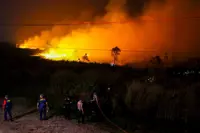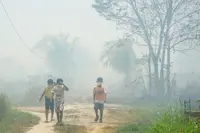
JAKARTA; Thick haze from forest and land fires has blanketed South Papua and the surrounding region, with pollution allegedly exacerbated by land clearing for food estate projects in the province, as the country’s easternmost island remains excluded from firefighting priorities.
The Merauke estate occupies 2.3 million hectares of land in the province, nearly twice the size of Greater Tokyo. It is a national strategic project (PSN) established for the development of rice, sugarcane and other plantations, as well as logistical hubs.
Ongoing monitoring by Papua-focused watchdog Pusaka Bentala Rakyat found that wildfire smoke had intensified throughout October in Merauke, including in parts of the estate where fires were reportedly ignited to clear land for rice and sugarcane cultivation.
“The fires have been spiralling out of control, particularly in areas plotted for the PSN,” Pusaka Bentala Rakyat executive director Franky Samperante told The Jakarta Post on Wednesday.
In low-lying Merauke, fires are common, as indigenous communities use controlled small burns as part of their traditional management of grasslands for agricultural purposes.
However, since mid-August, the group has documented multiple large-scale blazes originating from the Merauke estate, including around parts of a 58-kilometre-long food estate corridor stretching from near Wanam village in Ilwayab district to Muting district.
The land clearing was allegedly carried out to pave the way for the construction of a road and an airport.
In a separate report, environmental group the Indonesian Forum for the Environment (Walhi) recorded 807 fire hotspots with high confidence levels inside the PSN between January and August. The monitored hotspots were located in areas operated by both the government and selected private contractors.
“There is no room for a PSN to dodge accountability for environmental risks and damage,” said Walhi campaign coordinator Uli Arta Siagian.
Officials from the Agriculture Ministry did not respond to The Jakarta Post’s request for comment at the time of publication.
The food and energy estate was launched under former president Joko “Jokowi” Widodo’s administration and later continued by President Prabowo Subianto. The project aims to help the country achieve food and energy self-sufficiency.
However, the project has faced criticism over the high risk of deforestation and the increasing militarisation of the estates.
Since 2024, the food estate has received substantial backing through the deployment of Indonesian Military (TNI) personnel in newly established territorial development infantry battalions (Yonif TP).
The project also involves Brigade Pangan (food brigade), a group of civilian farmers deployed and supervised by the TNI’s village supervisory non-commissioned officers (babinsa).
Indonesian Military (TNI) personnel carry flags of new military units on Oct. 5 during a ceremony commemorating the TNI’s 81st anniversary at the force’s headquarters in Cilangkap, East Jakarta. President Prabowo Subianto inaugurated 204 new TNI units, including six regional commands and 150 territorial development infantry battalions (Yonif TP). (Antara/Galih Pradipta)
The country’s easternmost island has been affected by a decades-long conflict between Indonesian security forces and Papuan separatists, making the increased military presence a concern for civilian security.
Although the TNI has been assisting with firefighting operations, Franky of Pusaka argued that the alleged burning highlighted a contradiction, as land clearing under military oversight could increase the risk of human rights and environmental violations in Papua.
TNI spokesperson Brig. Gen. Muhammad Nas and Merauke-headquartered Mandala Trikora Command spokesperson Lt. Col. Ronny W. Koesuma did not respond to The Jakarta Post’s request for comment at the time of publication.
The government has been conducting firefighting and cloud-seeding operations in six priority provinces in Kalimantan and Sumatra, which have been heavily affected by forest and peatland fires. Haze from the blazes has reached neighbouring Malaysia and Singapore.
However, Papua remains excluded from the regions prioritised for these efforts, despite smoke from fires on the island reaching Timor-Leste.
The Europe-based Earth observation platform Copernicus Atmosphere Monitoring Service (CAMS) has tracked a “much higher than normal” concentration of burning and fire emissions in the region since late July, with microscopic airborne pollutants mostly travelling west and north-west.
“Our data, and the satellite observations it is based on, also show a high concentration of burning in southern parts of Papua and also Papua New Guinea,” CAMS senior scientist Mark Parrington said on Tuesday.
Timor-Leste authorities closed schools across the country for three days from Oct. 15 after thick haze made air quality unsafe, including in the capital, Dili.
The haze has also affected health in South Papua, with at least 451 cases of respiratory illnesses recorded at Mopah Baru community health centre (Puskesmas) in Merauke regency throughout September. This represented a 50 per cent increase compared with the previous two months.
The Transportation Ministry said earlier this week that haze had disrupted operations at 16 airports across Papua between Oct. 13 and 17.
The National Disaster Mitigation Agency (BNPB) said all blazes in South Papua had so far been contained, while acknowledging that the region still needed more firefighting resources. - Jakarta Post/ANN