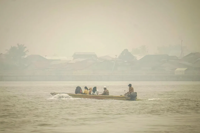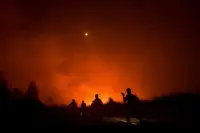
JAKARTA: Indonesia’s refusal to declare the prolonged forest fires a national disaster has drawn mounting criticism as hae affects millions at home and abroad, prompting Malaysia’s carriers to cancel flights and Singapore to revive a health subsidy scheme for the first time in more than a decade.
Greenpeace forest campaigner Belgis Habiba said on Tuesday (Oct 13) that the scale of crisis and their impact on communities warranted declaring a national disaster. She criticised the government for failing to prevent the fires despite longstanding scientific warnings about the risk of prolonged drought linked to El Niño this year.
“This situation hasn’t been handled seriously, evidenced by the failure to declare the [fires and haze] a national disaster,” she said.
The Indonesian Forum for the Environment (Walhi) similarly criticised the government’s ineffective response and questioned its reluctance to accept foreign assistance. “The government has struggled with a crisis of its own making from the get-go. It should’ve taken stronger mitigation efforts early on,” Walhi campaigner Uli Arta Siagian said.
Uli cautioned, however, that declaring a national disaster should not allow the fires to be framed as a natural calamity, potentially absolving companies of responsibility for fires on their concession areas: “Even without the status designation, a government with a sense of crisis and humanity would open the door to foreign help, because public safety should come first.”
House of Representatives Commission IV member Daniel Johan, who oversees forestry, said declaring a national disaster could enable the government to allocate more funding and manpower for firefighting.
“The House fully supports if the government wants to declare the forest and land fires a national disaster, because our top priority is the safety of the people in Kalimantan, Sumatra and other affected areas,” the National Awakening Party (PKB) politician said on Tuesday.
Going it alone
The criticism followed Coordinating Political and Security Affairs Minister Dudung Abdurachman’s statement on Monday that the government had no plans to declare the fires a national disaster.
“We are still capable of handling it,” Dudung said after meeting with President Prabowo Subianto and senior ministry officials, adding that the President had ordered authorities to intensify firefighting and mitigation efforts to bring the fires under control “as soon as possible”.
Dudung said international assistance had not been discussed at the meeting, although he acknowledged concerns from neighbouring countries over the transboundary haze. Malaysia and Singapore have offered to help Indonesia tackle the fires as the haze has disrupted air travel, prompted school closures and raised health concerns.
On Tuesday, Malaysia Airlines canceled flights to and from Jeddah and Madinah until Oct. 17, while low-cost carrier Firefly extended cancellations between Kuala Lumpur and Singapore through Wednesday.
Singapore, which ranked among the world’s most polluted major cities in recent days, has reactivated subsidies for haze-related health care for the first time since 2015, when smoke from Indonesian fires blanketed the region for weeks.
Malaysian Prime Minister Datuk Seri Anwar Ibrahim said last Thursday that he had contacted Prabowo over the “alarming” level of haze affecting Malaysia and the wider region. Meanwhile, Singapore’s Minister for Sustainability and the Environment, Grace Fu, said over the weekend that she had contacted Indonesian Environment Minister Jumhur Hidayat to offer support.
The offers come as Indonesia grapples with a severe fire season, with environmental groups pointing to deliberate land clearing by companies and individuals as a major cause of the blazes. Persistent fires have also strained fire fighting volunteers, forcing some who worked in Tanjung Puting National Park in Central Kalimantan to give up amid lack of government support.
At least four firefighter volunteers have died in the line of duty. The government has continued to handle the fires by itself, focusing efforts across six priority provinces, namely Central Kalimantan, South Kalimantan, West Kalimantan, South Sumatra, Jambi and Riau.
At Monday’s meeting, President Prabowo ordered authorities to pay particular attention to Central Kalimantan, where more than 513 hectares had recently burned in the Tanjung Puting National Park. - The Jakarta Post/ANN