




Amid rising tensions over artificial intelligence (AI) competition and global concerns about the technology, China appears to have an edge over the US and European Union (EU) in trust to regulate AI among mostly middle-income countries.
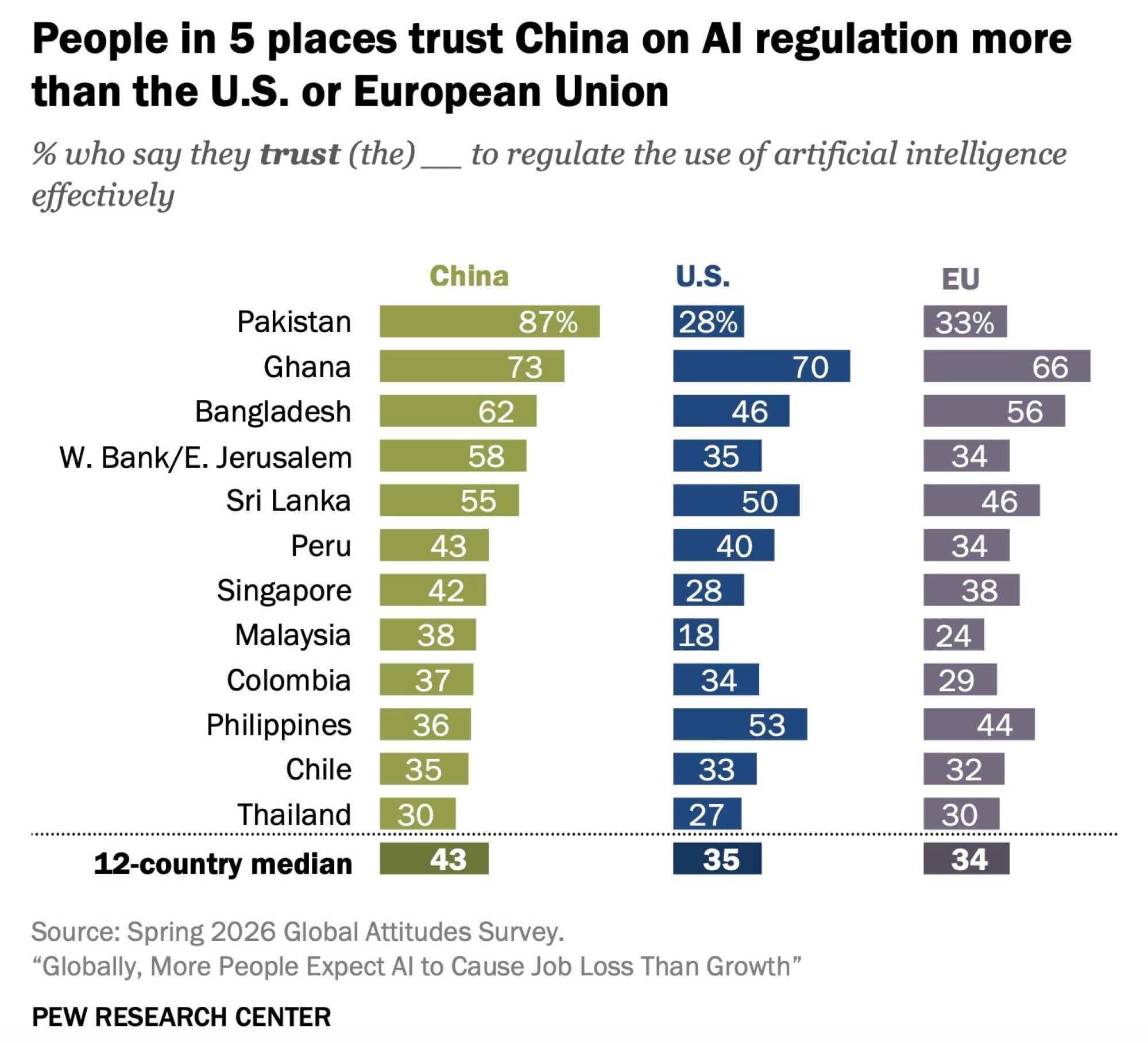
A new Pew Research Centre report released on Thursday found that, on a median basis across 11 countries and two territories, more people trust China than the US or the EU to regulate AI effectively. China was not among the countries surveyed in the broader report.
“Middle-income countries tend to have more positive views of China than high-income countries,” Pew’s associate director of research Laura Silver told the South China Morning Post.
“We see that trust in a country to regulate AI and views of that country tend to be closely related.”
The 11 countries are Bangladesh, Chile, Colombia, Ghana, Malaysia, Pakistan, Peru, the Philippines, Singapore, Sri Lanka and Thailand. The two territories are the West Bank and East Jerusalem.
Most, but not all, of the nations are middle-income countries. Pew said the group skews middle-income because it consisted largely of countries newly added to this year’s survey.
A median of 43 per cent across these countries said they trusted China to regulate AI effectively, compared with 35 per cent for the US and 34 per cent for the EU.
China was the country people trusted most to regulate AI in five of the places surveyed: Bangladesh, Malaysia, Pakistan, Sri Lanka and the West Bank and East Jerusalem. The gap was widest in Pakistan, where 87 per cent said they trusted China to regulate AI, compared with 28 per cent for the US and 33 per cent for the EU.
The Philippines was the only country where the US was more trusted than both China and the EU.
The findings contrast with Pew’s 2025 survey of a different group of 25 countries. That survey found a median of 53 per cent trusted the EU to regulate AI effectively, compared with 37 per cent for the US and 27 per cent for China.
Trust in China was relatively strong in four middle-income countries surveyed in 2025 – Kenya, Nigeria, South Africa and Indonesia.
Silver said views of China “have risen in many places since last year”, which likely contributed to some of the high levels of trust in China on AI regulation this year.
The report comes as Washington and Beijing spar over AI and work to structure a long-planned AI dialogue ahead of a planned visit by Chinese President Xi Jinping to meet US President Donald Trump in the US next week.
The two sides have clashed over a wide range of AI-related issues, including chip export controls, model distillation and intellectual property as each country figures out how to handle AI’s disruptive effects on jobs and industry.
The Chinese embassy in Washington said China advocates a people-centred, open and inclusive approach to AI and supports dialogue and cooperation.
“China stands ready to work with all parties to bridge the digital divide, strengthen international cooperation and global AI governance,” the embassy’s spokesperson Liu Chang said.
The White House did not respond to a request for comment.
Chris Miller, a senior fellow at the American Enterprise Institute, downplayed China’s stronger showing in some middle-income countries.
“In terms of trust in China versus the US, AI companies are unlikely to focus heavily on the views of small economies,” he said, because the primary markets will be the US, Europe and the major Asian economies.
In the long run, Miller said, he expects each country to impose its own AI regulations, much as countries have developed somewhat different rules governing social media.
The report also found sharp anxiety in wealthy countries over AI’s effect on jobs. The concern was most pronounced in Australia and South Korea, where 76 per cent said AI would lead to job losses, and in the US, where 71 per cent said the same – up seven percentage points from when Pew last asked the question in 2024.
Trump has meanwhile dismissed growing domestic concern over AI, calling warnings about the technology’s risks a “hoax” and rejecting calls for stronger guardrails.
“There is a SICK conspiracy going on against AI and Data Centers, and the only one that is happy about it is China. WHOEVER WINS AI, WINS!” he wrote on social media. -- SOUTH CHINA MORNING POST


