




Nestled between the Tianshan Mountains and the Gobi Desert, the Hami oasis in Xinjiang Uygur autonomous region is a land of little rain, battered by wind and sand year-round.
It is also home to the region’s oldest known burial site, the Tianshanbeilu cemetery, located around 500km (310 miles) east of Urumqi, the regional capital. More than 700 Bronze Age tombs have been unearthed here, long assumed to belong to Eurasian nomads who migrated eastward from the steppes.
But a study published on Friday in the journal Science upends that view, revealing a previously unknown, genetically mixed population that lived in the eastern Tianshan region 3,600 years ago, during China’s Shang dynasty (1600-1050BC).
About half of this population’s ancestry can be traced to the millet-farming groups of the Middle and Late Neolithic period (around 4000-2000BC) along the Yellow River. The other half originated with Chemurchek-related populations in the Altai and Dzungaria regions.
“These interactions began nearly 1,800 years before the historic Silk Road, revealing deep prehistoric foundations for trans-Eurasian mobility and exchange,” wrote corresponding author Fu Qiaomei, a researcher at the Institute of Vertebrate Palaeontology and Palaeoanthropology, Chinese Academy of Sciences.
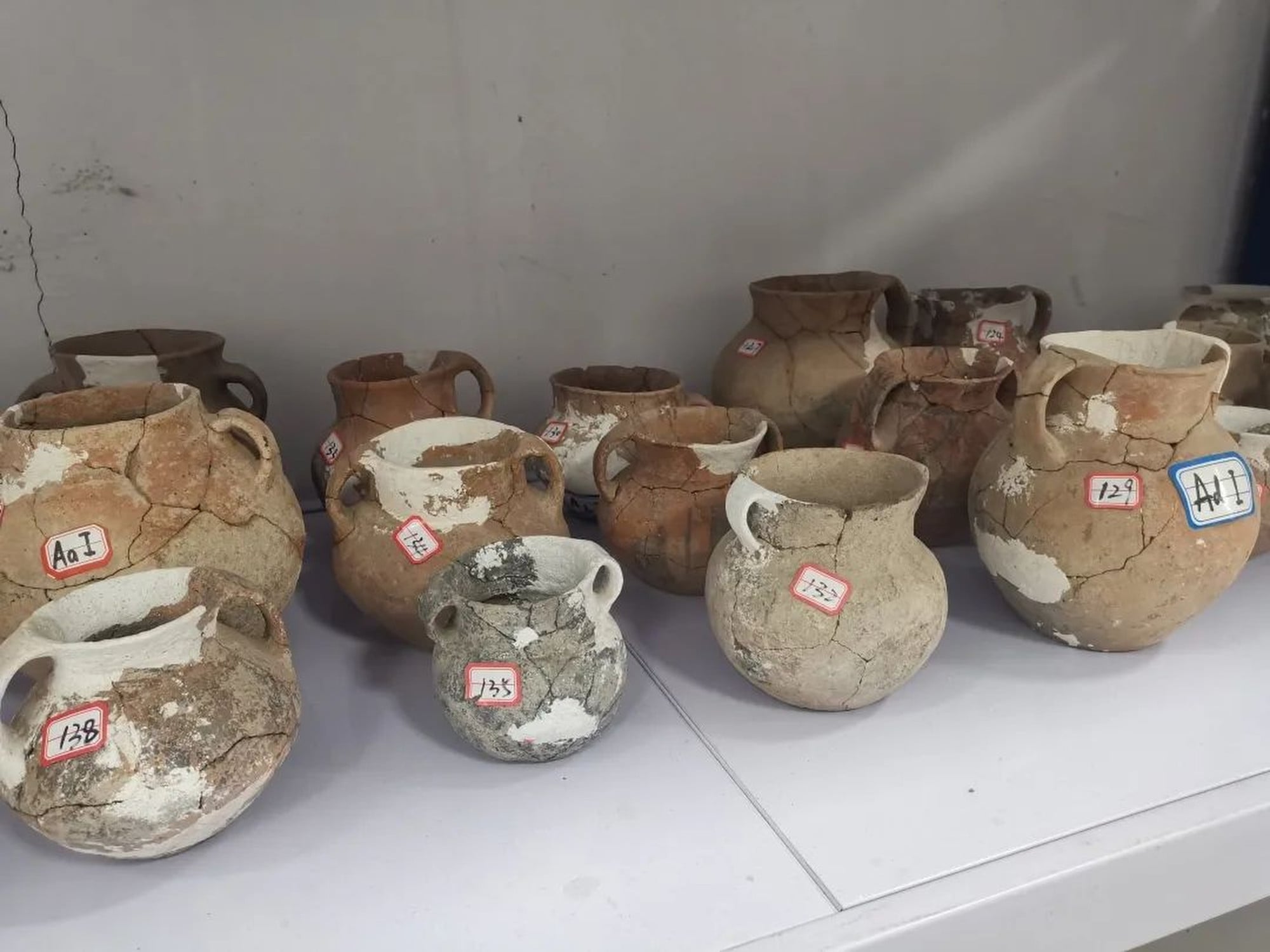
The Tianshanbeilu cemetery has vast expanses of evenly spaced circular pits or rectangular burial grounds that contain one or more human skeletons, dating back between 3,000 and 4,000 years. The circular tomb chambers also contain burial objects such as bronze and pottery.
The researchers obtained whole-genome data from 135 ancient individuals across 11 sites at the cemetery. The oldest of these people lived around 3,580 years ago.
The scientists combined this data set with 735 published ancient genomes and 2,850 modern samples from previous databases.
By analysing the genetic data, they found that most Bronze Age individuals from the eastern Tianshan region belonged to a distinct, newly discovered genetic group whose members shared remarkably similar ancestry.
Compared with other ancient Xinjiang populations, this group was genetically closer to modern East Asians. At the same time, they had a mix of both Eastern and Western Eurasian heritage – a finding consistent with local archaeological evidence.
As an oasis, Hami was visited by travellers moving between east and west and was home to both grassland nomadic culture and East Asian crop cultivation.
The researchers’ genetic modelling showed the population was a mix of East Asian roots and ancestry from the Chemurchek – a Bronze Age culture distributed along the southern foothills of the Altai Mountains in Xinjiang.
Human samples from tombs at the Tianshanbeilu cemetery have a nearly identical genetic composition, suggesting that this core Bronze Age population with mixed ancestral origins was widely distributed across the eastern Tianshan region.
Further genetic analysis revealed that more DNA from outside groups entered the local gene pool starting around 1000BC, though the local Bronze Age population remained the genetic foundation.
This shows that Iron Age populations in Xinjiang grew out of repeated waves of genetic mixing, combining the local Bronze Age population with groups arriving from East Asia, the Eurasian steppe and Central Asia.
The findings reveal that long before the Silk Road emerged, human migration, crop dispersal and cultural transmission between East and West had already become deeply intertwined in what is now China’s Xinjiang region. -- SOUTH CHINA MORNING POST


