
A lack of mutual trust and confidence haunts Sino-US relations, a major security conference in Beijing has heard, just a week before Xi Jinping travels to America for his first state visit there in over a decade.
“[While] we have the agreement on this constructive strategic stability, we don’t have the illusion that things will be easy going ahead. There are always problems, sometimes very big problems,” said Cui Tiankai, a former Chinese ambassador to Washington, at a panel of the Xiangshan Forum on Tuesday.
Cui praised the stability in bilateral ties since Xi hosted US President Donald Trump in May, including in terms of regular exchanges in diplomacy, economics, the military and law enforcement.
“I expect things will remain the same in the next few months,” he said.
However, Cui listed a number of issues in China-US relations that Beijing still believed needed to be taken seriously, saying “there are more attempts at more tariffs, more restrictions and sanctions against Chinese companies or even research and higher learning institutions”.
The challenge that still needed to be overcome was the building of trust and confidence, he said.
“I hope our American friends will have trust in our policy statements [and that] they will not see Chinese policy statements just as rhetoric,” Cui added.
“For instance, when we say we want to be a partner and friend to the United States, we mean what we say ... when we say the Taiwan question is the red line of the red lines, you better trust we mean what we say.”
Beijing sees Taiwan as part of China to be reunited by force if necessary. Most countries, including the United States, do not recognise Taiwan as an independent state, but Washington is opposed to any attempt to take the self-ruled island by force and is committed to supplying it with weapons.
Cui’s comments came just over a week before Xi is expected to travel to Washington, the Chinese leader’s first state visit to the US since 2015.
Despite weeks of preparations, Beijing has yet to officially confirm Xi’s schedule. On this point, Cui simply said it was necessary to wait for an “official announcement”.
Trump announced the US invitation to Xi during his own state visit to Beijing in May, when the two sides agreed to seek strategic stability.
According to David Finkelstein of the US-based Centre for Naval Analyses, the bilateral relationship was “in a better place after the summit” than it was beforehand.
The consensus among analysts was that US-China relations had been more stable since Trump’s Beijing trip, Finkelstein said, but it was “still quite fragile”.
The May summit had focused only on trade and investment issues, he added, with these areas representing just some of the points of dispute between the two sides.
According to Finkelstein, strategic stability is critical in defence matters, particularly in crisis management.
He said one sign of progress was the first meeting between Yang Zhibin, commander of the People’s Liberation Army’s Eastern Theatre Command, and US Navy Admiral Samuel Paparo on the sidelines of a conference for Indo-Pacific defence chiefs in Canada earlier this month.
The meeting ended a two-year break in theatre-level military contact between China and the US.
“I think all of us in the US agree that crisis management between the two sides is weak,” Finkelstein said. “We could do a lot better there.”
A dialogue on nuclear issues, emerging technologies and strategic domains, such as cyber, hypersonic and space, would help build strategic confidence, he added.
The three-day Xiangshan Forum, China’s most important annual defence gathering, is taking place in the Chinese capital from Tuesday to Thursday. It is widely seen as Beijing’s answer to the Shangri-La Dialogue held in Singapore.
China this year is hosting defence officials and scholars from nearly 100 countries.
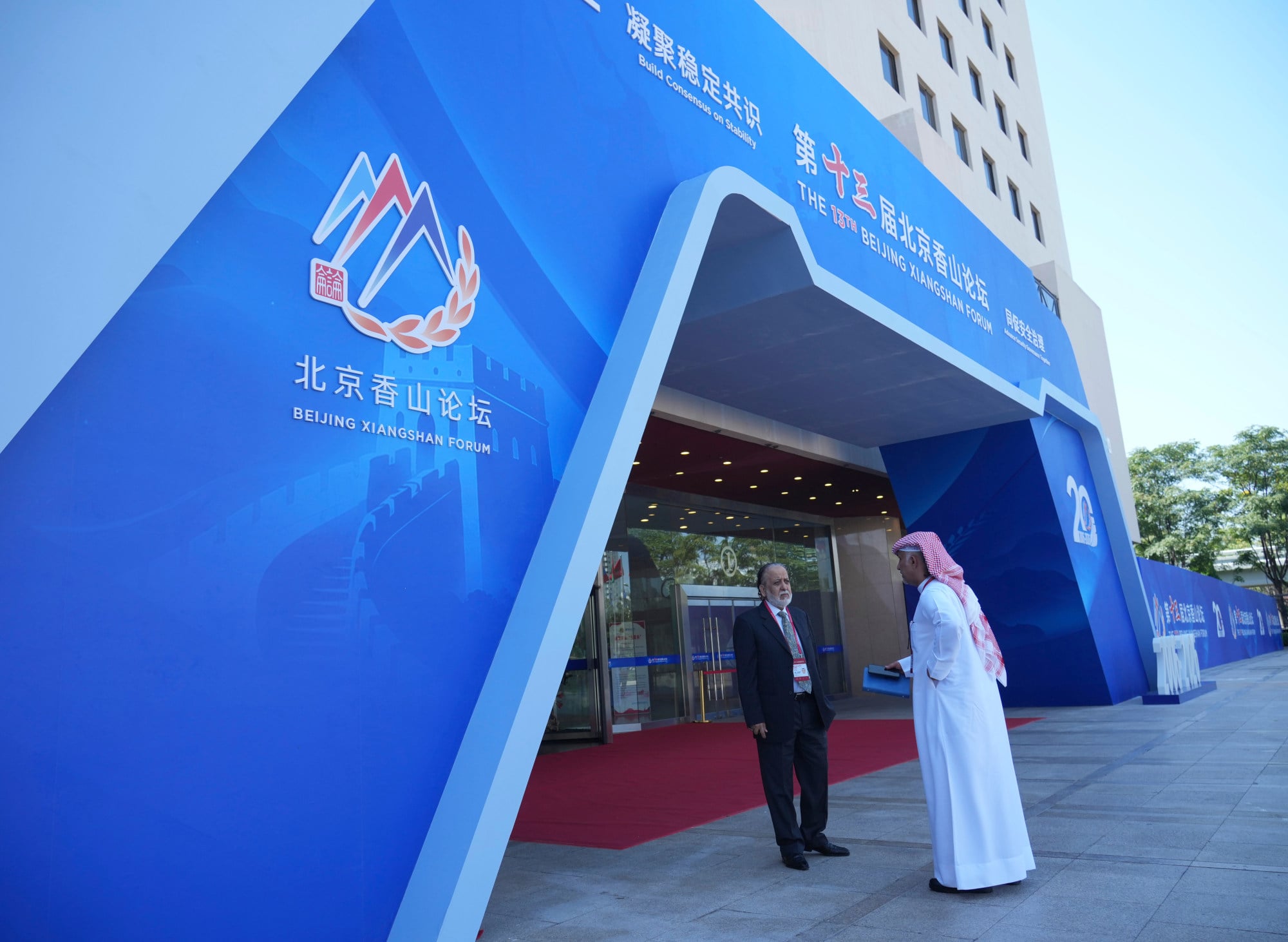
No official delegations from Japan or the Philippines are attending, according to people familiar with the matter.
The US had originally planned to send Cynthia “Xanthi” Carras, the Pentagon’s principal director for China, Taiwan and Mongolia, to lead its delegation. But she cancelled her attendance days before the forum, according to two sources familiar with the matter.
One source said Carras pulled out because of an illness. Another source said Brigadier General Stacy Kihara, the senior defence official at the US embassy in Beijing, replaced Carras in leading the American delegation.
Chinese Defence Minister Dong Jun is expected to outline Beijing’s security position in a keynote speech at the forum’s opening ceremony on Wednesday morning.
Dong on Tuesday held separate meetings in Beijing with senior officials attending the forum, including the defence ministers of Armenia, Azerbaijan, Belarus, Kyrgyzstan and Myanmar, according to China’s defence ministry.
Dong also met with Asean Secretary General Kao Kim Hourn and Brunei’s coordinating minister for national security, Halbi bin Haji Mohd Yussof.
Meanwhile, Wu Xinbo, dean of the Institute of International Studies at Fudan University, said Trump might view stable US-China relations as an “asset” ahead of America’s midterm elections in November.
According to Wu, who hosted Tuesday’s panel, Trump is unlikely to take action on Taiwan, including through arms sales to the island, that would upset Beijing in the period between the summit and the midterm elections.
Cui said the elections had “no impact” on Sino-US relations.
“For the past few years, people have told me that the only thing that is still bipartisan is to be tough on China,” he added. “Hopefully, there could be a new bipartisan agreement that we should together build constructive strategic stability.” -- SOUTH CHINA MORNING POST