




Okinawa’s election on Sunday of a governor backed by Japan’s ruling party ended 12 years of local leadership opposed to the relocation of a US airbase and elements of Tokyo’s defence build-up plans.
While experts say that Genta Koja’s victory will not give Tokyo any new military authority in the region, it could lead to closer integration of civilian infrastructure into Japan’s defence network in case of a conflict – including one over Taiwan.
Koja’s election would give Tokyo “room to expand its so-called Nansei shift, that is to concentrate its military build-up in the southwestern part of Japan to deter China’s military presence in the East and South China seas”, said Sebastian Maslow, an associate professor at the University of Tokyo.
Maslow said much of this shift would probably have happened regardless of the election result. But with a prefectural government backed by Prime Minister Sanae Takaichi’s Liberal Democratic Party, the process would be “less noisy and perhaps faster”.
Michael Bosack, director of the Parley Policy Institute, said Koja’s victory suggested Okinawan politics could become more receptive to a greater role for the prefecture in Japan’s defence planning.
But Koja has drawn limits around his support for Tokyo’s defence build-up. During the campaign, he said he understood the need for the Nansei shift but believed there was no need “at present” to deploy long-range missiles in Okinawa.
The clearest sign of Koja’s political break with his predecessors is his stance on the decades-old dispute over the US Marine Corps’ Futenma airbase in Ginowan, a densely populated city on Okinawa’s main island.
Tokyo and Washington agreed in 1996 to relocate the station once a replacement facility was completed elsewhere in Okinawa. Successive Okinawan governors opposed relocating Futenma within the island but that facility is now being built beside the existing US Marine Corps’ Camp Schwab in Okinawa’s less-populated area of Henoko.
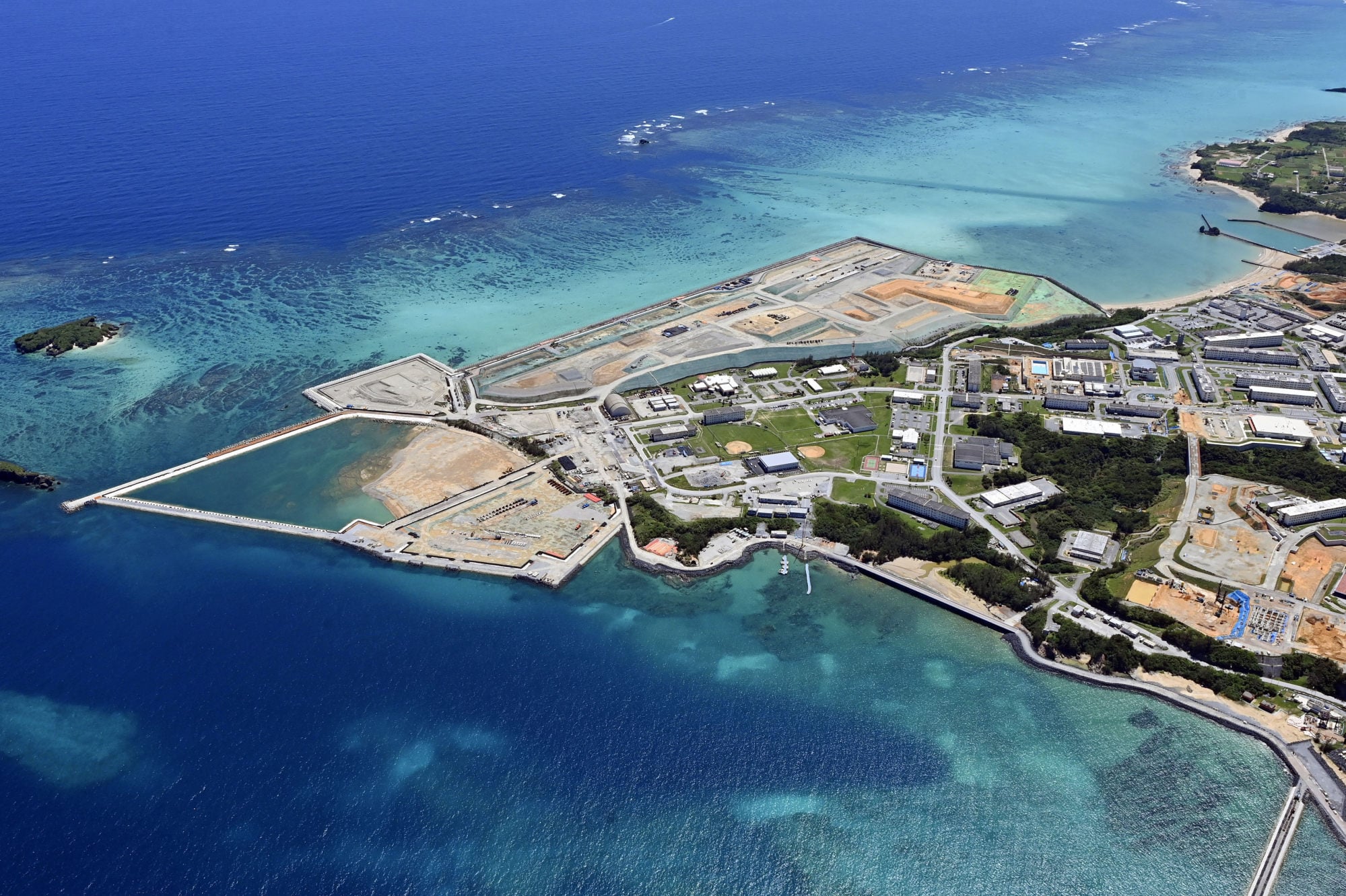
Unlike his predecessors, Koja accepts the relocation of the airbase, although he has called for a clearer timetable for the closure of the Futenma base.
“Koja’s win removes the political deadlock over the base issue,” Maslow said, adding that while anti-base protests would not stop, the election could help drive the relocation forward.
For Beijing, the significance of the Henoko airbase lies less in the US military expanding in the region than in potentially making its presence in Okinawa more durable, reducing a long-standing source of political friction over the alliance’s forward posture near Taiwan.
A more immediate effect of the leadership change could come from Tokyo’s “specified-utilisation” programme, intended to make selected civilian airports and ports more usable by the Self-Defence Forces (SDF) and Japan Coast Guard.
Okinawa’s main airport at Naha is already in the programme and is managed by the central government. The city-managed Ishigaki and Hirara ports are also designated.
By contrast, three prefecture-managed facilities – Ishigaki Airport, Miyako Airport and Nakagusuku Bay Port – remain outside the programme.
The outgoing governor, Denny Tamaki, moved towards accepting their inclusion in February 2025, but eventually decided against it.
Koja, however, indicated during the campaign that he was prepared to move towards accepting the designations after discussions over implementation.
The government says the programme does not turn civilian airports and ports into military bases and that civilian use remains the priority. But it allows arrangements for smoother access and for upgrades that take security requirements into account.
Maslow said Koja’s support for the programme sent “a clear signal” about strengthening Japan’s defence infrastructure and Okinawa’s role in deterring China’s regional military presence.
“These efforts will bolster the islands’ role as defence hubs in the region, especially for evacuation operations in the case of a Taiwan contingency,” he said.
Bosack said that expanding SDF operations into additional Okinawan airports and seaports would be a significant consideration for both Beijing and Tokyo in a Taiwan contingency.
“One of the first considerations for military planners is logistics throughput and space,” he said. “There are only so many berthings and aircraft spaces available, so an increase in that capacity is important from both sides’ planning considerations.”
He said US and Japanese planners had previously considered using additional civilian air and seaports for military purposes and non-combatant evacuation operations, but politics had limited how far such planning could go.
The implications are particularly significant on Ishigaki and Miyako islands, where Japan has already stationed Ground Self-Defence Force units.
Misato Matsuoka, an associate professor at Teikyo University, said those facilities could add redundancy to Japan’s logistics network by providing alternative routes for moving personnel, fuel, equipment and supplies if major military bases were damaged or temporarily unavailable.
But their military value would, at least for now, be constrained by limited parking, storage and loading capacity. Matsuoka also warned that increased military use could invite closer Chinese scrutiny and expose those sites to attack in a conflict. -- SOUTH CHINA MORNING POST


