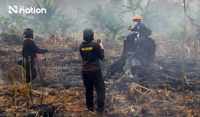
BANGKOK: Wildfires in Indonesia have burned more than 400,000 rai (64,000 hectares) over the past week. Thailand’s Geo-Informatics and Space Technology Development Agency (GISTDA) said current wind patterns had not brought a direct haze impact to southern Thailand.
Indonesia’s fires have continued for several weeks, becoming a regional environmental concern. Satellite imagery shows dense smoke rising into the atmosphere, with impacts reported across Indonesia and neighbouring countries and concerns about haze potentially reaching Thailand.
Indonesia recorded 12,241 hotspots on Tuesday (Sept 15), according to information from GISTDA’s Disaster Platform and the Suomi National Polar-orbiting Partnership (Suomi NPP) satellite. Hotspots were concentrated particularly on Sumatra and in southern Kalimantan, the Indonesian part of Borneo.
A GISTDA satellite graphic dated Sept 15 shows smoke from Indonesian wildfires and highlights areas containing fires and hotspots.
Fires were spreading towards Nusantara, Indonesia’s planned new capital, prompting authorities to mobilise resources. The report put the area burned over the preceding week at more than 400,000 rai, equivalent to 64,000 hectares.
Indonesian authorities’ response measures include:
>Deploying personnel to contain the fires and control their spread
>Conducting cloud-seeding operations to encourage rainfall and increase moisture
>Using aircraft to drop water on fires in areas that are difficult to reach
Thick haze has covered six provinces on Sumatra and Borneo, Post Today reported. The report identified four neighbouring countries, including Malaysia, Singapore, Brunei and the Philippines already affected by cross-border pollution from Indonesia’s fires.
More than 50,000 people had developed respiratory illnesses after inhaling wildfire smoke.
GISTDA’s analysis of current wind patterns indicates that haze from Indonesia has not yet directly affected southern Thailand.
Conditions remain uncertain, and residents and relevant authorities in southern Thailand are advised to monitor developments closely.
They should follow efforts to contain the fires in Indonesia, monitor air quality, including fine particulate matter (PM2.5) levels, and watch for changes in wind direction that could carry smoke towards Thailand. - The Nation/ANN