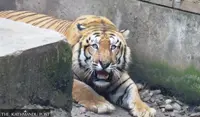
CHITWAN: As Nepal’s tiger population grows, so does the need to capture animals that enter settlements and attack people or livestock. But the country has too few facilities to house rescued tigers, and many of the existing enclosures are designed only for short-term confinement.
The latest national tiger census, released last month, put Nepal’s tiger population at 429. Nineteen are kept either at the Jawalakhel zoo, the country’s only zoo, or in rescue facilities. Chitwan National Park and the surrounding forests have the country’s largest tiger population, with 145 tigers, up from 128 four years ago. Seven tigers are currently being kept in enclosures in Chitwan alone.
Tiger numbers in Chitwan and Parsa national parks have risen by 47 over the past four years. While the population in Bardiya National Park has declined, neighbouring Banke National Park has gained 26 tigers. Every year, tigers that stray into settlements have to be rescued from these areas.
Baburam Lamichhane, a wildlife expert who has studied tigers for years, said 31 tigers had been captured and removed from Chitwan and Parsa national parks and surrounding areas over the past six years, averaging about five a year.
He said 25 tigers had also been captured from the Bardiya and Banke national park areas over the past five years.
Not all tigers living in the wild pose a threat. Lamichhane’s research suggests that at most five per cent of the country’s tigers are likely to become problem animals. But if officials don't deal with such tigers promptly, the loss of human life and livestock could increase, fuelling local resentment towards conservation itself.
Injured tigers or those too old to hunt effectively in the forest often move toward settlements in search of easier prey, particularly dogs and livestock. People can also become targets.
On June 23, a Chitwan National Park team captured an incapacitated tiger after it entered Laxmaniya village in ward 1 of Madi Municipality, in the park’s buffer zone, and killed livestock in a shed.
On August 12, another tiger was captured from the buffer-zone forest in Meghauli after it attacked and killed resident Mangal Boté.
On August 16, park officials captured a third tiger from Piple in ward 1 of Rapti Municipality, in the eastern part of the park. The tiger had entered a settlement and attacked a cow and a resident, injuring both.
Bardiya National Park has the country’s second-largest tiger population, and it also faces recurring conflict as animals enter settlements.
On August 18, park officials captured a tiger from Patalchuli Buffer Zone Community Forest after it repeatedly entered a settlement to prey on livestock. On August 24, officials captured another tiger in ward 4 of Geruwa Rural Municipality.
Abinash Thapa Magar, information officer at Chitwan National Park, said officials had to capture such animals to protect people and livestock.
“If tigers that repeatedly enter settlements are not removed, losses of people and livestock could increase, fuelling anger among local communities and creating an additional challenge for conservation,” he said.
Five years ago, Chitwan recorded 14 tiger attacks in a single year. Lamichhane said two tigers in the Kumroj and Meghauli-Jagatpur areas were responsible for 11 of those incidents.
Capturing a tiger, however, is complex. Chitwan National Park works with a technical team from the National Trust for Nature Conservation to carry out rescues.
A typical operation involves veterinarians, veterinary technicians, a trained person to fire the dart gun, teams that locate the tiger and erect a perimeter of white cloth to prevent it from escaping, and soldiers deployed to protect the park.
Four to six elephants may also be needed.
Teams search for the tiger from elephant-back and, once they locate it, use a dart gun to administer a sedative and capture the animal, according to Thapa Magar.
Once brought under control, the tiger undergoes a health examination. Animals that are old or incapacitated and unable to hunt in the wild cannot simply be released. Even healthy tigers may attack people or other animals when they encounter them unexpectedly, often in self-defence.
Officials keep such animals under observation and release them only if they determine they can safely return to the wild.
Two years ago, on August 5, 2024, a tiger that came to the banks of the Narayani river in Narayanghat early in the morning attacked and injured a resident out for a walk.
Park officials took 16 hours to capture it. After examination showed the tiger was healthy and capable of surviving in the wild, officials kept it in an enclosure for some time before releasing it deep inside the forest.
Tigers released in such circumstances are often fitted with satellite collars so they can be monitored. The collars regularly transmit their location to computers.
But some released tigers have returned to settlements and caused further incidents.
Lamichhane said one tiger captured in Kumroj had been fitted with a satellite collar and released into the forest, only to be recaptured after it caused another incident.
Another tiger followed a similar trajectory. It was captured in Chitwan and taken to an enclosure in Parsa National Park, where it died on April 8, 2024.
Between mid-April and mid-May 2022, officials spotted a tiger near Shishuwar village in western Chitwan. It had not attacked anyone, but park officials decided to capture it because of the potential risk.
An examination found no injuries and showed that the tiger was in good health. Officials decided to return it to the forest and fitted it with a satellite collar for monitoring before releasing it near Kachhuwani post on May 14, 2022.
The tiger then travelled through Parsa National Park to Thori, moved west along the edge of Valmiki Tiger Reserve in Bihar, India, before reaching Triveni and crossing into Nawalparasi. It eventually crossed the Narayani River and followed its banks back towards Shishuwar, near where it had first been captured.
Once the animal returned to the settlement, officials had little choice but to capture it again. It was taken into custody on July 4, 2022 and died in the enclosure on March 30 the following year.
The repeated return of some released tigers to settlements has made authorities increasingly reluctant to release animals once they have been captured.
Reports of tigers entering settlements around Chitwan continue to come in, leaving park officials with a growing problem: where to put the next tiger they capture.
Chitwan currently has space for up to seven tigers. After all the enclosures filled up, the park had to send a newly captured tiger to Parsa National Park on August 16 this year. The enclosures in Bardiya are also at capacity.
Captured tigers are generally kept in holding centres with narrow enclosures designed for emergency confinement for a few days.
They are not intended for long-term stays, but a lack of alternatives means some tigers remain there for extended periods.
“The way rescued tigers are being kept at present is not appropriate and needs to change,” Lamichhane said. “The existing enclosures were built for keeping animals for only a few days in an emergency. But because there are no alternatives, tigers are being kept there for much longer.”
A larger rescue facility was built in Chitwan two years ago. Visitors can buy tickets to see the tigers there.
The facility at Devnagar, about seven kilometres south of Gondrang in Bharatpur, has two concrete enclosures, each measuring 53 by 40 feet and standing 12 feet 4 inches high. Two raised wooden platforms outside the enclosures allow visitors to look inside.
Animal-rights and welfare campaigners have objected to keeping and displaying rescued tigers in this way.
Campaigner Surajan Shrestha says facilities for such animals should cover about one bigha (1.67 acres), citing the Wild Tiger Health Project. They should have adequate water sources and shelter from extreme weather, he said.
“The way captured tigers have been kept until now is inhumane and inappropriate,” Shrestha said. “The government should establish proper rehabilitation centres and invest in their long-term management. These animals should not be used for tourism.”
He said there is already enough opportunity to see tigers in Nepal’s national parks and forests. Rescued animals should instead be allowed to live in peace.
Wildlife experts say Nepal needs clear standards for when a tiger should be rescued and how rescued animals should be managed afterwards.
In India, Lamichhane said, tigers that repeatedly attack people, or those that have become extremely weak because of age or injury and cannot be treated or rehabilitated, may be killed.
Nepal’s National Parks and Wildlife Conservation Act also provides for the killing of elephants that have become habituated to attacking people and tigers that have become habitual man-eaters. But Nepal does not currently practise such a measure.
Before the 1960s, there were cases in which authorities followed official procedures to kill man-eating tigers. In recent decades, however, the practice has disappeared. Authorities generally capture and rescue problem animals and keep them in enclosures instead.
Lamichhane said Nepal urgently needed standards suited to current wildlife-rescue and management needs.
“There should be clear criteria for how each tiger is to be managed, and those standards must be properly implemented,” he said.
He also suggested that tourism could help fund the treatment and long-term care of tigers that cannot be returned to the wild.
“But management should follow a sanctuary model,” he said. “Tourists should not be brought in to see weakened tigers. The animals should be managed in a way that does not interfere with their natural behaviour. When tigers are kept in small rooms with limited space, they become stressed, aggressive and sick.”
Plans are underway to establish rescue centres at six locations across Nepal. Lamichhane said they should be designed and operated on a sanctuary model.
Bed Kumar Dhakal, deputy director general and spokesman for the Department of National Parks and Wildlife Conservation, also acknowledged the need to better manage rescued tigers.
“The enclosures used for rescued tigers are strong enough to prevent the animals from escaping. Beyond that, however, many improvements are needed. The current system is essentially a stopgap arrangement,” Dhakal said.
The department is preparing standards for wildlife rescue centres and wildlife hospitals, he said.
Once the standards are approved, the government plans to manage the facilities with support from federal and provincial governments and conservation organisations, Dhakal said.
He also said provincial zoos could house rescued wildlife and potentially generate revenue through ecotourism. But he stressed that not every rescue centre would become a tourist attraction.
Nepal’s growing tiger population has raised concerns that encounters between tigers and people could become more frequent. But authorities can identify and rescue potentially dangerous animals before they cause further harm.
“That is why tigers that need to be rescued should be captured,” Lamichhane said. “But once they are rescued, they also need to be managed properly. We cannot afford to delay action on either front.”