PHNOM PENH: Cambodia has informed the UNCLOS Conciliation Commission that its goal is to form a treaty with Thailand that will provide a solution that benefits the people of both countries and contributes to peace, cooperation and long-term stability in the region.
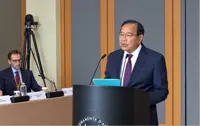
Prak Sokhonn, Minister of Foreign Affairs and International Cooperation, outlined Cambodia’s position during the first meeting of the conciliation mechanism under the UN Convention on the Law of the Sea (UNCLOS), held in Singapore Tuesday (Sept 15).
In a statement, Sokhonn outlined four objectives Cambodia hopes to achieve through the compulsory conciliation process.
“Our foremost objective is to achieve a solution that benefits the people of both countries and contributes to peace, cooperation and long-term stability in the region,” he said.
“To achieve this goal, Cambodia intends to conclude a treaty with Thailand, with the assistance of the commission and in accordance with international law, to establish a single, comprehensive maritime boundary between the two countries,” he added.
According to the minister, another option under the mechanism would be for Cambodia to conclude an agreement with Thailand on joint development and equitable resource sharing between the two states while awaiting a final agreement on the maritime boundary.
As a final scenario, Sokhonn said that if no final agreement could be reached either on the maritime boundary or joint development, Cambodia would ask the commission to prepare a report containing recommendations for both parties.
The recommendations could then serve as a basis for future negotiations between the two sides to reach agreements, in accordance with their obligations under UNCLOS, he said.
Sokhonn also informed the five-member commission and the Thai delegation that Cambodia’s initiation of the mechanism was not intended to escalate tensions, but rather to provide a peaceful way forward in accordance with international law and to build confidence.
He cited Prime Minister Hun Manet as saying that Cambodia and Thailand would both benefit from a fair and sustainable solution guided by international legal experts and consistent with international law.
“A peaceful solution will benefit both countries and contribute to building peace and stability in the region,” Manet noted previously.
Such a solution would protect sovereignty, strengthen confidence, enable the two countries to benefit from energy resources, support development and create new employment opportunities, not only for the present but also for future generations of Cambodians and Thais, the prime minister explained.
The compulsory conciliation mechanism is being overseen by a five-member commission chaired by Australian Katrina Cooper, who was selected as conciliator by both sides.
Cambodia selected Peter Taksøe-Jensen of Denmark and Jean-Marc Thouvenin of France, while Thailand selected Albert J. Hoffmann of South Africa and Rüdiger Wolfrum of Germany. - The Phnom Penh Post/ANN