Taiwan’s top weapons developer has unveiled details of its Chiang Kung, or Strong Bow, anti-ballistic missile system as it seeks legislative funding for mass production to strengthen the island’s air defences amid growing pressure from Beijing.
The government-funded National Chung-Shan Institute of Science and Technology disclosed key specifications of the locally developed system earlier this month, including its hypersonic speed, two-stage solid-fuel propulsion, guidance system and active electronically scanned array (AESA) radar.
The disclosure comes as the government prepares another attempt to secure funding after the system was excluded from a pared-back special defence spending package approved by the opposition-controlled legislature in May.
The defence ministry plans to resubmit Strong Bow and other programmes through a supplementary budget, which the cabinet could consider as early as Thursday before sending it to lawmakers.
The ministry has proposed spending NT$36.1 billion (US$1.13 billion) to produce two Strong Bow systems and 128 interceptor missiles.
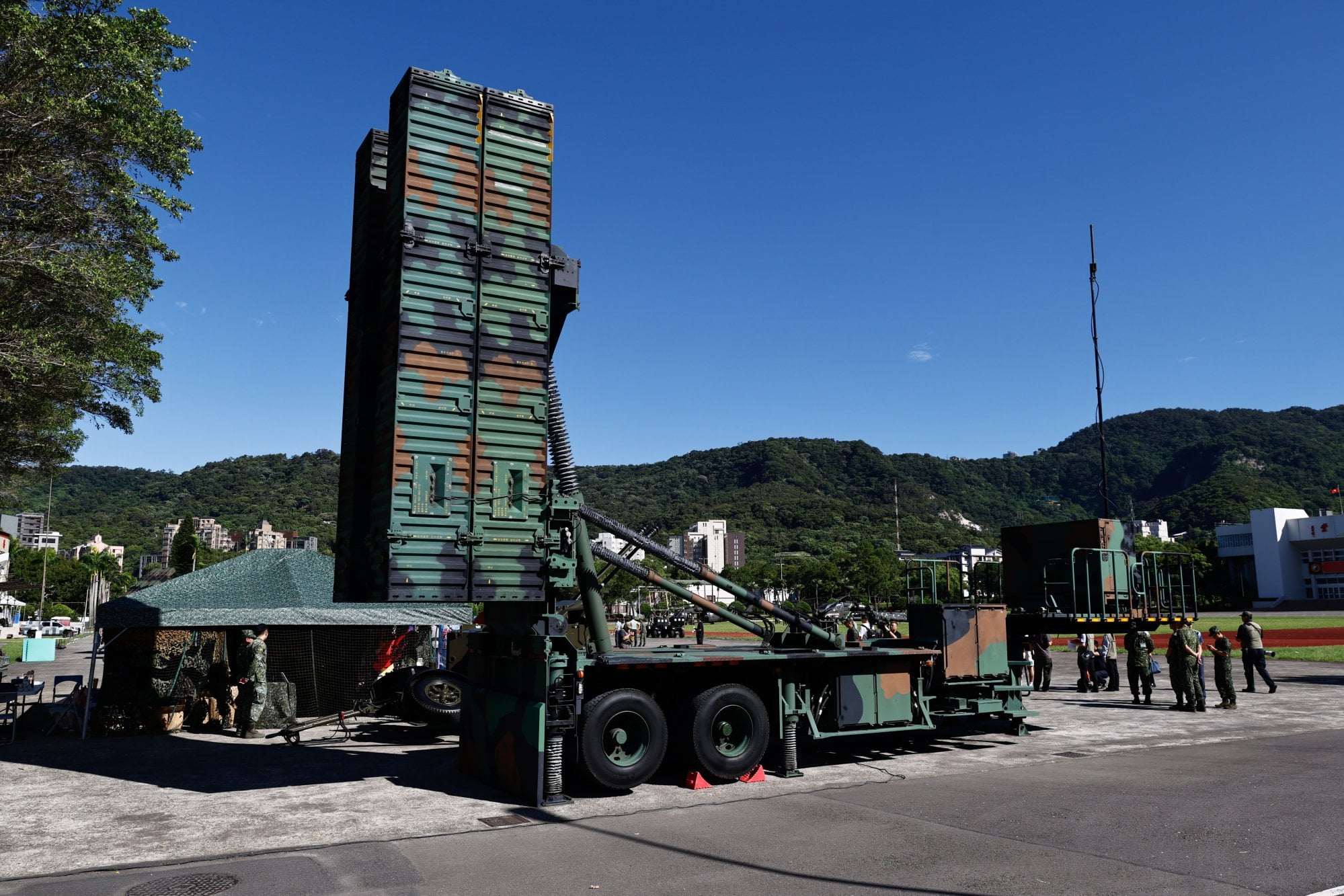
Strong Bow, also referred to as Tien Kung (Sky Bow) IV, is a land-based mid-tier anti-tactical ballistic missile system designed to intercept incoming missiles at altitudes of at least 70km (43 miles) – higher than Taiwan’s existing Patriot and Tien Kung III systems.
According to the institute, the vertically launched missile can reach hypersonic speeds and uses a two-stage solid-fuel rocket motor. It relies on inertial guidance and radar uplink corrections during midcourse flight before switching to an active seeker in the terminal phase.
It also uses thrust-vector control to manoeuvre in the thin atmosphere at high altitudes and carries a high-explosive fragmentation warhead.
The system includes mobile launchers carrying four missile canisters each, tactical command vehicles and an AESA radar capable of identifying and tracking targets, resisting electronic countermeasures and simultaneously engaging multiple tactical ballistic missiles.
The defence ministry said the radar could detect threats at greater ranges and altitudes than those used by the Patriot PAC-3 and Tien Kung III systems.
It has described Strong Bow as the outermost layer of Taiwan’s planned multilayered missile defence network, or “T-Dome”, giving defenders an earlier opportunity to intercept ballistic missiles before lower-tier systems engage those that penetrate the first layer.
Lu Chien-sheng, deputy director of the institute’s Tien Kung programme, has said Strong Bow was developed specifically to counter tactical ballistic missiles and could operate alongside Patriot and Tien Kung III to create a multilayered interception network.
He said its mobile configuration would improve battlefield survivability, while allowing it to command and control other air defence missile units in joint operations.
The defence ministry said Strong Bow had completed operational testing and evaluation and was ready for mass production.
Funding, however, remains the biggest obstacle.
Strong Bow was originally included in the government’s proposed NT$1.25 trillion special defence package, with production scheduled to begin this year and the first integrated locally developed regional air defence system targeted for completion in 2027.
The network would initially link Strong Bow with the Tien Kung III and land-based Tien Chien II missiles. A later phase envisages connecting them with United States-made Patriot and National Advanced Surface-to-Air Missile Systems through the US Integrated Battle Command System as part of the planned T-Dome.
But Strong Bow was among the local programmes excluded after lawmakers approved only about two-thirds of the government’s requested special defence spending earlier this year.
Efforts to shift it into the regular 2027 defence budget have also faced difficulties because of commitments to other locally developed weapons and a peak in payments for US arms purchases.
The government has now turned to supplementary appropriations. Defence ministry comptroller Hsieh Chi-hsien confirmed last week that additional funding was being planned for missile and drone programmes that failed to secure legislative approval.
Analysts have warned that further delays could hamper Taiwan’s efforts to build layered defences against the People’s Liberation Army’s growing ballistic missile arsenal.
Su Tzu-yun, a senior analyst at the government-funded Institute for National Defence and Security Research, said Strong Bow was essentially a new missile despite being designated Tien Kung IV.
“The tactical advantage is that the higher it can fly, the larger the area it can protect,” he said, estimating that a battery could provide 100km to 150km coverage.
Su said Strong Bow had been described as “Taiwan’s version of THAAD”, referring to the US Terminal High Altitude Area Defence system, and estimated its radar detection range was almost 1,000km.
Chi Tung-yun, president of the Taiwan Security and Development Association, said deploying Strong Bow alongside Patriot PAC-3 Missile Segment Enhancement interceptors could give defenders one or two additional opportunities to engage each incoming ballistic missile.
He urged lawmakers “to fund production as soon as possible”, warning that postponing it until 2028 would be “bad news for Taiwan’s missile defence capability” as the PLA continued expanding its ballistic missile forces.
Beijing regards Taiwan as part of China to be reunited by force if necessary. Most countries, including the US, do not recognise Taiwan as an independent state, but Washington opposes any attempt to take the self-ruled island by force and is committed to supplying it with weapons. -- SOUTH CHINA MORNING POST