




China’s global image has rebounded from its pandemic-era lows, with international views of both the country and President Xi Jinping improving as confidence in the United States has declined, according to a new Pew Research Centre survey.
The survey, released on Wednesday, polled more than 45,000 people across 37 countries spanning every region of the world, including many advanced economies and emerging markets, such as Argentina, Australia, France, Ghana, India, Israel, Japan, Mexico, Turkey and the US.
“Views of China were at or near historic lows in many countries during the Covid-19 pandemic but have since steadily increased,” Jonathan Schulman, a research associate at Pew Research Centre, said in a statement to the South China Morning Post.
“Views of the US have declined in many places, and the share of people saying that the US is a reliable partner to their country has similarly fallen sharply.”
The survey was conducted between February and May through telephone, face-to-face and online interviews, during a period when the US was becoming increasingly entangled in the conflict with Iran and other regional crises.
One of the survey’s most notable findings is the shift in relative perceptions of China and the US.
Across the 20 countries that Pew has surveyed consistently over time, all of which were included in this year’s 37-country survey, China now enjoys a higher average favourability rating than the US, with 46 per cent of respondents expressing a favourable view of China, compared with 36 per cent for the US.
In 2023, the US enjoyed a much more favourable image, with 54 per cent of respondents viewing it more positively than China, while only 19 per cent favoured China.
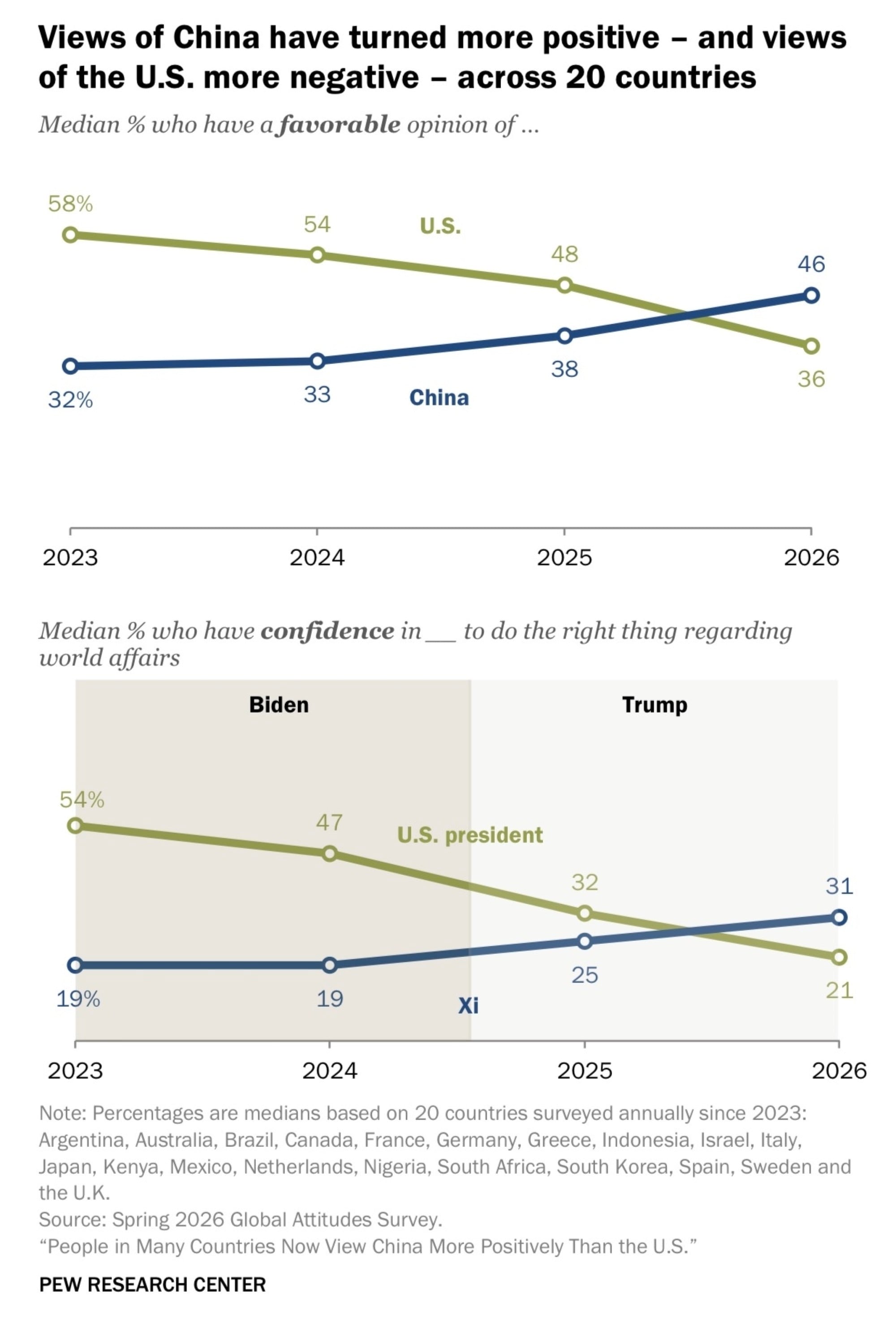
“I was not surprised,” Zack Cooper, a senior fellow at the American Enterprise Institute, said. “The view internationally has become far more negative about the United States in the last year or two.”
Cooper said China’s political stability under Xi has contributed to perceptions of consistency, while leadership changes in Western democracies often produce shifts in foreign policy.
Even in the US, where China is increasingly viewed as a geopolitical competitor, 27 per cent of respondents expressed a favourable view of the country, up from the lows recorded during the pandemic.
Confidence in Xi to do the right thing regarding world affairs has also risen in many countries, although opinions of the Chinese leader remain more negative than positive in most of the wealthier nations surveyed.
Pew has decades of work history studying views of the US and China and their political leaders.
The survey found that favourable views of China are strongest across much of Latin America, Africa and parts of South and Southeast Asia, while attitudes remain considerably less positive in Europe and advanced East Asian economies.
Cooper said many developing countries place greater weight on China’s economic opportunities than on concerns over political freedoms or human rights.
Despite the improvement in China’s overall image, many respondents continued to express concern about the Chinese government’s respect for personal freedoms.
Younger adults, however, were more likely than older respondents to believe China respects individual freedoms.
In Britain, for example, 30 per cent of adults under 35 agreed with that statement, compared with 13 per cent of those aged 50 and older.
The survey also found a decline over the past five years in the share of respondents who believe the US government respects the personal freedoms of its own citizens.
Israel showed the largest gap in perceptions between the two countries, with respondents expressing among the strongest support for the US and among the least favourable views of China. By contrast, several countries in Southeast Asia viewed China substantially more favourably than the US.
Liu Chang, a spokesperson for the Chinese embassy in Washington, said the findings reflected growing international recognition of China’s development and governance.
“We welcome more Americans to visit China for more exchanges, see with their own eyes a true, multidimensional and panoramic picture of China,” Liu said. “A friendly China-US relationship is the aspiration of people in both countries and serves the two sides’ common interests.”
Liu also called on Washington to ease visa and border entry restrictions for Chinese citizens and increase the number of direct flights between the two countries.
The survey also asked respondents an open-ended question about whether they viewed China as an ally or a threat. Respondents in South and Southeast Asia often identified China as one of their country’s top allies.
By contrast, respondents in the Philippines, Japan and Australia were among the most likely to identify China as a threat.
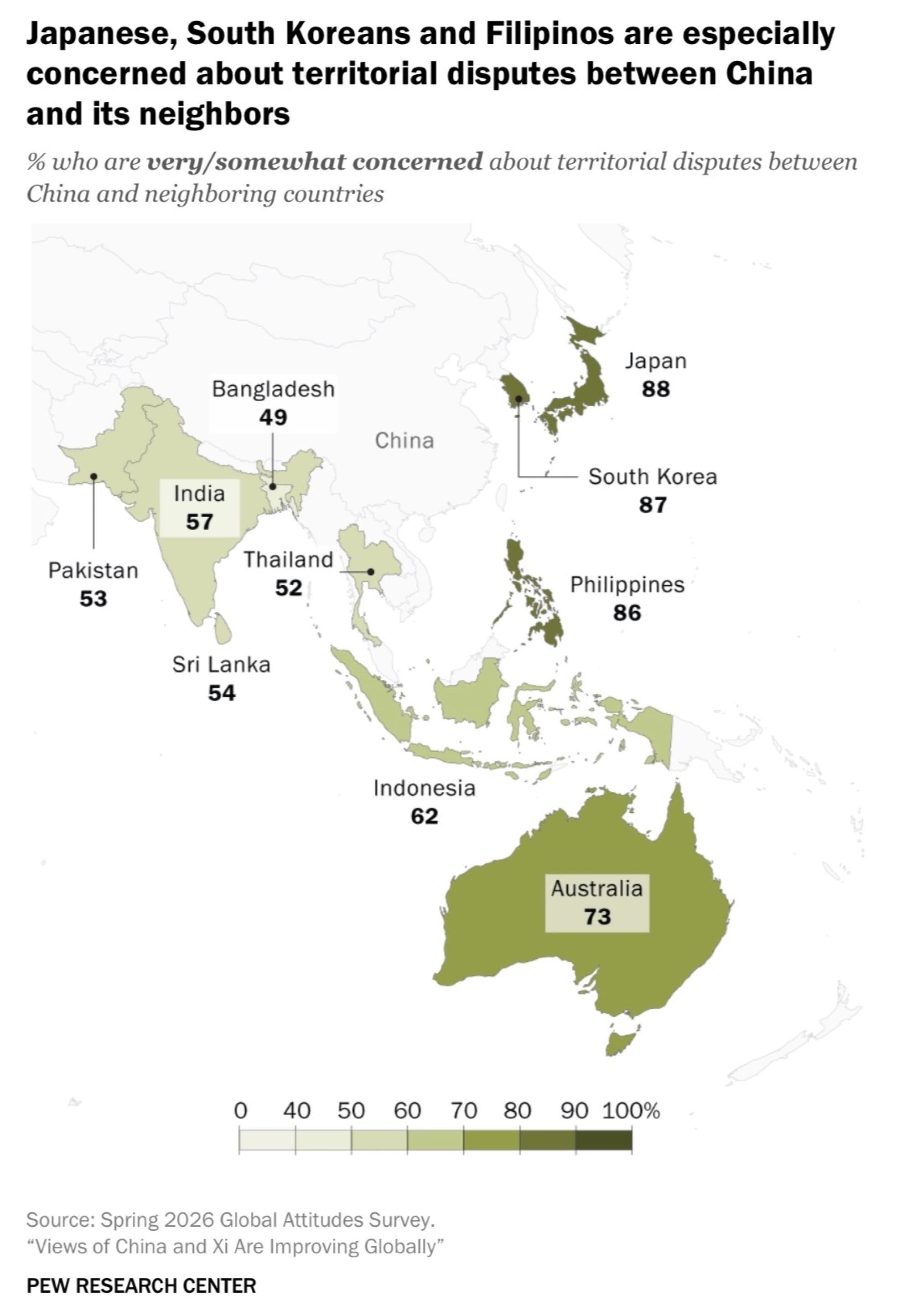
The report also found that concerns over China’s territorial disputes with its neighbours remain high in several countries.
“These levels of concern have been high for over a decade,” the report said.
“In Japan, the Philippines and South Korea, at least eight in 10 have been very or somewhat concerned about these disputes in surveys going back to 2014.” -- SOUTH CHINA MORNING POST


