As the United States marks the 250th anniversary of its founding, it confronts a new world order dominated by its relationship with China. In this wide-ranging series, we examine the pressure points and possibilities in those ties, from hard tech to soft power. In this article, Sylvia Ma examines the numerous financial links between the two economies that make a true decoupling a difficult affair.
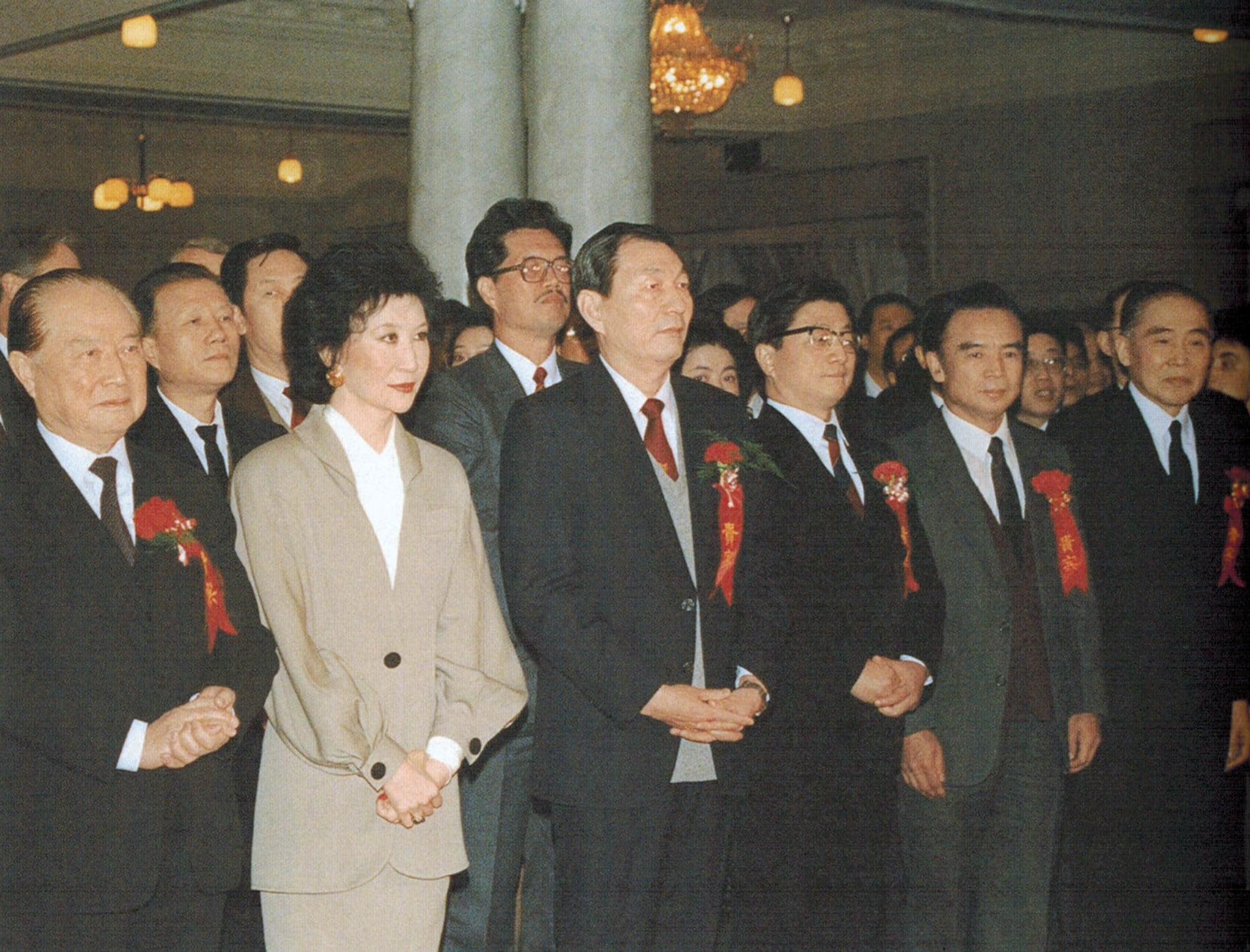
On a landmark visit to Beijing in 1986, the New York Stock Exchange chairman at the time, John Phelan, received a historic gift from Deng Xiaoping, the chief architect of China’s reform and opening-up: a share certificate for Shanghai Feilo Acoustics – one of the earliest public stocks issued in the reform era.
But the Wall Street veteran noticed an issue. The share certificate, with a face value of 50 yuan when it was presented in a ceremony at the Great Hall of the People, was not registered in his name, but that of a Chinese bank official.
Eager to own the Chinese share certificate under his own name, Phelan – then chairman of the world’s largest stock exchange – flew with his delegation to Shanghai, where he had the ownership formally transferred at a tiny trading counter, a full four years before the city would open its stock exchange.
Now, as the United States marks 250 years since the signing of its Declaration of Independence, America remains home to the world’s largest stock market, while China’s own capital market has grown dramatically in scale – becoming the world’s second largest by total market capitalisation.
But the two countries’ former embrace of economic ties has given way to an era of strategic rivalry. As Washington busied itself erecting limits to cross-border capital flows, Beijing has fortified its financial moats by building alternative payment systems and diversifying away from the US dollar.
However, experts said the underlying financial plumbing between the world’s two largest economies remained too deeply entangled.
“Our capital markets remain tethered together, and capital, by its very nature, will always flow towards wherever it sees the best returns,” said Charles Chang, a finance professor at Fudan University in Shanghai.
While acknowledging that great-power competition was here to stay, he added that “a complete detachment of the payment and capital systems is something that cannot be achieved in the near term.”
The apprentice years
If Phelan’s 1986 visit to a makeshift trading counter offered a glimpse of the financial frontier at play, the mid-1990s presented Wall Street with a far bigger prize: access to one of the world’s largest untapped markets.
At that time, China’s sprawling state-owned enterprises were grappling with inefficiency and chronic capital shortages, while the country’s fledgling financial markets lacked the depth needed to fund large-scale restructuring. For policymakers in Beijing, foreign expertise and capital offered a solution.
In 1995, a landmark deal was struck in Beijing: Morgan Stanley invested US$35 million for a 35 per cent stake in China International Capital Corporation (CICC), the country’s first joint-venture investment bank.
Minority-stake arrangements soon became the standard method for market entry, with Goldman Sachs and UBS forging similar local partnerships in 2004 and 2006, respectively, as they navigated a long-standing regulatory cap that prevented majority foreign ownership.
Chang said that while that period appeared to be a honeymoon phase in the two countries’ financial ties, it was in essence a “technology-for-market” exchange.
“Foreign banks earned the payouts they deserved, and China secured the technology transfer it needed, allowing the local industry to slowly catch up over the following decades,” he said.
In practice, Wall Street acted as a mentor, teaching Chinese counterparts how to conduct due diligence, market deals to international investors and price large initial public offerings. Together, they orchestrated historic offshore listings for state enterprises like China Telecom and generated substantial underwriting fees for the US banks.
But the relationship gradually evolved as Chinese firms absorbed Western expertise and leveraged their growing domestic networks.
As China’s financial industry increasingly moved beyond apprenticeship and began charting its own course, Morgan Stanley cashed out of CICC in 2010, turning its initial US$35 million investment – for a stake later diluted to 34.3 per cent – into proceeds of roughly US$1 billion.
Trillion-dollar loop
While Chinese firms were learning from Wall Street, a much larger and more profound entanglement was taking shape at the sovereign level.
Following its accession to the World Trade Organization in 2001, China’s export engine roared to life, generating massive trade surpluses as it became popularly known as “the world’s factory”.
To absorb the resulting flood of US dollars and maintain exchange-rate stability, Chinese authorities amassed foreign exchange reserves that peaked at around US$4 trillion, with a large portion invested in US dollar assets.
For years, that recycling made China into Washington’s largest foreign creditor, with its stockpile of federal debt peaking at more than US$1.3 trillion in 2013, according to data from the US Treasury Department.
But as geopolitical frictions intensified and Chinese officials and academics became more concerned about US dollar dependency, China began a prolonged drawdown of its US Treasury holdings.
The sell-off gained fresh momentum in recent years as concerns mounted about the sustainability of US debt. China dropped to third place in the rankings of America’s largest foreign creditors in March last year, and its US Treasury stockpile fell to an 18-year low this April, roughly half its peak.
But Matteo Giovannini, a senior finance manager at Industrial and Commercial Bank of China, said the headline figures did not tell the full story, as some holdings appeared to have been shifted to offshore custodial centres or state-owned financial institutions operating overseas.
“That said, US Treasuries remain extremely difficult to replace,” he added, pointing to China’s large trade surpluses and foreign exchange reserves, which require a deep, liquid and scalable market capable of absorbing vast amounts of capital.
“Despite growing purchases of gold and increased diversification into other assets, no alternative market currently matches the liquidity, safety, and depth of the US Treasury market,” said Giovannini, who is also a non-resident associate fellow at the Centre for China and Globalisation in Beijing.
Fudan’s Chang offered another perspective, viewing the sheer volume of Beijing’s holdings as a form of financial deterrence rather than mere dependency.
“If China truly pulled the trigger on a massive, one-off sell-off, it would cause severe mispricing across global Treasury markets,” he said.
From boom to barriers
While China’s retreat from US Treasuries is among the more visible financial effects of the deepening geopolitical stand-off between Beijing and Washington, the battle lines have been drawn even more sharply in the equity markets.
Just over a decade ago, Alibaba Group Holding’s record-breaking US$25 billion listing in New York established the high-water mark of an era in which Chinese technology firms tapped American liquidity, and US investors eagerly rode China’s growth to handsome returns. Alibaba owns the South China Morning Post.
That period reached its peak in 2020 and 2021, when Chinese companies listed in the US had a total market value exceeding US$2 trillion, before regulatory crackdowns in both Beijing and Washington brought the boom to a swift halt.
In China, the regulatory tightening began with the suspension of Ant Group’s blockbuster initial public offering. Soon, the campaign expanded, mandating stricter national security reviews for overseas listings and a multipronged policy initiative intended to rein in what authorities called the “irrational expansion of capital” in the technology sector.
Meanwhile, in the US, the Holding Foreign Companies Accountable Act laid the groundwork for the forced delisting of Chinese firms from American exchanges if they failed to grant regulators access to their audit records.
The stand-off reshaped listing strategies, with many Chinese companies pursuing primary or secondary listings in Hong Kong, even after Beijing and Washington reached an audit inspection agreement that averted mass removal.
As of the end of last month, the combined market value of US-listed Chinese firms totalled less than US$1 trillion, according to Chinese financial data provider Wind.
In January 2025, the US outbound investment regime took full effect, prohibiting or requiring notice for some investments in sensitive Chinese technologies.
Washington also moved to tighten controls on inbound capital, with US President Donald Trump directing the Committee on Foreign Investment in the US to intensify scrutiny of Chinese-affiliated investment in strategically important sectors.
Experts said that while the era of deep financial integration symbolised by Chinese tech listings in New York had largely come to an end, financial ties between the two countries remained difficult to unwind completely.
“Finance is not a bilateral issue; it is a globalised network,” said Jiang Wei, a finance professor at Emory University in Atlanta. “While some capital might not flow directly between China and the US, it might be able to route from the US to Singapore, and then to China – a complete decoupling is not realistic.”
Giovannini expressed a similar view: “What we are witnessing is not a complete financial decoupling, but rather a process of ‘selective de-risking’ driven by national security concerns on both sides.”
He said the process would be a long-term structural shift, with capital flows increasingly channelled through politically acceptable sectors and intermediary jurisdictions such as Hong Kong.
“The future is likely to be characterised by fragmentation rather than separation,” Giovannini said.
Parallel plumbing
For Beijing, the West’s growing use of financial sanctions – most notably the weaponisation of the US dollar-dominated payment network – has reinforced the urgency of reducing vulnerabilities to external pressure.
At the centre of that effort is a push to internationalise the yuan and expand an alternative cross-border payments infrastructure, including the Cross-Border Interbank Payment System and Project mBridge, a multi-country platform designed to facilitate direct settlement using central bank digital currencies.
Experts said that while the yuan had gained ground in trade settlement – particularly across the developing world – that reflected a gradual diversification of global payment channels rather than a severing of financial links with the US-led system.
“Providing the payment pipes does not automatically generate a demand to hold the yuan,” Chang said, noting that the hurdles were compounded by the absence of investment channels for offshore yuan due to China’s capital account controls.
“Decoupling from the US payment infrastructure is not something that can be achieved in the short term – not even in 10 or 20 years,” he added.
Emory’s Jiang described the effort as “a natural process of a rising economic power seeking to establish its own monetary soft power” – framing it as strategic competition rather than decoupling.
The US dollar maintained an undisputed primacy not just as a global reserve, but as the default currency for trade invoicing and capital pricing, she said.
“Building that soft power in the short term is exceptionally difficult because this shift is about ... the entire world changing its mind.”
The Chinese yuan’s share in global central bank reserves rose from 1 per cent in 2016 to 1.95 per cent by the end of last year, when the US dollar’s share stood at 56.42 per cent, according to data from the International Monetary Fund.
Giovannini said Beijing’s push was more about “gradually creating a more multipolar financial system in which China gains greater strategic autonomy at the margins”.
“These initiatives can reduce exposure to specific financial risks and sanctions, but they are unlikely to fundamentally sever the deep financial interdependence that still links the Chinese and American economies,” he said. -- SOUTH CHINA MORNING POST