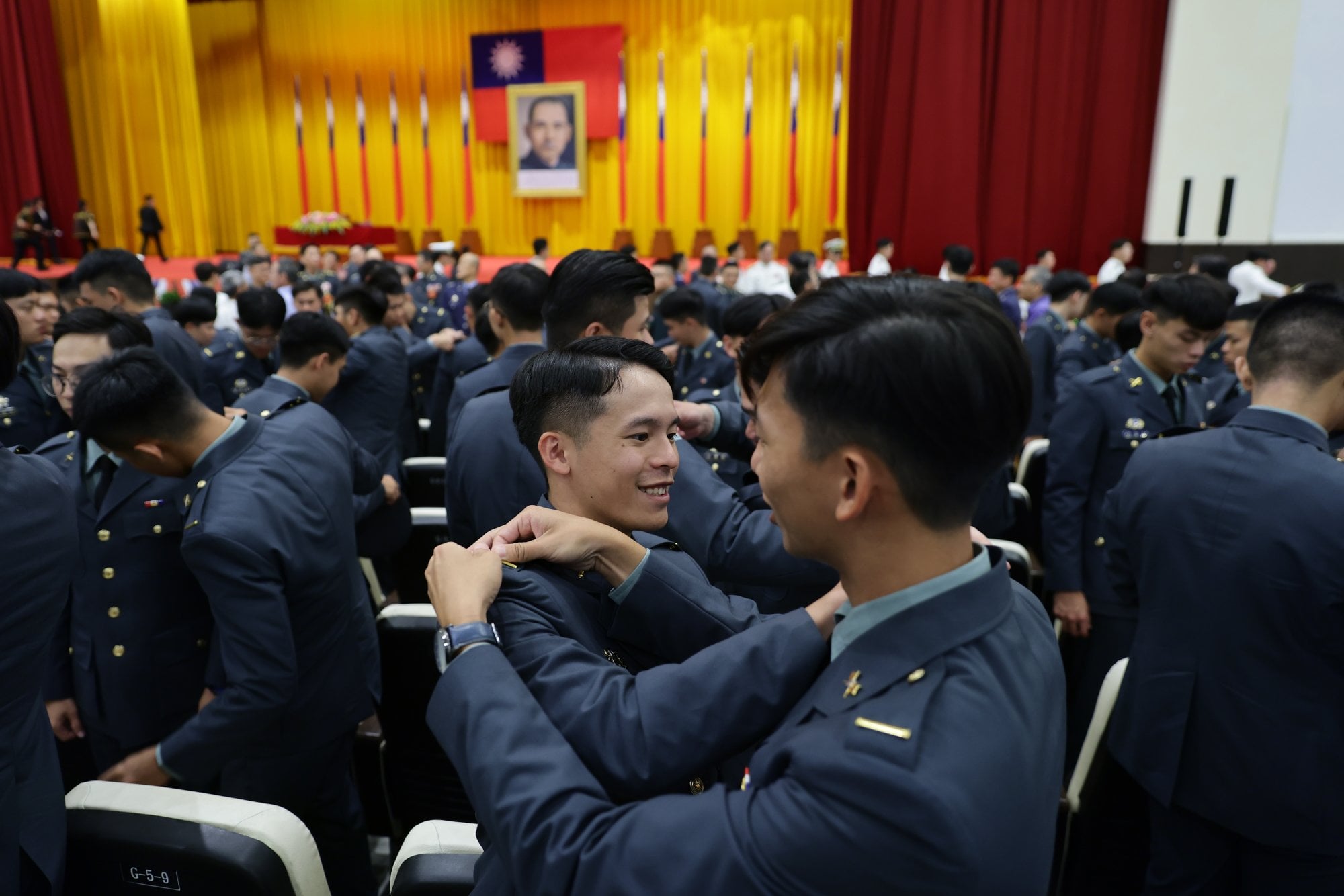
Taiwan has revived its “anti-communist patriotic education” programme for military academy graduates, reflecting growing concern over Beijing’s efforts to infiltrate the island’s armed forces after a string of espionage cases involving service members.
The compulsory five-day course, held from July 1 for graduates of Taiwan’s eight military academies, restores the programme’s original name after a 24-year hiatus.
Introduced in 1965, the programme was renamed “patriotic education” in 2002 but has reverted to its original title as the military seeks to strengthen awareness of security threats from Beijing.
The defence ministry said the change was prompted by Beijing’s intensifying military pressure, “united front” activities and grey-zone operations.
“Newly commissioned officers need a clearer understanding of national security threats and of ‘why they fight and for whom they fight’,” the ministry said on Sunday.
United front activities are efforts to influence and build solidarity with members of the diaspora and their organisations to align them with the Communist Party’s goals.
Beijing, which sees Taiwan as part of China to be reunited by force if necessary, has yet to comment.
Most countries, including the United States, do not recognise Taiwan as an independent state, but Washington is opposed to any attempt to take the self-ruled island by force and is committed to supplying it with weapons.
The revamped curriculum includes lectures by senior officials from agencies including the Mainland Affairs Council, and security and intelligence services on Beijing’s military coercion, cognitive warfare, espionage and recruitment tactics.
According to Taiwan’s top security bureau, 159 people were indicted in espionage cases between 2020 and 2025, with serving and former military personnel accounting for about 60 per cent of those prosecuted.
The agency said Beijing was recruiting its targets through retired service members, online contacts, financial inducements and debt coercion, while also using organised crime groups, underground lenders, front companies, religious temples and civic organisations to approach military personnel.
The concern follows several high-profile espionage cases. Last year, four former servicemen, including three members of the elite 211th Military Police Battalion responsible for guarding the office of Taiwan’s leader, were jailed for spying for Beijing.
In another case, in April, a sergeant stationed on the frontline Matsu Islands was sentenced to 12 years in prison after photographing classified operational plans for the Matsu Defence Command and passing them to mainland Chinese handlers in return for about NT$67,000 (US$2,100) to repay debts.
Beijing’s Taiwan Affairs Office has repeatedly denied the espionage accusations. Mainland China’s counter-espionage agency has also warned of infiltration and influence efforts from Taipei.
The education programme’s revival has nevertheless sparked debate over whether restoring the term “anti-communist” is a necessary response to mounting security threats or a return to ideological education.
Some online critics argued the move carried unnecessary political overtones and that military education should focus on modern warfare and defence technology rather than reviving Cold War-era terminology.
Others defended the change. One social media user wrote: “Given the current situation, opposing China and protecting Taiwan is patriotic enough.”
Legislator Chen Kuan-ting of the ruling Democratic Progressive Party said “anti-communist patriotic education” should not become a political slogan but instead equip officers with practical skills to detect and counter espionage.
“Meaningful defence education must reflect the real threats Taiwan faces today,” he added, citing military pressure, intelligence gathering, organisational infiltration and cognitive warfare by Beijing.
Chen said the military should place greater emphasis on counter-intelligence, teaching soldiers and officers not only who the adversary is but also how it recruits spies and exploits social media, personal relationships and financial vulnerabilities.
Military analyst Zivon Wang of the Chinese Council of Advanced Policy Studies, a Taipei-based think tank, said it was unrealistic to expect a five-day course to achieve all the military’s objectives.
“It is primarily a declaration that ensures newly commissioned officers understand the current security environment before joining their units, particularly the military threat and China’s increasingly serious infiltration efforts,” Wang said.
Like similar courses in previous decades, the programme was largely symbolic, with more substantive education taking place after officers reported to their units through the military’s continuing political education system, he added. -- SOUTH CHINA MORNING POST