




Nato Secretary General Mark Rutte defended US President Donald Trump’s criticism of the transatlantic security alliance, while saying this year’s summit showed “a huge sense of unity” and produced procurement plans worth tens of billions of dollars.
During a press conference after the North Atlantic Council meeting of leaders at the Nato summit hosted by Turkey in Ankara on Wednesday, Rutte said this year’s gathering had resulted in more than US$50 billion in procurement deals as part of efforts to meet the defence spending target of 5 per cent of GDP by 2035, agreed at last year’s summit in The Hague.
These investments will support Nato’s capability targets across all domains, including deep precision strike, integrated air and missile defence, uncrewed systems, cutting-edge technologies and intelligence capabilities, as well as developing “interoperable transatlantic warfighting clout” and adopting powerful AI models, Rutte said.
He said that there was a “great sense of unity” among the leaders, who “warmly welcomed” the leadership of Trump, whom he described as “transforming” the alliance and making it “stronger,” where the member states pledged €70 billion (US$80 billion) in military equipment, assistance and training and “unwavering support” for Ukraine.
“This summit has shown that the alliance is stronger than ever. An alliance that is united and ready to defend every edge of our territory,” said Rutte.
“Here in Ankara, allies reaffirmed their ironclad commitment to collective defence under Article 5 that an attack on one is an attack on all, and we will stand together. Our unity, solidarity and collective strength remain the foundation of peace, security and prosperity.”
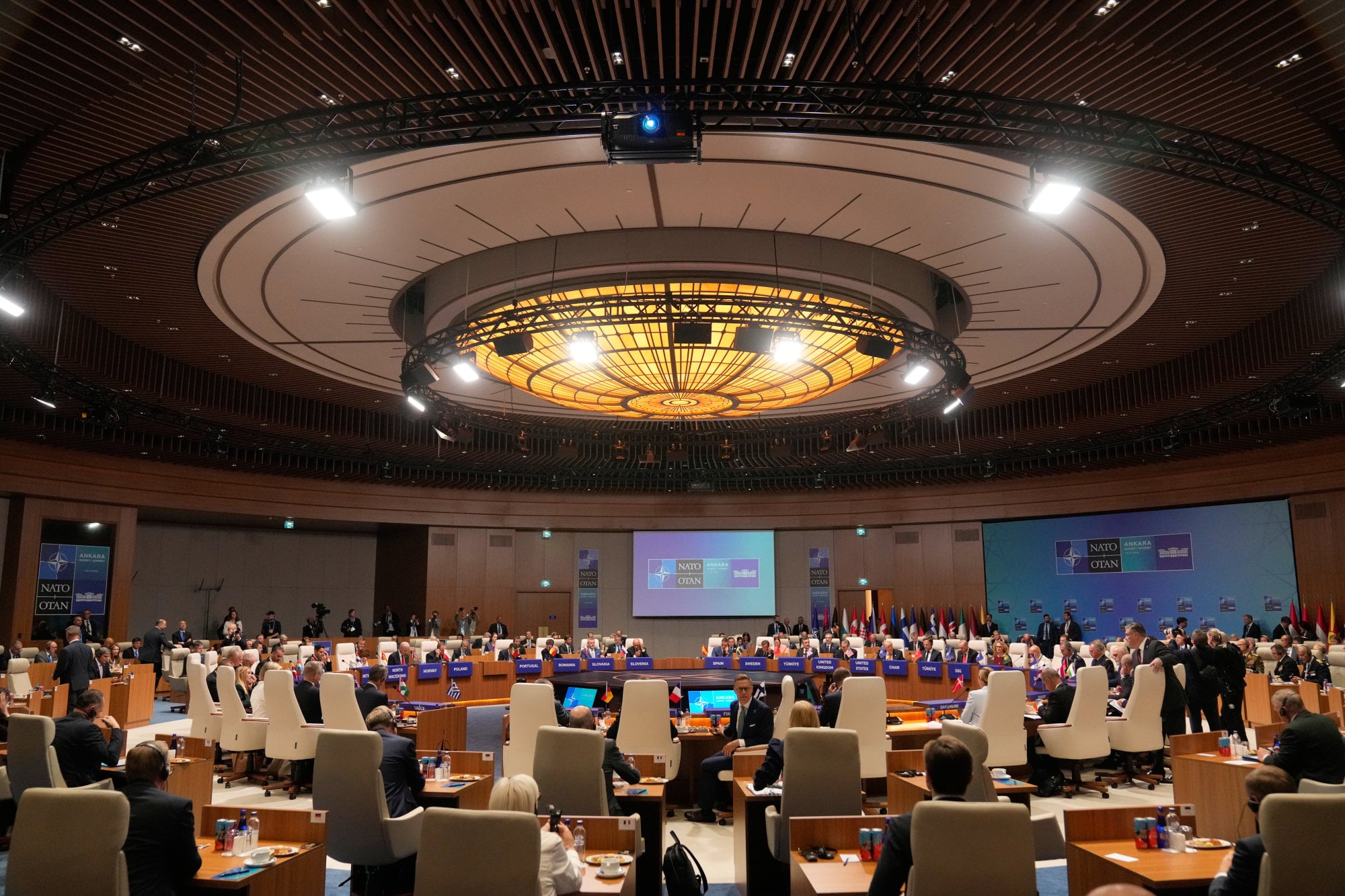
Rutte’s remarks follow Trump’s criticism of Nato as a “paper tiger”, pressuring the transatlantic alliance to take more responsibility for its own defence.
The US president’s frustration with Nato was further fuelled after allies refused to support Washington’s military campaign against Iran or assist efforts to reopen the Strait of Hormuz following Tehran’s blockade, while the US announced a review of its troop deployment in Europe.
Trump repeatedly said during his attendance at the Nato summit that he was “not happy” with the allies’ unwillingness to help his country, despite Washington’s “trillions” of dollars’ worth of investment.
According to the declaration issued after the leaders’ summit, the member states reiterated that Iran “must never have a nuclear weapon” and called on Iran to fully respect freedom of navigation in the Strait of Hormuz.
Responding to the question of whether there is a plan B in case of the Trump administration’s retreat of the troops from Europe, Rutte said that he saw a “huge sense of unity” in the room with the 32 leaders, and that he has “never worried” about the “forceful debates” between the member states.
He said Trump was “completely committed” to the alliance but had a “big irritant” that Europeans were not paying as much as the Americans. According to Rutte, Trump’s push for allies to increase military spending had been a “huge encouragement” that made the alliance “so strong” and “more together than ever”.
The secretary general is seen by analysts as wanting to keep the US leader engaged as much as possible.
Rutte did not directly answer a question about whether Nato member states should become more involved in the conflict with Iran, after Trump declared that the ceasefire agreement was over. Instead, Rutte said Iran was outside Nato’s remit and that the question of whether the US could use European bases for air strikes on Iran should be dealt with on a case-by-case basis through bilateral agreements between Washington and individual European countries.
The US air strikes on Iran “would have been very difficult to do without Europe being a platform of power projection for the United States”, Rutte said, adding that Washington’s investment in its European allies also served its own security interests by helping protect the US from threats such as Russia.
Regarding Washington’s claims over Greenland, Rutte said that Trump was “absolutely” right that there is a “huge risk” of Russia and China gaining more access to America through the Arctic region, and it is his role to work with military leaders to make sure the “Arctic stays safe” by implementing cooperation among Nato allied countries in the region.
Asked about the absence of most Indo-Pacific Four leaders from the Nato summit, Rutte said it was “not necessary” for all of them to be present. He added that he was “very happy” to meet South Korean President Lee Jae Myung during the summit, describing the relationship between the transatlantic alliance and the Indo-Pacific as “important” because the two theatres are “more and more interconnected”.
“You cannot separate the two ... The goal is to work as much together on defence industry, on innovation, on standards, also exchanging views on defence spending. How to do it in the best way,” said Rutte.
Rutte said that leaders agreed on the importance of “modernising” the alliance and building for the future, which he explained was “stronger Europe in a stronger Nato,” with European allies and Canada working with the US and taking greater responsibility for “defence of the alliance, transformative investment in defence, major deals for industry on both sides of the Atlantic”.
“We are rebalancing our security for the better, that is what Nato 3.0 is all about. An alliance that continues to adapt. An alliance that continues to deliver to keep one billion people safe,” said Rutte. -- SOUTH CHINA MORNING POST



