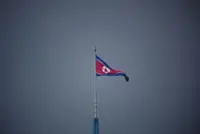
PYONGYANG: North Korea has prepared key sectors for heavy rainfall and floods, state media said Thursday (July 9), warning of "disastrous" conditions as both sides of the Korean Peninsula brace for intense monsoon weather.
Natural disasters tend to have an outsized impact on isolated North Korea due to its weak infrastructure and economy.
Authorities have issued repeated calls to minimise damage from increasingly frequent extreme weather, which has hit the impoverished country's agriculture and infrastructure in recent years.
Pyongyang's State Hydro-Meteorological Administration issued a heavy rain warning, forecasting 100-150 millimetres (3.9-5.9 inches) of rain between Thursday night and Friday morning across several southern provinces, state television said, according to South Korea's Yonhap News Agency.
North Korea's official Korean Central News Agency (KCNA) said authorities had intensified disaster prevention efforts in recent weeks.
The Kim Chaek Iron and Steel Complex, widely believed to be the largest steel mill in North Korea, completed river dredging, built retaining walls and reinforced embankments in flood-prone areas, KCNA said.
The Musan Mining Complex in the country's north has also carried out dredging and landslide prevention work, while rearranging mining facilities to prevent iron ore from being washed away.
Monsoon downpours have also battered South Korea, where heavy rain advisories were in effect Thursday for parts of the Seoul metropolitan area, mountainous areas of Gangwon province and parts of North Gyeongsang province.
Emergency crews were searching for a person swept away by a swollen stream, while more than 300 cases of property damage were reported.
In the central province of North Chungcheong, torrential rain damaged schools and other educational facilities, with classes suspended in some areas.
Last summer was South Korea's hottest on record, with both the North and the South recording their warmest June.
Scientists say human-driven climate change is increasing the intensity, length and frequency of extreme weather events such as heatwaves.
Adding to the mix is the return this year of El Nino, a natural climate phenomenon that warms Pacific surface temperatures and can bring heat, drought and heavy rain to parts of Asia.
North Korea has long endured power shortages, and experts say most residents have no access to air conditioning.
The country was hit by severe flooding in its northern regions near China in 2024, with South Korean media reporting the number of dead and missing in the North could be as high as 1,500 -- estimates Pyongyang dismissed at the time. - AFP