




Fresh footage has offered the first look at China’s truck-mounted electromagnetic catapult launching a drone, with its developer unveiling details of this large family of containerised weapon systems.
The footage shows three eight-wheeled flat-top trucks driving on to what appears to be an airfield runway. Once aligned and connected via mechanical hinges, they form a continuous platform, along which a fixed-wing propeller drone accelerates and takes off.
The Beijing Institute of Technology’s (BIT) school of mechanical engineering posted the video to social media on Tuesday – about six months after the system was first seen aboard the cargo vessel Zhong Da 79 at a Shanghai shipyard.
The post appears to have been deleted.
The late-December sighting attracted much attention, with photographs showing a range of military equipment, including vertical missile launchers, radar sensors and self-defence systems, all integrated into modified freight containers.
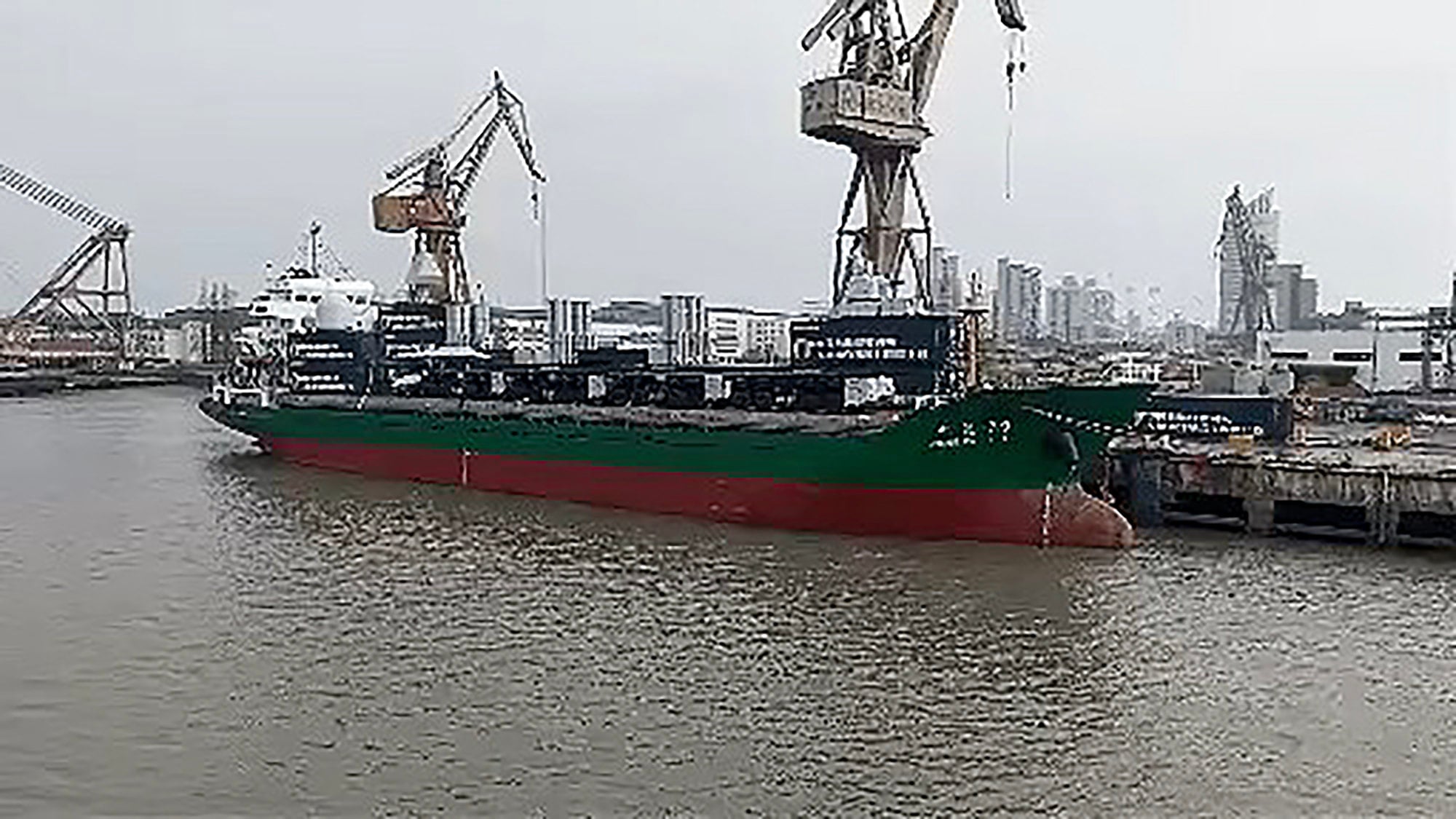
The new video also features a scene of the latest containerised modules revealed in Tuesday’s post – including the segmented electromagnetic aircraft launch system (EMALS) – being loaded onto the Zhong Da 79.
According to the post, each truck is designed to fit in a standard-sized container and is part of the “containerised weapon module suite” project, headed by BIT and involving more than 70 Chinese research entities.
There were at least 10 other modules, including ship-borne drones, air-defence, anti-ship and anti-submarine warfare, land attack, radar detection, close-in defence, electronic warfare, underwater combat, command and control, and logistics and support, it said.
“With an annual production target of 2,000 units, these systems enable large-scale, rapid ‘plug-and-play’ modular deployment across maritime and land-based platforms,” the post said.
“This will become a disruptive capability characterised by extremely low cost, massive production capacity and widespread deployment.”
While it is likely that some of the container modules spotted last year were mock-ups, the footage of truck-mounted EMALS in action showed that this part of the project is indeed moving forward.
“Whether this technology is fully matured remains to be seen. But the latest release is sending a message to the outside,” said military commentator Song Zhongping.
Fu Qianshao, a mainland military analyst, noted that the containerised EMALS enabled aircraft to take off from complex terrain and surface vessels, improving the deployment flexibility of unmanned aerial vehicles (UAVs).
“Assembling a mobile electromagnetic catapult with a few trucks allows for launch capabilities from virtually anywhere, eliminating the need for even a standard road,” Fu said.
Large drones could be deployed from environments like China’s high-altitude western border with India or the island chains of the Pacific Ocean.
Fu noted that the system could be operated directly on the front line – such as coastlines or even from aboard ships – dramatically cutting the drones’ flight distances by hundreds of kilometres.
Some Chinese military watchers say the containerised weapon suites could enable a rapid conversion of civilian ships for military use, especially in cases of a conflict in the Taiwan Strait.
Beijing sees Taiwan as part of China and has never ruled out the use of force for reunification. The United States, like most nations, does not recognise Taiwan as an independent state but is opposed to any forcible change to the status quo and is committed to providing arms for its defence.
The BIT post said that in addition to serving China’s national defence, the aim is to export the containerised weapons, particularly to Belt and Road Initiative partners and Global South nations.
The goal is to “break the historical monopoly on global maritime dominance” by the West and “promote the equal sharing of maritime rights” worldwide, it said.
Song said the standard-sized containerised weapon suite streamlined transport, storage, management and mission-specific configuration but for the international market, it would depend on how much potential clients accepted the concept.
Yue Gang, a retired People’s Liberation Army colonel and military commentator, said containerised modular weapon systems could “reshape the rules of modern warfare” by enabling a distributed, intelligent combat architecture spanning both maritime and land domains.
The system – linking universities, state-owned defence companies and private enterprises – formed part of the country’s military-civil fusion strategy, which sought to channel private-sector innovation into national defence, he said.
“It could maximise the military-civil fusion potential ... while benefiting both national defence and industrial development,” he said. -- SOUTH CHINA MORNING POST


