In a bid to cool searing trade tensions, the European Union and China have launched a new ministerial-level platform for solving grievances, with Brussels insisting that disputes over trade imbalances, export controls and intellectual property must deliver “tangible results” by October.
On Monday, in the middle of marathon talks in the Belgian capital, the sides issued a rare joint statement, in which they announced four initial workstreams, focused on trade and investment balancing, export controls, intellectual property rights and World Trade Organization reform.
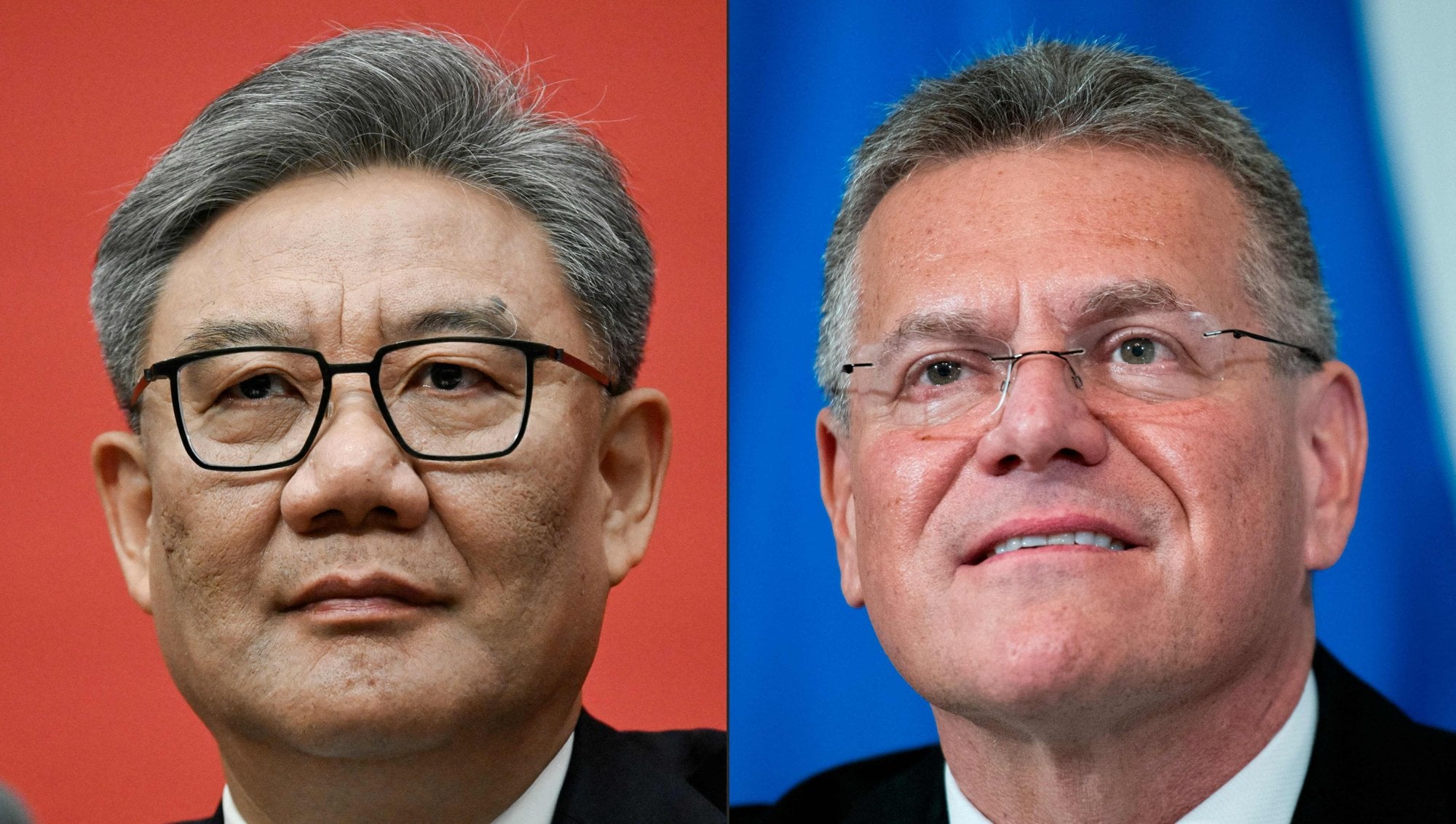
As part of this, and amid a rancorous debate about the impact of Chinese industrial overcapacity on Europe’s economy, Beijing agreed to establish a “joint monitoring mechanism of trade flows”, EU trade chief Maros Sefcovic said during a break from an all-day negotiating session with Chinese Commerce Minister Wang Wentao.
This will see them use the same agreed trade data to monitor surges in imports that would cross into a “red” zone, and quickly escalate to political talks, which would appear to be a departure from Beijing’s public dismissal of Europe’s complaints about trade imbalances and overcapacity.
Sefcovic said talks had been “intensive, focused and constructive”, but warned that the bloc would be forced to take action should meaningful progress not be achieved before the autumn.
“There is much more understanding for the common challenges for the European situation from our Chinese counterparts than we had before,” Sefcovic told reporters, adding that he would travel to Beijing again in the autumn to assess progress.
“We had a dedicated session on our trade relations with China on the level of European heads of state and government. The expectation is quite clear; they expect from us expedient action, I would say fast steps, and therefore we set this deadline [for] October.”
Sefcovic added that by that stage, the “direction of travel” on issues such as the EU’s gaping trade deficit with Beijing and its firms’ complaints over a lack of market access will be clear.
Asked what would happen if no progress is made, Sefcovic said he preferred to “focus on the positive”.
The long-awaited meeting – which will continue into Monday evening – came 10 days after the first substantive discussion in three years among the EU’s 27 national leaders on China policy.
EU leaders confront ‘China shock’ in marathon meeting
A majority of capitals agreed that Europe is in the grip of a “China shock” and that drastic action is needed to tackle the challenge posed to its industrial engine by Chinese firms, which often compete at much lower prices.
In May alone, the EU’s trade deficit with China rose by 15 per cent compared with a year earlier, with Germany’s own deficit expanding by 31.6 per cent. At this rate, the gap is on course to exceed the near-€1 billion-per-day deficit of 2025.
EU leaders instructed the European Commission to develop new instruments to address the problem, and to ramp up engagement with Beijing to avoid a trade war.
The October timeline could see Sefcovic meet Wang again before the leaders discuss China once again at that month’s European Council summit.
There, European Commission President Ursula von der Leyen is expected to present a suite of new tools for advancing China policy, which could be previewed in September during her annual State of the EU speech.
The clock is therefore ticking for the sides to find an off-ramp if they are to avoid descending into a tit-for-tat trade battle.
“My objective from the outset has been clear: to begin balancing the trade relationship between the EU and China. The gap is widening. China’s exports to the EU keep rising, while our market share in China keeps shrinking. This trend is not sustainable. The status quo is not an option,” Sefcovic said.
“The EU remains open for business. But we need to defend our industrial base and keep pushing for a level playing field globally, so our industries get a fair shot at competing. That is why today’s talks – and the ones to follow – matter. They help us avoid unnecessary tension,” he continued.
Those tensions have mounted for months amid a surge in Chinese imports, which many economists attribute in part to the country’s industrial overcapacity, itself partly attributable to sizeable and undeclared state subsidies.
Bloc accused of being ‘insincere’ in dealings with China
The bloc’s moves to respond to the “China shock” have been met with numerous threats from Beijing, which vows to retaliate against any EU action.
Over the weekend, several fresh threats emerged in state media organs. Yuyuantantian, a micro-site associated with state broadcaster CCTV, insisted that Beijing could withstand even a total “freeze” in trade with Europe.
A Global Times article, meanwhile, accused the bloc of being “insincere” in its dealings with China, given that it has moved ahead with its plans for a tougher trade and industrial policy even as it continues discussions with Beijing. -- SOUTH CHINA MORNING POST