As the United States marks the 250th anniversary of its founding, it confronts a new world order dominated by its relationship with China. In this wide-ranging series, we examine the pressure points and possibilities in those ties, from hard tech to soft power. Here, Khushboo Razdan separates the signals from the noise in the US debate over drones.
Whether responding to a wildfire or searching for a missing person, Battalion Chief William Marsiglio of Chesterfield, Virginia, relies on one tool above all others – a drone.
The drone helps Marsiglio’s crews locate victims, map flood zones and assess dangerous terrain from the skies.
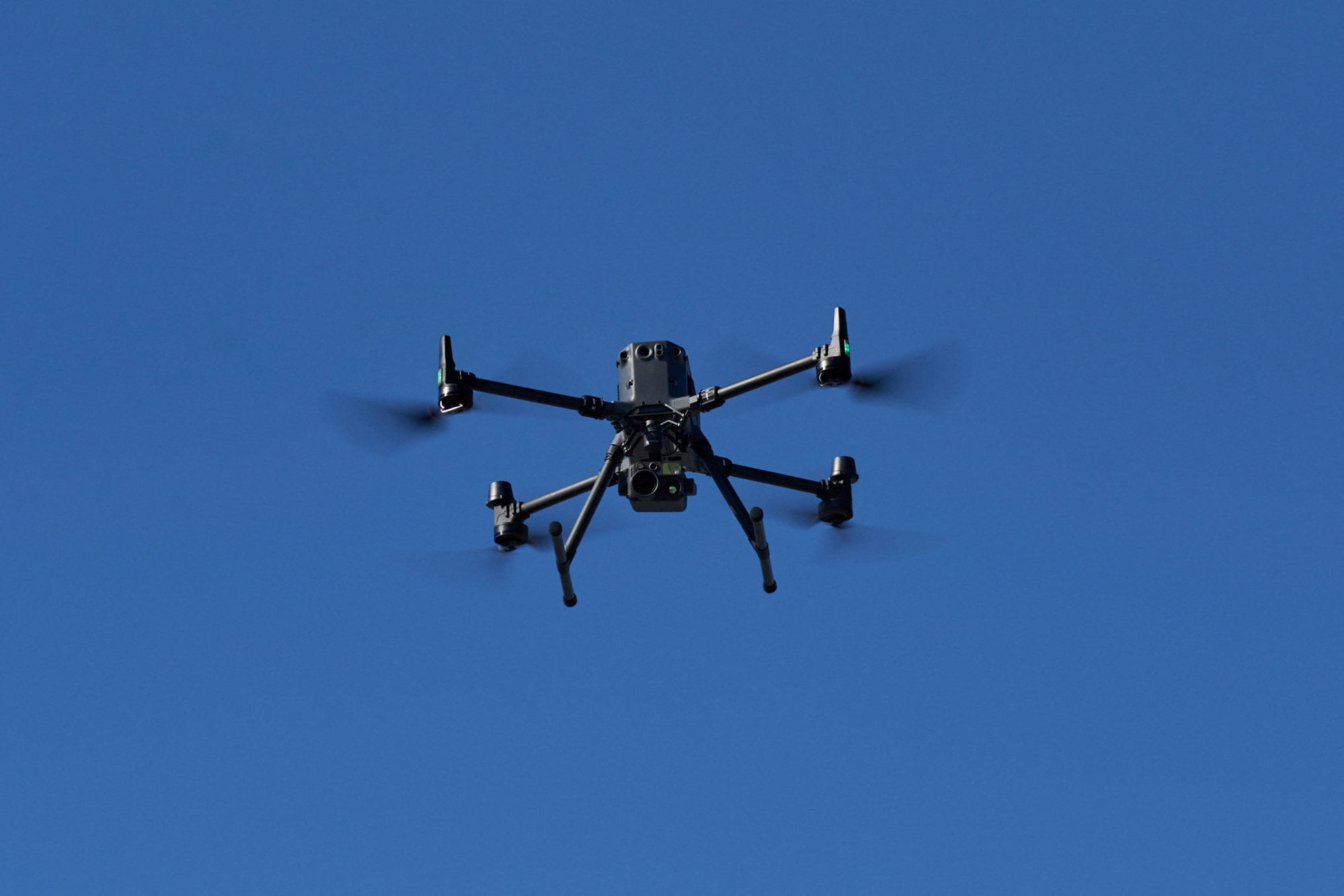
Made in China, the uncrewed aerial vehicle also happens to stand at the heart of the 21st century’s fiercest geopolitical competition and has become a major strategic headache for a United States approaching its 250th birthday.
For nearly a decade, Marsiglio’s department has used DJI systems, made by the Chinese company that dominates the global commercial drone market.
Now, as Washington tightens restrictions on Chinese technology, he is among more than 3,000 Americans urging federal regulators not to restrict equipment they consider essential to public safety and livelihoods.
“We have had countless uses, successes and life-safety wins because of the drone being on scene,” Marsiglio wrote in a filing to the US Federal Communications Commission (FCC) in May.
Forcing emergency services to shift to more expensive and less capable alternatives could directly undermine response capacity, he warned.
In December last year, the US defence budget specifically targeted DJI, citing bipartisan national security concerns about Chinese-made technology. This led the FCC to effectively bar the import of DJI’s newest models and its vital components to the US.
Toby Dziubala, a commercial pilot based in Las Vegas, Nevada, said the number of public comments submitted to the FCC on the issue was 10 times higher than in the agency’s comparable previous proceedings, highlighting how widely the technology was used now.
In his own comments, Dziubala asserted that “the US government did not conduct the security review it required of itself”.
Observers have argued that DJI’s case should not be viewed in isolation but as an indicator of a new reality of Sino-American relations following the May summit between Chinese leader Xi Jinping and US President Donald Trump, in which high-level diplomacy increasingly runs alongside a steady process of selective decoupling.
Beneath the emphasis on “constructive” stability, guard rails and managed competition, analysts highlight how export controls, regulatory restrictions and national security designations are steadily redesigning the practical architecture of interdependence far from the negotiating table.
For policymakers, the challenge is building a predictable framework that can actually separate legitimate military threats from blunt commercial warfare.
Against a backdrop of limited domestic alternatives and local backlash, observers say the debate has moved beyond market-access questions to a more fundamental challenge: how the US, long dominant in setting the technological frontier, navigates a landscape where that frontier is increasingly shared.
In this environment, efforts to incrementally unwind ties with a globally competitive China are proving messy and may carry the unintended cost of eroding American leverage even as Washington seeks to tighten technological boundaries.
It also tests the limits of the newly minted US-China Board of Trade – a government-to-government mechanism – raising questions over whether high-level summitry can establish rules sharp enough to manage friction in the grey zones of national security.
According to Denis Simon, a senior fellow at the Quincy Institute for Responsible Statecraft, a Washington think tank, the FCC controversy “reveals something larger than a dispute over DJI”.
“It demonstrates that US-China relations have entered a phase where diplomatic stabilisation and technological distancing are occurring simultaneously,” he said.
Simon, a former executive vice-chancellor of Duke Kunshan University, added that Washington now treated dependence on Chinese technology as a strategic vulnerability “even absent any concrete evidence of immediate misconduct”.
“What has changed over the past 20 years is not simply China’s rise,” he said. “It is the emergence of a genuinely multipolar innovation system.”
And whether one likes DJI or not, “it represents technological leadership in a sector that was not invented in China, but where China became the global leader”.
Simon said the new reality had forced Washington to confront something that many American policymakers historically did not have to: what happened when the technological frontier itself was no longer primarily in the US.
“The DJI dispute captures that transition vividly. The controversy is not simply about whether Chinese drones should be allowed in the United States. It is about how a country that spent much of the last century defining the technological frontier adapts to a world in which others increasingly help define it as well,” he said.
“There is a psychological dimension to this that is often underappreciated.”
This friction translates directly into a loss of American leverage.
According to David Zhang, a macroeconomics and policy analyst at Trivium China, public backlash over the FCC restrictions “speaks volumes about the economic costs of tech decoupling” and bolstered Beijing’s talking point that “conflict hurts both sides”.
“The DJI case feeds into Beijing’s framing that Washington’s broader restrictions on Chinese firms are as much about politics as security and economically self-defeating.”
Sourabh Gupta of the Institute for China-America Studies, another Washington think tank, said the public backlash effectively provided a “diplomatic upper hand to Beijing”.
Yet, he argued that safety officers and commercial operators would “just have to get used to” taking a loss, adding that without a federal technology ban as a starting point, there would be no substantive indigenisation or growth of the domestic drone supply chain.
At the same time, Gupta said a wider restriction on Chinese systems commercially would result in a black market of sorts – as is the case with advanced American chips headed to China.
For both sides, the stakes are high.
DJI sells more than half of all commercial drones in the US.
To protect its dominance, the Shenzhen-headquartered firm filed a lawsuit in February challenging the FCC’s decision in December last year to add its technology to a federal “covered list”.
And to counter Washington’s national security concerns, DJI in October last year commissioned an independent audit by OnDefend, a US-based cybersecurity firm. The investigation was not concluded until March, with the findings released in May.
The review found “no evidence of data transmission outside the United States”, nor any hidden back doors or unauthorised remote access.
Armed with these findings, DJI has aggressively lobbied US lawmakers, contending that facts rather than political anxiety should dictate policy.
A DJI spokeswoman said in June that it took the security of its products “very seriously” and that the new findings showed what DJI had consistently maintained.
“Our products are secure, our data practices are transparent” and Washington’s concerns are not supported by technical evidence, according to the spokeswoman.
Separately, the Chinese embassy in Washington said in a statement this month that it firmly opposed “the overstretching of the concept of national security and its unjustified suppression of Chinese companies”.
Also in June, China’s customs administration issued new drone-export declaration requirements, strengthening export compliance and disclosure obligations for drones and related items. But it did not introduce any blanket bans.
The advisory urged exporters to more precisely classify drone-related goods, disclose detailed technical specifications and clearly declare whether items fell under export-control rules, particularly to prevent diversion into restricted or military end-uses, including grey-zone applications.
This came just days after the Virginia-based Association for Uncrewed Vehicle Systems International and the Industrial Technology Research Institute in Taiwan announced they were working together on drone technology.
Hilton Root, a professor of public policy at George Mason University, noted that Beijing would “almost certainly” see the DJI restriction as inconsistent with diplomatic stability at the rhetorical level.
Practically, it could “probably” treat the case as “manageable friction so long as the restriction remains bounded and major trade channels remain open”.
Root cautioned, however, that stability required a predictable architecture distinguishing bona fide defence needs from blanket commercial exclusion.
“Without that, a drone rule becomes another data point in decoupling instead of a manageable exception inside a broader relationship,” he said.
To prevent that slide, Root pointed to the nascent Board of Trade, which the White House has presented as merely a channel for “managing trade in non-sensitive products”.
The DJI issue illustrated “why the board will need rules clear enough to separate managed trade in non-sensitive goods from genuine national security controls”, he added.
Because dual-use drones sit right on the line between civilian and military use, Root described them as a “boundary case” that was “appropriate for confidence-building measures and technical standards dialogue, but not for simple tariff bargaining”.
Back in Chesterfield, Marsiglio’s position is more pragmatic than ideological.
In his filing to regulators, he wrote that the market itself would determine the outcome if American manufacturers could match Chinese competitors on performance and cost.
“As US-made airframes and drones become more reliable, capable and within the price range, the market will naturally shift to those manufacturers,” the battalion chief said.
The challenge extends well beyond airframes. From batteries to rare earth magnets, many of the inputs that underpin modern drone manufacturing remain deeply tied to supply chains dominated by China. -- SOUTH CHINA MORNING POST