




The two-week US trip by Taiwan’s main opposition leader offered Washington a different take on cross-Strait relations, although whether it will change anything remains in question, some experts said.
Kuomintang (KMT) chairwoman Cheng Li-wun landed back in Taipei early on Tuesday, concluding a five-stop visit she called “beyond expectations”.
Cheng began her trip on June 1, visiting San Francisco, Boston, New York, Washington and Los Angeles.
She met with representatives from several think tanks and universities, and in each city met with Chinatown communities and attended dinners for Taiwanese Americans.
The 56-year-old party official also held closed-door meetings in Washington with several influential senators and representatives, including Senate Armed Services Committee member Dan Sullivan, a Republican from Alaska; House Foreign Affairs Committee member Brad Sherman, a Democrat from California; and East Asia and Pacific Subcommittee Chair Young Kim, a Republican also from California.
Cheng also met with Republican Senator Steve Daines from Montana, who is widely seen as an ally of US President Donald Trump.
It remains unclear whether Cheng met with Trump administration officials and, if so, what level they were from.
The White House did not immediately respond to a question on her meetings. Some Taiwanese media reported without attribution that officials from the National Security Council cancelled their meeting with Cheng.
The KMT said on Sunday that meetings with US government officials were ordinarily not public, and Cheng had “seen the people she wanted to see and said what she wanted to say”.
Analysts have differing views on what Cheng accomplished on this trip, but they say she at least succeeded in getting Washington to hear the KMT’s position.
Bonnie Glaser, managing director of the Indo-Pacific programme at the German Marshall Fund of the United States, said it was “useful to hear KMT Chair Cheng elaborate on her vision for cross-Strait relations”.
“Many people in Washington, DC, have a better understanding of her views as a result of her visit,” she said.
However, “some concerns about Cheng’s positions on defence spending and on her approach to Beijing will persist”, Glaser said.
“But it was important for her to have an exchange of views with officials, academics, and think tank experts.”
Beijing sees Taiwan as part of China to be reunited by force if necessary. Most countries, including the United States, do not recognise Taiwan as an independent state, but Washington is opposed to any attempt to take the self-governed island by force and is committed to arming Taiwan.
Washington has repeatedly urged Taipei to increase its defence budget, while Beijing has consistently pressed Washington to stop arms sales to Taiwan.
Before the Xi-Trump summit last month, Washington put on hold a plan to sell Taiwan weapons worth US$14 billion, a move some observers saw as a concession to Beijing.
After some US lawmakers and analysts questioned the KMT’s stance, Cheng said, speaking in the US, that the KMT does not oppose US arms purchases because a “credible military deterrent” and a “smooth and sincere framework for dialogue” were both important to prevent conflict, but that the KMT opposes the ruling Democratic Party’s (DPP) “black-box operations”.
Cheng added that the KMT has supported a special defence budget of NT$780 billion (US$26 billion), noting that although this amount is lower than the NT$1.25 trillion requested by the DPP, it is more than double the amount her party had previously proposed.
At a press conference on Monday shortly before leaving Los Angeles, Cheng said: “If the region’s future lacks strong US leadership, it will be difficult to have a sustainable and stable cross-Strait relationship.”
Glaser said she believes that “Cheng has considered carefully what she wants to achieve with Xi in the coming two years,” referring to Chinese President Xi Jinping, who met with Cheng in early April.
“But she is less clear about the ‘final solution’ that she envisions for cross-Strait relations beyond achieving a peaceful relationship,” Glaser added.
Cheng has repeatedly stated that the KMT adheres to the One China policy and the 1992 consensus.
The 1992 consensus, reached when the KMT was in power, is a verbal cross-Strait agreement in which both sides acknowledge there is only one China, but each has its own interpretation of what one China is.
Xin Qiang, a professor and deputy director of the Centre for American Studies at Fudan University, said the level of Cheng’s visit was “not low” as she met with nine US lawmakers as an opposition leader.
Xin also said Cheng walked a fine line on arms sales. She needed to try and “pass a test” in Washington, which largely favours more purchases, while also “catering to some opinion within her party and on the island”.
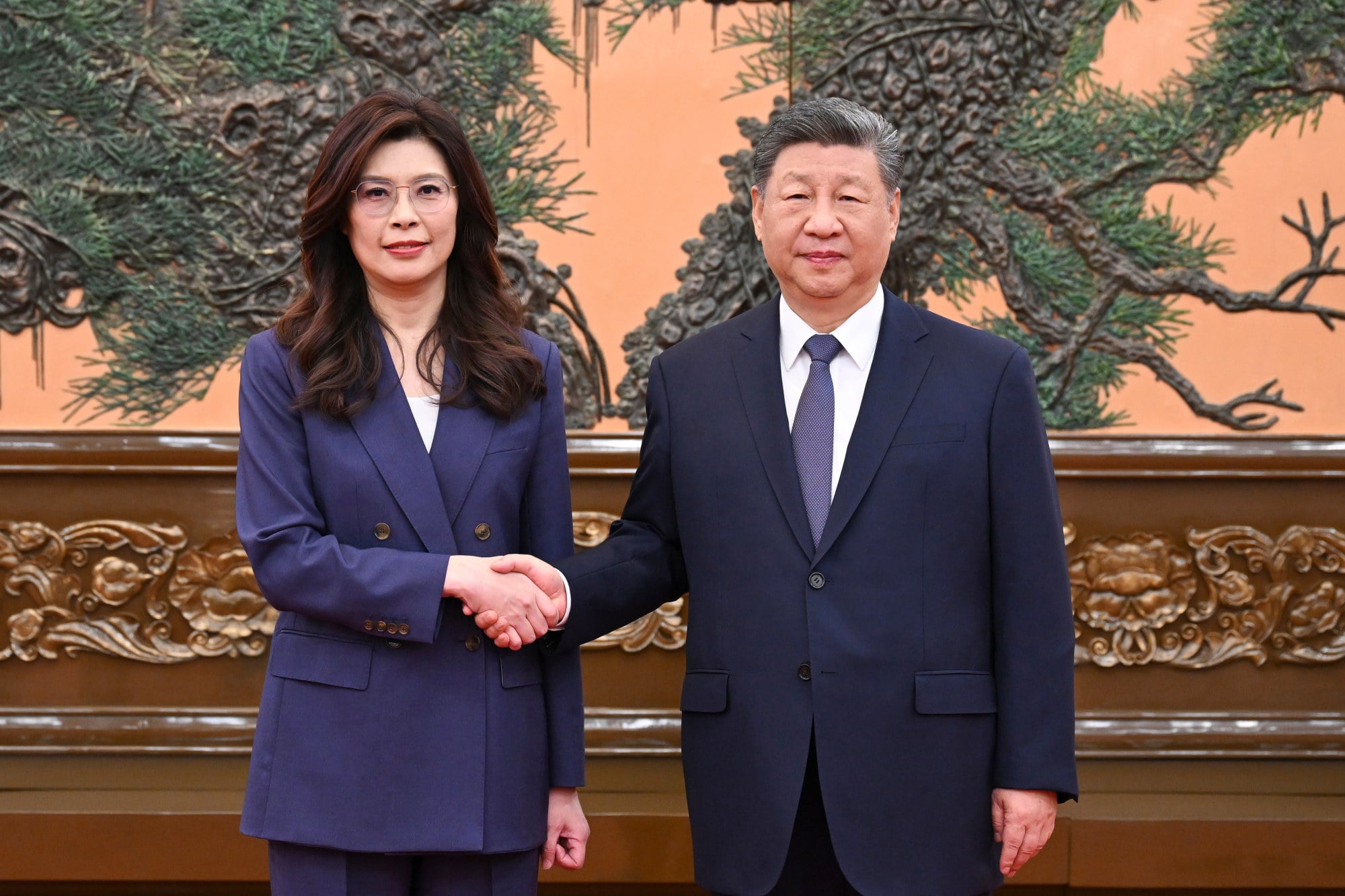
For Beijing, publicly expressing support for the “One China” policy and the 1992 consensus was more important, Xin added.
Xin also said that Cheng’s activities in the US “at least allowed the US to hear the KMT’s voice, so Washington won’t hear only the DPP’s side”.
But Shi Yinhong, a professor of international affairs at Renmin University in Beijing, said Cheng had not achieved “impressive fruit”.
“She gave half support and half opposition to the DPP’s position, seeming to be an ineffective strategy for election and inner party cohesion,” Shi said.
Cheng’s party is actively preparing for this year’s local Taiwanese elections and the 2028 leadership contest.
In the US, she did not say whether she would run as a KMT candidate, only indicating that she hoped to lead the KMT in regaining power, which she called the only path to maintaining cross-Strait peace.
Cheng was not the only important KMT figure to visit the US this year.
Taichung mayor Lu Shiow-yen, widely seen as a potential KMT contender in the island’s 2028 leadership race, also made a US visit in March.
In addition, the KMT’s Han Kuo-yu, president of the Legislative Yuan, who lost to the DPP’s Tsai Ing-wen in the 2020 election, will lead a delegation to the US from June 21 to 27, according to Taiwan’s Central News Agency.
Beijing strongly opposes official contact between Washington and Taipei. Members of the ruling DPP typically travel to the US in a low-key, informal, or working-level capacity. -- SOUTH CHINA MORNIN POST


